اِفیرا - اپیروس: آکروپولیس مایسیانی: نتایج کاوشها ۱۹۷۵-۱۹۸۶ و ۲۰۰۷-۲۰۰۸
Ephyra - Epirus: the Mycenaean acropolis : results of the excavations 1975-1986 and 2007-2008
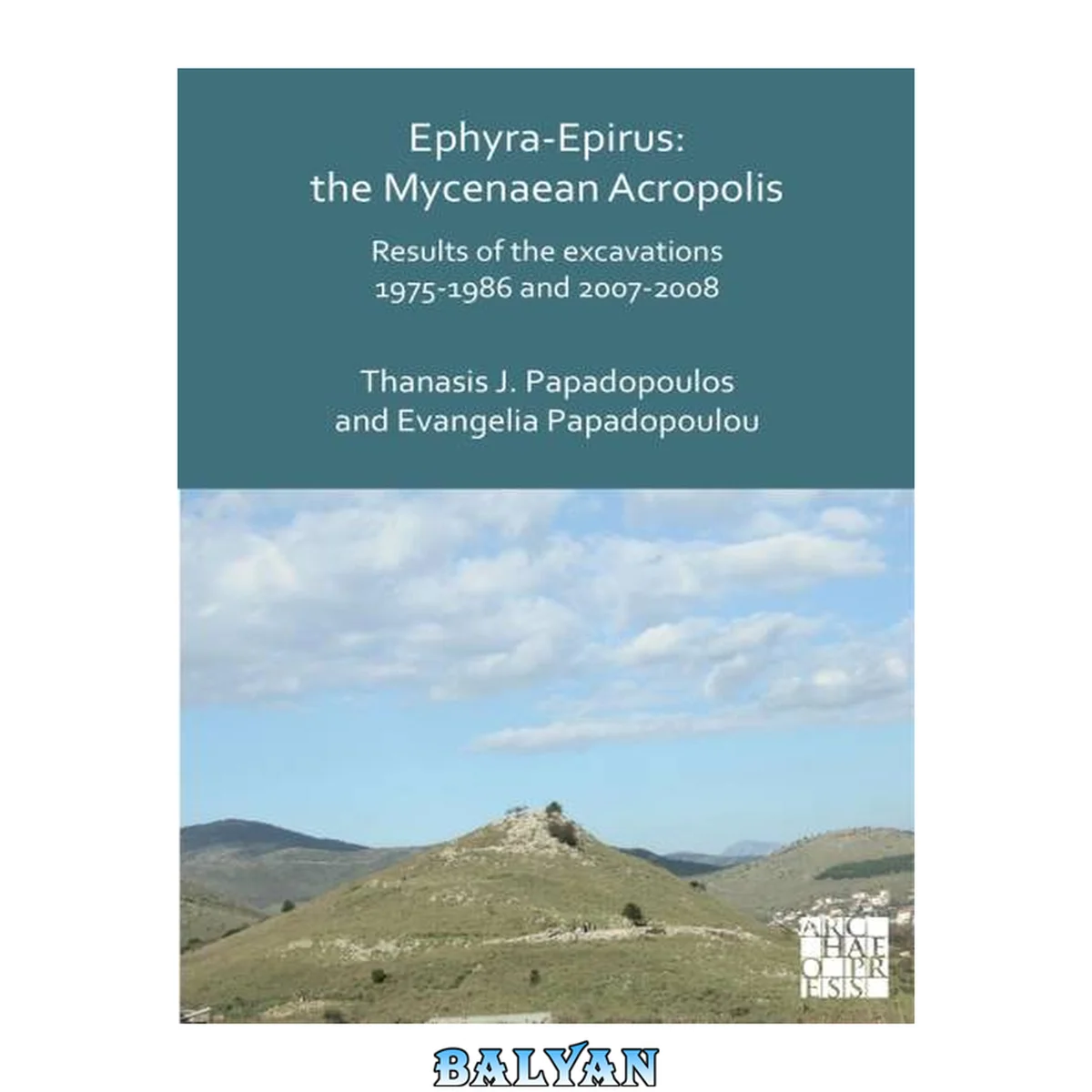
معرفی کتاب «اِفیرا - اپیروس: آکروپولیس مایسیانی: نتایج کاوشها ۱۹۷۵-۱۹۸۶ و ۲۰۰۷-۲۰۰۸» (با عنوان لاتین Ephyra - Epirus: the Mycenaean acropolis : results of the excavations 1975-1986 and 2007-2008) نوشتهٔ Thanasis I. Papadopoulos, Evangelia Papadopoulou-Chrysikopoulou, Evangelia Papadopoulou، منتشرشده توسط نشر Archaeopress; Archaeopress Archaeology در سال 2020. این کتاب در فرمت pdf، زبان انگلیسی ارائه شده است.
Ephyra-Epirus: The Mycenaean Acropolis presents the results of the 1975-1986 and 2007-2008 excavations on the prehistoric-Mycenaean acropolis of Ephyra, one of the most important Bronze Age sites of Epirus. Ephyra is a small coastal fortified site in the region of the lower Acheron valley and the only one that has been systematically excavated, producing impressive and, in some cases, unique Bronze Age remains (architectural, burial, pottery, artefacts). It stands on a high hill, in an exceptional position that overlooks and commands the lower Acheron valley and provides easy access both to the nearby Glykis Limin, the Ionian sea and the hinterland. Moreover, it is surrounded by three successive perivoloi, two of which (middle and lower) belong to LH III times, with a monumental south entrance gate. Ephyra fits the criteria of a major fortified settlement, as it covers an important and strategic prehistoric citadel, cemetery, residence and port of call for those travelling to the West. Strictly based on the archaeological data presented, this study suggests that the acropolis had a permanent Mycenaean population during the entire LH III period and continued to thrive after the collapse of Mycenaean centres until (and including) the Archaic period. Finally, it is tempting to suggest a correlation of the archaeological record with the Homeric tradition (Homeric Efýra , Od.a..259,b.238). Table of Contents Preface and acknowledgements Introduction I. EPIRUS Topography, Geomorphology, Climate and the history of previous research. II. EPHYRA 1: Environment, myth, literary evidence and history of the excavation 2: Description of the acropolis and architectural remains 3: Tombs and burial customs in Epirus 4: The Prehistoric cemetery of tumuli at Ephyra 5: Pottery: The prehistoric pottery of Epirus. Fabric and technique, Typology The prehistoric pottery of Ephyra. Fabric and technique. Typology 6: Indicative catalogue of prehistoric pottery and artefacts of Ephyra: Pottery Artefacts 7: Classical and Hellenistic pottery 8: Conclusions 9: Selected Bibliography Ephyra-Epirus: The Mycenaean Acropolis presents the results of the 1975-1986 and 2007-2008 excavations on the prehistoric-Mycenaean acropolis of Ephyra, one of the most important Bronze Age sites of Epirus. Ephyra is a small coastal fortified site in the region of the lower Acheron valley and the only one that has been systematically excavated, producing impressive and, in some cases, unique Bronze Age remains (architectural, burial, pottery, artefacts). It stands on a high hill, in an exceptional position that overlooks and commands the lower Acheron valley and provides easy access both to the nearby Glykis Limin, the Ionian sea and the hinterland. Moreover, it is surrounded by three successive perivoloi, two of which (middle and lower) belong to LH III times, with a monumental south entrance gate. Ephyra fits the criteria of a major fortified settlement, as it covers an important and strategic prehistoric citadel, cemetery, residence and port of call for those travelling to the West. Strictly based on the archaeological data presented, this study suggests that the acropolis had a permanent Mycenaean population during the entire LH III period and continued to thrive after the collapse of Mycenaean centres until (and including) the Archaic period. Finally, it is tempting to suggest a correlation of the archaeological record with the Homeric tradition (Homeric Εφύρα, Od.a..259,b.238). Cover 1 Title Page 3 Copyright page 4 Dedication 5 Contents Page 7 List of Figures 8 Abbreviations 12 Preface and acknowledgments 13 Contents 7 List of Figures 8 Abbreviations 12 Preface and acknowledgments 13 1. 15 Epirus 15 Topography, geomorphology, climate, and history of previous research 15 Figure 1. Map of Greece (Hope Simpson-Hagel 2006: Figure1a). 15 Figure 2. Epirus, geophysical map (Ηπειρος, 4000 χρόνια ελληνικής ιστορίας και πολιτισμού, Εκδοτική Αθηνών, 1997: εικ.1). 16 Figure 3. Map of Bronze Age sites in Epirus (Tartaron 2004, fig. 3:3). 17 1. Environment, myth, literary evidence and history of the excavation 19 2. 19 Ephyra 19 Figure 4.1. Map of the plain of Acheron and Acherousia (Dakaris Οδηγός Νεκρομαντείου, ΤΑΠΑ 1993). 19 Figure 4.2. Map of the south-western region of Epirus (Dakaris 1963: Abb. 9). 20 Figure 4.3. The hill of Xylokastron-Ephyra (view from the south). 20 Figure 5. Two pithoid jars containing infant burials (Dakaris 1958: pl. 86). 21 Figure 6. Ephyra, south gate (view from north). 21 Figure 7. Ephyra acropolis, extant segments of the three fortification walls. 22 Figure 8. Acherousia today (view from the acropolis of Ephyra). 22 2. Description of the acropolis and architectural remains 22 Figure 9. Map of the Acheron valley (Dakaris 1998). 23 Figure 10. Ephyra hill (view from the south). 24 Figure 11. Ephyra, Nekromanteion hills, Mesopotamos village and Acherousia (view from the east) (Ephorate of Antiquities of Preveza 2015, The archaeological sites of Nekromanteion and Ephyra: 20). 24 Figure 12.1. Ephyra, the northeastern unwalled side of the acropolis. 25 Figure 12.2. The present mouth of the Acheron (Ephorate of Antiquities of Preveza 2015, The archaeological sites of Nekromanteion and Ephyra: 10). 25 Figure 13. Ephyra, topographical plan (Dakaris 1973: Figure 39). 26 Figure 14. Ephyra. Lower-external wall and perimeter of the acropolis. 26 Figure 15a. Ephyra the upper fortification wall (Ephorate of Antiquities of Preveza, The archaeological sites of Nekromanteion and Ephyra: 49, 2015). 27 Figure 16. Ephyra, Cyclopean wall. 27 Figure 15. Glykis Limin in the Lower Acheron Valley (Tartaron 2004: Figure 7.6). 27 Figure 17.1. Ephyra, Cyclopean wall, southern part of middle wall. 28 Figure 17.2. Ephyra, Cyclopean wall, northern part of middle wall. 28 Figure 17.3. Ephyra, Cyclopean wall, northern part of middle wall, continued. 28 Figure 17.4. Ephyra, plan of northern part of middle wall. 28 Figure 17.5. Ephyra, plan of northern part of middle wall, continued. 28 Figure 18. Ephyra, three roughly square blocks at the start of the northern part of the middle wall. 29 Figure 19.2. Ephyra, southern part of middle wall. 29 Figure 20. Ephyra, plan of the southern part of middle wall, detail of the middle wall showing its foundation on the natural rock. 29 Figure 19.1. Ephyra, southern part of middle wall shaped as a semicircle to retain the cemetery of tumuli. 29 Figure 19.3. Ephyra, plan of the southern part of middle wall. 29 Figure 21. The lower wall in all its extant part, view from the south. 29 Figure 22.1: The south gate before excavation, view from the south. 30 Figure 22.2: The south gate after its cleaning, view from the north. 30 Figure 22.3: The destroyed NW side of the south gate, view from the south. 30 Figure 23.1: South gate, section. 30 Figure 23.2: South gate, plan. 30 Figure 23.3: South gate, plan of south face. 30 Figure 23.4: South gate, plan of west side. 30 Figure 23.5: South gate, plan of east side. 30 Figure 24: South gate after its final cleaning (2008) and the two stones indicating the existence of jambs (?). 31 Figure 26.1: Lower wall (first part, west of south gate). 31 Figure 26.3: Lower wall (third part, west of south gate). 31 Figure 26.5: Lower wall (fifth part, west of south gate). 31 Figure 25: South gate and the interior corridor leading to the upper acropolis. 31 Figure 26.2: Lower wall (second part, west of south gate). 31 Figure 26.4: Lower wall (fourth part, west of south gate). 31 Figure 26.6: Lower wall (sixth part, west of south gate). 31 Figure 27.1: Lower wall (plan of first part, west of south gate). 32 Figure 27.3: Lower wall (plan of third part, west of south gate). 32 Figure 27.4: Lower wall (plan of fourth part, west of south gate). 32 Figure 27.2: Lower wall (plan of second part, west of south gate). 32 Figure 27.5: Lower wall (plan of fifth part, west of south gate). 32 Figure 27.6: Lower wall (plan of sixth part, west of south gate). 32 3. Tombs and burial customs in Epirus 32 Figure 28: Map of the prehistoric cemeteries of Epirus. 33 Figure 29: Mazaraki, cist tomb (Vokotopoulou 1969: Pl.27a). 34 Figure 30: Ephyra, tumulus Γ, cist tomb A. 34 Figure 31a-b: Parga, tholos tomb and Mycenaean pottery. 34 4. The prehistoric tumuli cemetery at Ephyra (Figure 33.1.2.3) 35 Figure 32: Pogoni, tumuli A, B, Γ and tumulus from Glava (Andreou 1994: 262-63, plans 2-5). 35 Figure 33.1: Ephyra hill, view from the south (Ephorate of Antiquities of Preveza 2015, The archaeological sites of Nekromanteion and Ephyra: 58, right). 36 Figure 33.2: Ephyra, general view of the tumuli (Ephorate of Antiquities of Preveza 2015 The archaeological sites of Nekromanteion and Ephyra: 51). 36 Figure 33.3: Ephyra, general topographical plan of the excavated parts (by architect A. Lagopoulos). 36 Figure 34: Sketch plan of the three tumuli (by architect D. Skyrgiannis). 37 Figure 35.1.2: Tumulus A, view from the east, old and recent view. 38 Figure 35.3.4: Tumulus A (plan by G. Tsonis); burial A in situ. 38 Figure 36.1.2: Tumulus A, burial (after cleaning); burial B in situ. 38 Figure 36.3: Tumulus A, plan of primary and secondary burials and finds. 39 Figure 36.4: Tumulus A, plan of burial A and its offerings. 39 Figure 38.1: Tumulus Β, view from the north. 39 Figure 37.1: Tumulus A, primary burial C, in a contracted position. 39 Figure 37.2: Tumulus A, plan of burial C, in a contracted position. 39 Figure 38.2: Tumulus B, burial in situ. 39 Figure 39.1: Tumulus Γ, view from the north at the start of digging. 40 Figure 39.2: Tumulus Γ, view after final investigation. 40 Figure 40.1: Tumulus Γ, small cist tomb A. 41 Figure 41: Tumulus Γ, cist tomb B and the adjacent small perivolos (west view). 41 Figure 42.2: Tumulus Γ, cist tomb Β, primary burial Λ. 41 Figure 40.2: Tumulus Γ, interior of tomb A. 41 Figure 42.1: Tumulus Γ, cist tomb B and primary burial A (south view). 41 Figure42.3: Tumulus Γ, cist tomb B, primary burial Λ, burials H.I.K 41 Figure 42.4: Tumulus Γ, cist tomb B, primary burial B (outside and along the northern side of the cist). 42 Figure 42.5: Tumulus Γ, cist tomb B, upper part of burial B. 42 Figure 43.1: Tumulus Γ, burial of a woman and her child (Z). 42 Figure 43.2: Tumulus Γ, burial of a woman and her child (Z ). 42 Figure 43.3: Tumulus Γ, cist tomb B, plan of the burials. 42 Figure 43.4: Tumulus Γ, cist tomb B, interior, upper layer of burials. 43 Figure 44: Tumulus Γ, plan of burial Z (woman and her child). 43 Figure 43.5: Tumulus Γ, cist tomb B, interior, lower layer of burials. 43 Figure 45: Ephyra, cist grave NE of tumulus A. 44 Figure 47.1: Ephyra, cist grave E, N of tumulus Γ, with burial in situ. 44 Figure 47.2: Ephyra, cist grave E, N of tumulus Γ, after removal of the burial. 44 Figure 46: Ephyra, cist grave Δ, N of tumulus Γ. 44 Figure 48.1: NW building, view from the NE (excavation 1980). 45 Figure 48.2a: Plan of NW building and tumulus A (A. Lagopoulos). 45 Figure 48.2b: Plan of NW building. 46 Figure 49.4: Provisional reconstruction of horns of consecration. 47 Figure 49.1: Strong wall on south side of NW building. 47 Figure 49.2: Archaic shallow lekanae in situ (south view). 47 Figure 49.3: Poros-stone fragment of horns of consecration, in situ. 47 Figure 49.5: Whitish stone fragment of horn of consecration. 47 Figure 49.6: Stone metallurgical mould. 48 Figure 50.1: Ephyra, space between Tumulus A and NW building. 48 Figure 49.7: Stone double-axe. 48 5. Pottery 49 a) The prehistoric pottery of Epirus.Fabric, technique, typology 49 Figure 50.2: Middle retaining wall. 49 b) The prehistoric pottery of Ephyra Fabric and technique. Typology 51 I. Closed Shapes 52 II. Open Shapes 52 III. Pithoi 52 IV. Uncertain 52 Decoration 53 a) K.II/III 53 c) Category IVa-(b) 53 Figure 51.1.2: Cat. no. P1 . 54 d) Wheel-made Mycenaean pottery and/or imitation of it 54 6. An indicative Catalogue of prehistoric pottery and artefacts 54 a) Pottery 54 Figure 52: Cat. nos. P2-5. 55 Figure 53: Cat. nos. P6-9. 55 Figure 54: Cat. nos. P10-13 56 Figure 55: Cat. nos. P4-15. 57 Figure 56: Cat. nos. P16-18. 58 Figure 57: Cat. nos. P19-20. 58 Figure 58: Cat. nos. P22-23. 59 Figure 59: Cat. nos. P24-25. 59 Figure 60: Cat. nos. P26-29. 60 Figure 61: Cat. nos. P30-33. 61 Figure 62: Cat. nos. P34-37. 61 Figure 63: Cat. nos. P38-41. 62 Figure 64: Cat. nos. P42-45. 63 Figure 65: Cat. nos. P46-47. 63 Figure 66: Cat. nos. P48-51. 64 Figure 67: Cat. nos. P52-55. 64 Figure 68: Cat. nos. P56-59. 65 Figure 69: Cat. nos. P60-63. 66 Figure 70: Cat. nos. P64-66. 66 Figure 71: Cat. nos. P67-69. 67 Figure 72: Cat. nos. P70-73. 68 Figure 73: Cat. nos. P74-77. 68 Figure 74: Cat. nos. P78-81. 69 Figure 75: Cat. nos. P82-86. 70 Figure 76: Cat. nos. P87-90. 71 Figure 77: Cat. nos. P91-94. 71 Figure 78: Cat. nos. P95-98. 72 Figure 79: Cat. nos. P99-101. 73 Figure 80: Cat. nos. P102-105. 73 Figure 81: Cat. nos. P106-109. 74 Figure 82: Cat. nos. P110-112. 74 Figure 83: Cat. nos. P113-114. 75 Figure 84: Cat. nos. P115-116. 76 Figure 85: Cat. nos. P117-119. 76 Figure 86: Cat. nos. P120-124. 77 Figure 87: Cat. nos. P125-127. 78 Figure 88: Cat. nos. P128-131. 79 Figure 89: Cat. nos. P132-136. 79 Figure 90: Cat. nos. P137-139. 80 Figure 92: Cat. nos. P142-145. 81 Figure 91: Cat. nos. P140-141. 81 Figure 93: Cat. nos. P146-149. 82 Figure 94: Cat. nos. P150-153. 82 Figure 95: Cat. nos. P154-156. 83 Figure 96: Cat. nos. P157-159. 84 Figure 97: Cat. nos. P160-163. 84 Figure 98: Cat. nos. P164-167. 85 Figure 99: Cat. nos. P168-171. 86 Figure 100; Cat. nos. P172-175. 86 Figure 101: Cat. nos. P176-179. 87 Figure 102: Cat. nos. P180-183. 88 Figure 103: Cat. nos. P184-187. 88 Figure 104: Cat. nos. P188-191. 89 Figure 105: Cat. nos. P192-195. 90 Figure 106: Cat. nos. P196-199. 90 Figure 107: Cat. nos. P200-203. 91 Figure 108: Cat. nos. P204-207. 92 Figure 109: Cat. nos. P208-211. 92 Figure 110: Cat. nos. P212-215. 93 Figure 111: Cat. nos. P216-222. 94 Figure 112: Cat. nos. P223-227. 95 Figure 113: Cat. nos. P228-231. 96 Figure 114: Cat. nos. P232-235. 96 Figure 115: Cat. nos. P236-239. 97 Figure 116: Cat. nos. P240-242. 98 Figure 117: Cat. nos. P243-246. 98 Figure 118: Cat. nos. P247-249. 99 Figure 119: Cat. nos. P250-254. 99 Figure 120: Cat. nos. P255-257. 100 Figure 121: Cat. nos. P259-262. 101 Figure 122: Cat. nos. P263-266. 101 Figure 123: Cat. nos. P267-270. 102 Figure 124: Cat. nos. P271-274. 102 Figure 126: Cat. nos. P277-280. 103 Figure 125: Cat. nos. P275-276. 103 Figure 127: Cat. nos. P281-284. 104 Figure 128: Cat. nos. P285-288. 105 Figure 129: Cat. nos. P289-291. 105 Figure 130: Cat. no. P292. 106 Figure 131: Cat. nos. P293-296. 106 Figure 132: Cat. nos. P297-309. 107 Figure 133: Cat. nos. P310-312. 107 Figure 134: Cat. nos. P313-316. 108 Figure 135: Cat. nos. P317-321. 108 Figure 136: Cat. nos. P322-325. 109 Figure 137: Cat. nos. P326-329. 109 Figure 138: Cat. nos. P330-332. 110 Figure 139: Cat. no. A1. 110 b) Artefacts 110 Figure 140: Cat. no. A2. 111 Figure 141: Cat. no. A3. 111 Figure 144: Cat. nos. A6-18b. 113 Figure 142: Cat. no. A4. 113 Figure 143: Cat. no. A5. 113 Figure 145: Cat. nos. A19-24. 115 Figure 146: Cat. nos. A26-30. 117 Figure 147: Cat. nos. A31-35. 119 Figure 148: Cat. nos. A36-42. 120 Figure 149: Cat. nos. A43-48. 122 Figure 150: Cat. nos. A49-51. 123 Figure 151: Cat. no. A52. 123 c) Comments on the pottery 124 d) Comment on the Artefacts 126 A. Jewellery 126 B. Metallic finds 126 C. Bone objects 126 D. Weapons 127 E. Stone objects 127 D. Various finds 128 7. Classical-Hellenistic pottery 129 Figure 152: Cat. nos. C1, H1. 129 Figure 153: Cat. nos. H2-5. 129 Figure 154: Cat. nos. H6-9. 130 Figure 155: Cat. nos. H10-13. 131 Figure 156: Cat. nos. H14-18. 131 8. Commentary and provisional conclusions 132 Appendix 137 Table 1. Representative pottery to show fabric, technique and decoration. 137 P 23 (9803) 137 P 24 (9804) 137 P 327 (9827) 137 P 25 (9805) 137 (9826) 137 P 22 (9314) 137 P 10 (9319) 138 P 12 (9317) 138 (9331) 138 Table 2. Representative pottery to show fabric, technique and decoration. 138 (9319) 138 P 11 (9316) 138 P 148 (9320) 138 Table 3. Representative pottery to show fabric, technique and decoration. 139 P 30 (9797) 139 P 293 (9356) 139 P 142 (9330) 139 P 224 (9809) 139 P 143 (9328) 139 (9813) 139 P 120 (9329) 139 Table 4. Representative pottery to show fabric, technique and decoration. 140 P 20 (9313) 140 P 329 (9355) 140 (9325) 140 P 13 (9318) 140 (9318) 140 (9331) 140 P 19 (9315) 141 P 325 (9818) 141 (9819) 141 Table 5. Representative pottery to show fabric, technique and decoration. 141 P 157 (9821) 141 P 324 (9814) 141 P 122 (9820) 141 P 112 (9323) 142 P 256 (9354) 142 Table 6. Representative pottery to show fabric, technique and decoration. 142 P 15 (9321) 142 P 118 (9322) 142 P 319 (9332) 142 Table 7. Representative pottery to show fabric, technique and decoration. 143 P1 (9310) 143 P 14 (7019) 143 (9829) 143 P 143 (9828) 143 P 117 (9309) 143 P 116 (9830) 143 Selected bibliography 145 Back cover 149 Ephyra,Epirus,Mycenaean Acropolis,excavations Ephyra-Epirus: The Mycenaean Acropolis' presents the results of the 1975-1986 and 2007-2008 excavations on the prehistoric-Mycenaean acropolis of Ephyra, one of the most important Bronze Age sites of Epirus. Ephyra is a small coastal fortified site in the region of the lower Acheron valley and the only one that has been systematically excavated, producing impressive and, in some cases, unique Bronze Age remains (architectural, burial, pottery, artefacts). It stands on a high hill, in an exceptional position that overlooks and commands the lower Acheron valley and provides easy access both to the nearby Glykis Limin, the Ionian sea and the hinterland. Moreover, it is surrounded by three successive perivoloi, two of which (middle and lower) belong to LH III times, with a monumental south entrance gate.0Ephyra fits the criteria of a major fortified settlement, as it covers an important and strategic prehistoric citadel, cemetery, residence and port of call for those travelling to the West. Strictly based on the archaeological data presented, this study suggests that the acropolis had a permanent Mycenaean population during the entire LH III period and continued to thrive after the collapse of Mycenaean centres until (and including) the Archaic period. Finally, it is tempting to suggest a correlation of the archaeological record with the Homeric tradition (Homeric Efyra, Od.a..259,b.238) This volume presents the results of the 1975-1986 and 2007-2008 excavations on the prehistoric-Mycenaean acropolis of Ephyra, one of the most important Bronze Age sites of Epirus. Ephyra is a small coastal fortified site in the region of the lower Acheron valley, and it has produced impressive and, in some cases, unique Bronze Age remains.
دانلود کتاب اِفیرا - اپیروس: آکروپولیس مایسیانی: نتایج کاوشها ۱۹۷۵-۱۹۸۶ و ۲۰۰۷-۲۰۰۸