محاسبات مهندسی و مدلسازی در MATLAB®/Simulink® (آموزش AIAA)
Engineering Computations and Modeling in MATLAB®/Simulink® (AIAA Education)
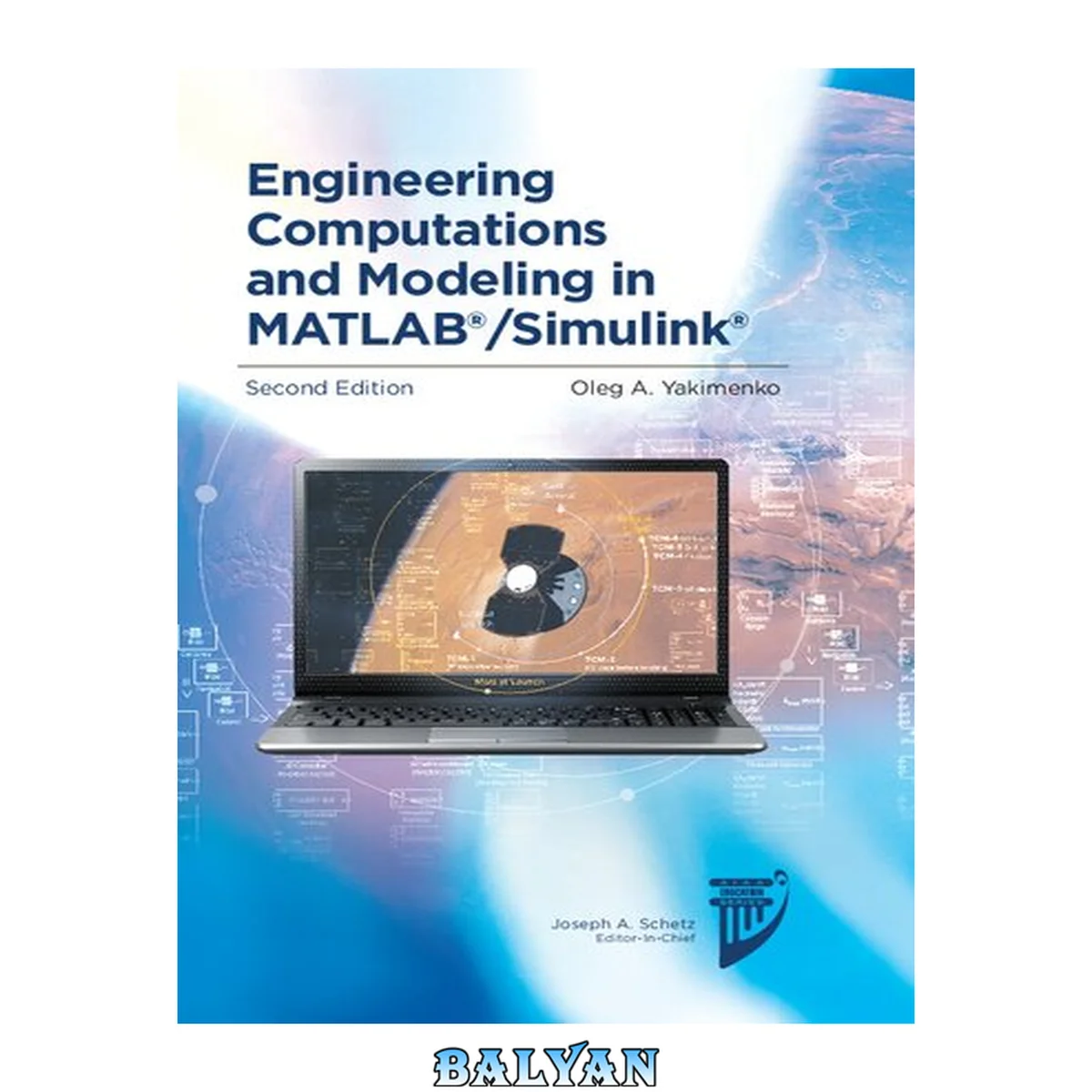
معرفی کتاب «محاسبات مهندسی و مدلسازی در MATLAB®/Simulink® (آموزش AIAA)» (با عنوان لاتین Engineering Computations and Modeling in MATLAB®/Simulink® (AIAA Education)) نوشتهٔ Oleg A. Yakimenko، منتشرشده توسط نشر American Institute of Aeronautics and Astronautics در سال 2019. این کتاب در 955 صفحه، فرمت pdf، زبان انگلیسی ارائه شده است. «محاسبات مهندسی و مدلسازی در MATLAB®/Simulink® (آموزش AIAA)» در دستهٔ ریاضیات قرار دارد.
Engineering Computations and Modeling in MATLAB®/Simulink®, Second Edition provides a broad overview of The MathWorks' MATLAB®/Simulink®/GUIDE development and modeling environment. This textbook shows how to use these software tools effectively in a variety of engineering applications, including modeling real-world dynamic systems. This book is used as a textbook by undergraduate and graduate students taking both introductory and advanced courses in applied programming, and also as a reference for working professionals using MATLAB®/Simulink®. Contents Chapter 1 - MATLAB/Simulink as a Technical Computing Language Chapter 2 - Development Environment and Basic Operations Chapter 3 - Arrays and Array Operations Chapter 4 - Mixed-Type Data 'Containers' and Input/Output Management Chapter 5 - Programming in MATLAB® Chapter 6 - 2-D and 3-D Plotting and Animation Chapter 7 - Symbolic Math Toolbox Chapter 8 - Accuracy of Digital Computations Chapter 9 - Numerical Linear Algebra and Eigenvalue Problems Chapter 10 - Root Finding and Introduction to Optimization Chapter 11 - Curve Fitting to Measured Data Chapter 12 - Numerical Differentiation Chapter 13 - Numerical Integration Chapter 14 - Initial-Value Problem Chapter 15 - Simulink Basics Cover Half Title Title Page Copyright Page Contents Preface Conventions List of Acronyms Chapter 1: MATLAB/Simulink as a Technical Computing Language 1.1 Introduction 1.2 History of MATLAB Creation and Development 1.3 Capabilities and Resources 1.4 Aerospace Application Tools 1.5 Overview of MathWorks Products Chapter 2: Development Environment and Basic Operations 2.1 Introduction 2.2 MATLAB Development Environment and MATLAB Online 2.3 Help System 2.4 Function Collections 2.5 Order of Precedence 2.6 Managing Work Session 2.7 Changing Preferences 2.8 Problem-Solving Methodology Problems Chapter 3: Arrays and Array Operations 3.1 Introduction 3.2 Types of Arrays and Indexing Their Elements 3.3 Array Operations 3.4 Array Functions 3.5 Using MATLAB Matrix Formalism To Handle Polynomials 3.6 Handling Text as Character and String Arrays Problems Chapter 4: Mixed-Type Data “Containers” and Input/Output Management 4.1 Introduction 4.2 Data Types 4.3 Cell Arrays 4.4 Structure Arrays 4.5 Tables 4.6 Types of MATLAB Files 4.7 Recording MATLAB Sessions and Storing Workspace Variables 4.8 Importing and Exporting Data 4.9 Writing and Displaying Formatted Data 4.10 Interactive Input and Output Problems Chapter 5: Programming in MATLAB 5.1 Introduction 5.2 Relational Operators 5.3 Logical (Boolean) Operators and Functions 5.4 Conditional Statements 5.5 Loops 5.6 The switch Construct 5.7 The Script Files 5.8 Functions 5.9 Developing Professional-Looking Functions 5.10 Editing and Debugging 5.11 Code Analyzer and Profiler 5.12 Formatting MATLAB Comments for Publishing Problems Chapter 6: 2-D and 3-D Plotting and Animation 6.1 Introduction 6.2 Anatomy of the 2-D (x–y) Plots in MATLAB 6.3 Line Specifications 6.4 Accessing Plot Properties via the get and set Functions 6.5 Text Strings 6.6 Overlays, Legends, Subplots, and Multiple Figures 6.7 Other Types of the 2-D Plots 6.8 The 3-D Plots 6.9 Changing the Color Palette 6.10 Function-Plotting Functions 6.11 Plot Editing 6.12 Interactive Plotting and Animation 6.13 Requirements to the Engineering Plots Problems Chapter 7: Symbolic Math Toolbox 7.1 Introduction 7.2 Symbolic Math Toolbox Overview 7.3 Getting Started 7.4 Linear Algebra Functions 7.5 Calculus Functions 7.6 Solving Algebraic and Differential Equations 7.7 Simplification and Substitution 7.8 Other Functions 7.9 Plotting Symbolic Expressions and Using Symbolic Notations 7.10 Using Symbolic Expressions in Numerical Operations 7.11 Symbolic Calculators 7.12 Units of Measurement Problems Chapter 8: Accuracy of Digital Computations 8.1 Introduction 8.2 Accuracy and Precision of Calculations and Measurements 8.3 Computer Number Representation 8.4 Round-Off Errors 8.5 Truncation Errors 8.6 Control of Numerical Errors Problems Chapter 9: Numerical Linear Algebra and Eigenvalue Problems 9.1 Introduction 9.2 Classification of LAEs 9.3 Inhomogeneous Sets of LAEs 9.4 Matrix Decompositions 9.5 Special Cases of LAEs 9.6 Applying Linear Algebra To Solve Systems of ODEs 9.7 Using the MATLAB Functions Problems Chapter 10: Root Finding and Introduction to Optimization 10.1 Introduction 10.2 Bracketing Methods 10.3 Open Methods 10.4 Zeroin Algorithm 10.5 Multiple Roots and Value Finding 10.6 Roots of Polynomials 10.7 From Root Finding to 1-D Unconstrained Optimization 10.8 Introduction to Multidimensional Optimization 10.9 Using the MATLAB Functions Problems Chapter 11: Curve Fitting to Measured Data 11.1 Introduction 11.2 Least-Squares Regression 11.3 Full-Degree Polynomial Approximation 11.4 Piecewise Approximation 11.5 Fourier Approximation 11.6 Using the MATLAB Functions Problems Chapter 12: Numerical Differentiation 12.1 Introduction 12.2 Two-Point Difference Approximations of the First-Order Derivative 12.3 Error Estimates from the Taylor Series Expansion 12.4 More Accurate Multiple-Point Approximations 12.5 Secondand Higher-Order Derivatives 12.6 Alternative Ways of Obtaining Approximation Formulas 12.7 Partial Derivatives 12.8 Using the MATLAB Functions Problems Chapter 13: Numerical Integration 13.1 Introduction 13.2 Rectangle Method 13.3 Trapezoidal Rule 13.4 Simpson’s 1/3 Rule 13.5 Simpson’s 3/8 Rule 13.6 Newton–Cotes Formulas 13.7 Multiple-Application Scheme 13.8 Gauss Quadrature 13.9 Using the MATLAB Functions Problems Chapter 14: Initial-Value Problem 14.1 Introduction 14.2 Initial-Value Problem Definition 14.3 Single-Step Methods 14.4 Adaptive Single-Step Algorithms 14.5 Multistep Methods 14.6 Stiff Problems and Other Issues 14.7 Using MATLAB IVP Solvers 14.8 Other MATLAB Solvers Problems Chapter 15: Simulink Basics 15.1 Introduction 15.2 Simulink Development Environment 15.3 Modeling Continuous Dynamics 15.4 Modeling Discrete Systems 15.5 Other Libraries of Simulink 15.6 Integration of MATLAB and Simulink 15.7 Practical Examples 15.8 Model Reviewing and Profiling Problems Appendix A: LaTeX Symbols, Math Constructs, and Matrices Appendix B: Functions for Handling Character and String Arrays Appendix C: Datetime and Categorical Data Types in Support of Tables and Timetables Appendix D: Hooke–Jeeves Minimization Appendix E: Aerospace Systems Modeling Tools Appendix F: Building and Sharing GUIs and Apps Bibliography Index Supporting Materials "Engineering Computations and Modeling in MATLAB/Simulink, Second edition provides a broad overview of The MathWorks' MATLAB/Simulink/GUIDE/App Designer development and modeling environment. This textbook shows how to use these software tools effectively in a variety of engineering applications, including modeling real-world dynamic systems. This book is used as a textbook by undergraduate and graduate students taking both introductory and advanced courses in applied programming, and also as a reference for working professionals using MATLAB/Simulink"-- Provided by publisher Provides a broad overview of The MathWorks' MATLAB (R)/Simulink (R)/GUIDE/App Designer development and modeling environment. This textbook shows how to use these software tools effectively in a variety of engineering applications, including modeling real-world dynamic systems.
دانلود کتاب محاسبات مهندسی و مدلسازی در MATLAB®/Simulink® (آموزش AIAA)