Elusive : How Peter Higgs Solved the Mystery of Mass
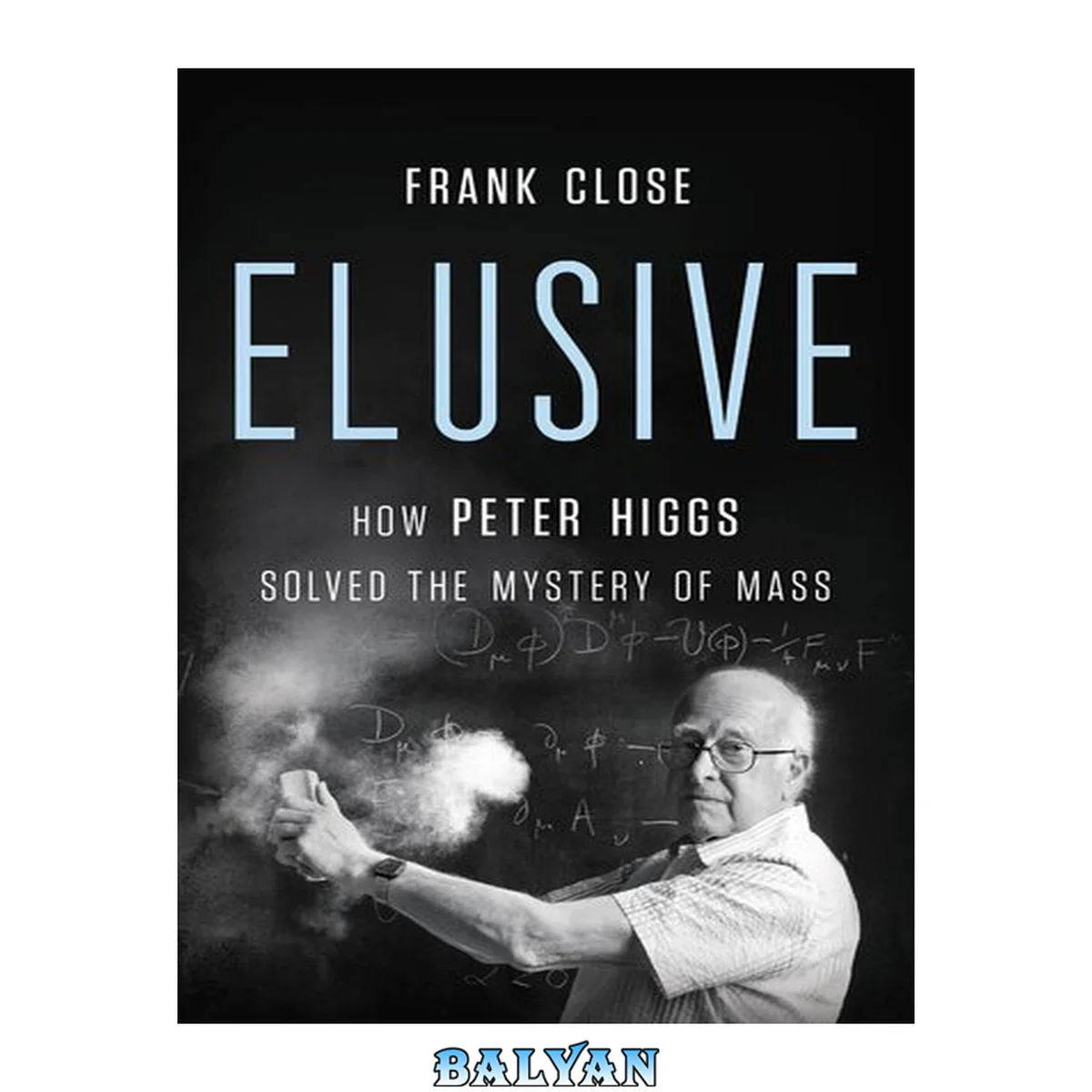
معرفی کتاب «Elusive : How Peter Higgs Solved the Mystery of Mass» نوشتهٔ Walter Rudin و Frank Close، منتشرشده توسط نشر Basic Books در سال 2022. این کتاب در فرمت pdf، زبان انگلیسی ارائه شده است.
The story of the Higgs boson - the so-called 'God particle' - and the man who thought of it. In the summer of 1964, a reclusive young professor at the University of Edinburgh wrote two scientific papers which have come to change our understanding of the most fundamental building blocks of matter and the nature of the universe. Peter Higgs posited the existence an almost infinitely tiny particle - today known as the Higgs boson - which is the key to understanding why particles have mass, and but for which atoms and molecules could not exist. For nearly 50 years afterwards, some of the largest projects in experimental physics sought to demonstrate the physical existence of the boson which Higgs had proposed. Sensationally, confirmation came in July 2012 at the Large Hadron Collider at CERN in Geneva. The following year Higgs was awarded the Nobel Prize for Physics. One of the least-known giants of science, he is the only person in history to have had a single particle named for them. This revelatory book is 'not so much a biography of the man but of the boson named after him'. It brilliantly traces the course of much of twentieth-century physics from the inception of quantum field theory to the completion of the 'standard model' of particles and forces, and the pivotal role of Higgs's idea in this evolution. It also investigates the contested history of Higgs's responsibility for the breakthrough when there were others close by, and explains why the boson is named for him alone. Competition between institutions and states, Close shows, then played as much of a role in creating Higgs's fame as his work itself. Drawing on conversations with Higgs over a decade (a figure generally as elusive as his particle) this is a superb study of a scientist and his era - and of how scientific knowledge advances. Front Cover Title Page Copyright Contents Preface Prelude: The Case of the Disappearing Professor Part 1 1. A Name on the Board A Solitary Child The Cotham School Alumnus A Nuclear Awakening The City of London 2. The Single Helix Molecular Physics and DNA Edinburgh and Gauge Invariance London and General Relativity Consultant for the Campaign for Nuclear Disarmament 3. The Particle Explosion 1960: A Missed Opportunity Encounter in the Staff Club 4. The Super Conductor Hidden Symmetry Mass from Nowhere Goldstone's Boson 5. Higgs' Epiphany Anderson Shows the Way From Anderson to Higgs Higgs' First Paper Decoded Higgs' Second Paper Decoded 6. Now We Are Six Fate and Higgs' Second Paper Guralnik, Hagen, and Kibble A Deafening Silence 7. Birth of a Boson 1966: North Carolina DNA of a Boson "You've Definitely Got Something Wrong" 8. "Peter—You're Famous!" Cocktail Conversation Weinberg's Model of Leptons The Flying Dutchmen Chicago 1972 A New Architecture Part 2 9. The First Disappearance—1976 A Visit to CERN Wilczek's Brain Wave Banquo and the Boson 10. Every Journey Begins with a Single Step A Theoretical Hint of the Higgs 11. A Machine for 1 TeV LEP Robert Brout Boson Politics Emotional Roller Coaster Quantum Roller Coaster 12. Father of the God Particle Hawking Higgs "This is Going to Be Huge" 13. The "Doomsday Machine" Hawking Rocks the Boat Catastrophe 14. "We Should Go to CERN" Popularising Higgs Preparations The Sicilian Hideaway 15. The Fourth of July Once in a Generation A Moment in History The Press Conference Not in My Lifetime Part 3 16. "Time to Plan My Escape" Nothing Is Guaranteed Prince of Asturias: Nobel Rehearsal 17. The Glittering Prizes The Swedish Prize Owned by the World 18. Zigzag Epilogue: The View Across the Plains Acknowledgements Appendix 4.1: Ginzburg and Landau’s Mexican Hat Appendix 5.1: Higgs' First Paper Decoded Appendix 5.2: Higgs' Second Paper Decoded About the Author Also by Frank Close Notes Preface Prelude 1. A Name on the Board 2. The Single Helix 3. The Particle Explosion 4. The Super Conductor 5. Higgs' Epiphany 6. Now We Are Six 7. Birth of a Boson 8. "Peter—You're Famous!" 9. The First Disappearance—1976 10. Every Journey Begins with a Single Step 11. A Machine for 1 TeV 12. Father of the God Particle 13. The "Doomsday Machine" 14. "We Should Go to CERN" 15. The Fourth of July 16. "Time to Plan My Escape" 17. The Glittering Prizes 18. Zigzag Epilogue: The View Across the Plains "On July 4, 2012, scientists at the Large Hadron Collider at CERN gathered to make a momentous announcement: after nearly a half century of speculation and work, the Higgs boson had been found, and the mystery of mass solved. Not far offstage was the man for whom the particle had been named: Peter Higgs. The Higgs boson is an anomaly. No other basic particle of physics is named after a person. And in a point of almost supreme irony, it is named after a man whom most physicists would call one of the most retiring people ever to join the field--indeed, on the day the Nobel committee called him to tell him he had won, Higgs had fled to a fish-and-chip shop by the sea, and ended up learning of his prize from a stranger who, recognizing him, stopped him the street to tell him the news. Or at least that's one way to tell the story. In Elusive, physicist and historian Frank Close tells for the first time ever the story of Peter Higgs' life and work. It is, as the title suggests, hard to pin down. How did Higgs become so famous, when he only published eight scientific papers in his entire life--especially when, as he himself admits, he no longer could keep up with the mathematics driving his field? It turns out it has as much to do with the machinations of scientific competition between the European Union and the United States as it does with Higgs' own insight. The truth is obscured as well by jockeying within physics, as scientists as famous as Stephen Hawking sought to use the hunt for the Higgs to enhance their own fame. And then there is the work itself, obscure and strange and yet somehow the key not just to mass, but to the entire edifice of particle physics. Frank Close clarifies them all, making the physics clear, but even more crucially, revealing just how important a single man's life can be to understanding the social and cultural roles of science in our world. A landmark event, Elusive will sit proudly beside great biographies of Richard Feynman, Albert Einstein, and Paul Dirac as portraits of a man and his work. But perhaps more importantly, it will help all of us understand--in a world where we all rely on "Big Science" for our material well-being--whether its functioning is truly as straightforward or distinterested as it seems. The answer to that question remains, well, elusive"-- Provided by publisher *A New York Times Book Review Editor's Choice Selection* The first major biography of Peter Higgs, revealing how a short burst of work changed modern physics On July 4, 2012, the announcement came that one of the longest-running mysteries in physics had been solved: the Higgs boson, the missing piece in understanding why particles have mass, had finally been discovered. On the rostrum, surrounded by jostling physicists and media, was the particle’s retiring namesake—the only person in history to have an existing single particle named for them. Why Peter Higgs? Drawing on years of conversations with Higgs and others, Close illuminates how an unprolific man became one of the world’s most famous scientists. Close finds that scientific competition between people, institutions, and states played as much of a role in making Higgs famous as Higgs’s work did. A revelatory study of both a scientist and his era, Elusive will remake our understanding of modern physics. "The first major biography of Peter Higgs, revealing how a short burst of work changed modern physics On July 4, 2012, the announcement came that one of the longest-running mysteries in physics had been solved: the Higgs boson, the missing piece in understanding why particles have mass, had finally been discovered. On the rostrum, surrounded by jostling physicists and media, was the particle's retiring namesake--the only person in history to have an existing single particle named for them. Why Peter Higgs? Drawing on years of conversations with Higgs and others, Close illuminates how an unprolific man became one of the world's most famous scientists. Close finds that scientific competition between people, institutions, and states played as much of a role in making Higgs famous as Higgs's work did. A revelatory study of both a scientist and his era, Elusive will remake our understanding of modern physics"-- Provided by publisher
دانلود کتاب Elusive : How Peter Higgs Solved the Mystery of Mass