اشکالزدایی مؤثر: ۶۶ روش خاص برای اشکالزدایی نرمافزار و سیستمها (مجموعه توسعه نرمافزار مؤثر)
Effective Debugging: 66 Specific Ways to Debug Software and Systems (Effective Software Development Series)
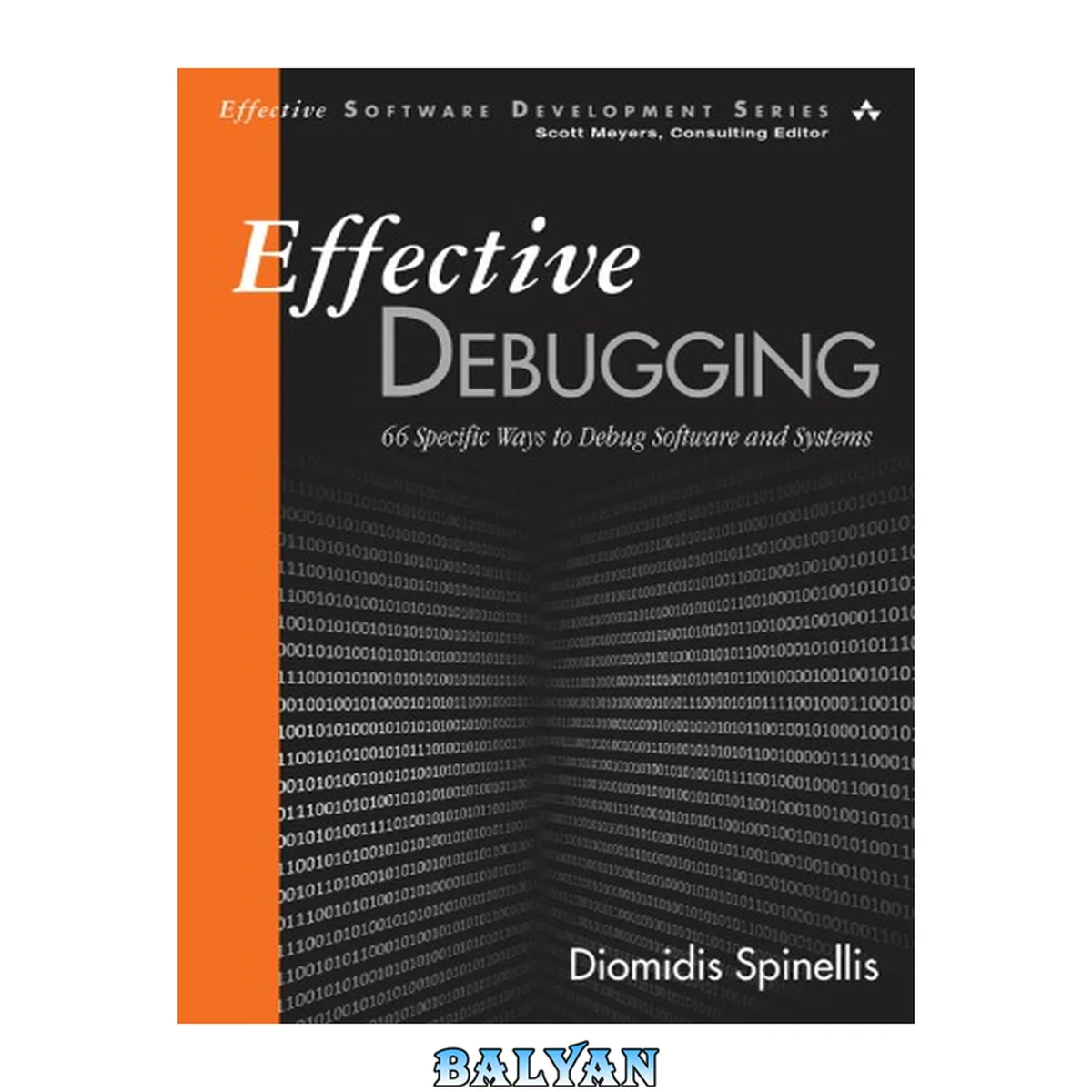
معرفی کتاب «اشکالزدایی مؤثر: ۶۶ روش خاص برای اشکالزدایی نرمافزار و سیستمها (مجموعه توسعه نرمافزار مؤثر)» (با عنوان لاتین Effective Debugging: 66 Specific Ways to Debug Software and Systems (Effective Software Development Series)) نوشتهٔ Amanda، Bouchet و Diomidis Spinellis، منتشرشده توسط نشر Addison-Wesley Professional; Addison-Wesley در سال 2016. این کتاب در فرمت pdf، زبان انگلیسی ارائه شده است.
Every software developer and IT professional understands the crucial importance of effective debugging. Often, debugging consumes most of a developer’s workday, and mastering the required techniques and skills can take a lifetime. In Effective Debugging, Diomidis Spinellis helps experienced programmers accelerate their journey to mastery, by systematically categorizing, explaining, and illustrating the most useful debugging methods, strategies, techniques, and tools. Drawing on more than thirty-five years of experience, Spinellis expands your arsenal of debugging techniques, helping you choose the best approaches for each challenge. He presents vendor-neutral, example-rich advice on general principles, high-level strategies, concrete techniques, high-efficiency tools, creative tricks, and the behavioral traits associated with effective debugging. Spinellis’s 66 expert techniques address every facet of debugging and are illustrated with step-by-step instructions and actual code. He addresses the full spectrum of problems that can arise in modern software systems, especially problems caused by complex interactions among components and services running on hosts scattered around the planet. Whether you’re debugging isolated runtime errors or catastrophic enterprise system failures, this guide will help you get the job done—more quickly, and with less pain. Key features include • High-level strategies and methods for addressing diverse software failures • Specific techniques to apply when programming, compiling, and running code • Better ways to make the most of your debugger • General-purpose skills and tools worth investing in • Advanced ideas and techniques for escaping dead-ends and the maze of complexity • Advice for making programs easier to debug • Specialized approaches for debugging multithreaded, asynchronous, and embedded code • Bug avoidance through improved software design, construction, and management Cover 1 Title Page 4 Copyright Page 5 Contents 8 Figures 12 Listings 14 Preface 16 Acknowledgments 24 About the Author 29 Chapter 1: High-LevelStrategies 30 Item 1: Handle All Problems through an Issue-Tracking System 30 Item 2: Use Focused Queries to Search the Web for Insights into Your Problem 32 Item 3: Confirm That Preconditions and Postconditions Are Satisfied 34 Item 4: Drill Up from the Problem to the Bug or Down from the Program’s Start to the Bug 36 Item 5: Find the Difference between a Known Good System and a Failing One 38 Item 6: Use the Software’s Debugging Facilities 41 Item 7: Diversify Your Build and Execution Environment 46 Item 8: Focus Your Work on the Most Important Problems 49 Chapter 2: General-Purpose Methods and Practices 52 Item 9: Set Yourself Up for Debugging Success 52 Item 10: Enable the Efficient Reproduction of the Problem 54 Item 11: Minimize the Turnaround Time from Your Changes to Their Result 57 Item 12: Automate Complex Testing Scenarios 58 Item 13: Enable a Comprehensive Overview of Your Debugging Data 61 Item 14: Consider Updating Your Software 62 Item 15: Consult Third-Party Source Code for Insights on Its Use 63 Item 16: Use Specialized Monitoring and Test Equipment 65 Item 17: Increase the Prominence of a Failure’s Effects 69 Item 18: Enable the Debugging of Unwieldy Systems from Your Desk 71 Item 19: Automate Debugging Tasks 73 Item 20: Houseclean Before and After Debugging 74 Item 21: Fix All Instances of a Problem Class 75 Chapter 3: General-Purpose Tools and Techniques 78 Item 22: Analyze Debug Data with Unix Command-Line Tools 78 Item 23: Utilize Command-Line Tool Options and Idioms 84 Item 24: Explore Debug Data with Your Editor 86 Item 25: Optimize Your Work Environment 88 Item 26: Hunt the Causes and History of Bugs with the Revision Control System 93 Item 27: Use Monitoring Tools on Systems Composed of Independent Processes 96 Chapter 4: Debugger Techniques 100 Item 28: Use Code Compiled for Symbolic Debugging 100 Item 29: Step through the Code 105 Item 30: Use Code and Data Breakpoints 106 Item 31: Familiarize Yourself with Reverse Debugging 109 Item 32: Navigate along the Calls between Routines 111 Item 33: Look for Errors by Examining the Values of Variables and Expressions 113 Item 34: Know How to Attach a Debugger to a Running Process 116 Item 35: Know How to Work with Core Dumps 118 Item 36: Tune Your Debugging Tools 121 Item 37: Know How to View Assembly Code and Raw Memory 124 Chapter 5: Programming Techniques 130 Item 38: Review and Manually Execute Suspect Code 130 Item 39: Go Over Your Code and Reasoning with a Colleague 132 Item 40: Add Debugging Functionality 133 Item 41: Add Logging Statements 137 Item 42: Use Unit Tests 141 Item 43: Use Assertions 145 Item 44: Verify Your Reasoning by Perturbing the Debugged Program 148 Item 45: Minimize the Differences between a Working Example and the Failing Code 149 Item 46: Simplify the Suspect Code 150 Item 47: Consider Rewriting the Suspect Code in Another Language 153 Item 48: Improve the Suspect Code’s Readability and Structure 155 Item 49: Fix the Bug’s Cause, Rather Than Its Symptom 158 Chapter 6: Compile-Time Techniques 162 Item 50: Examine Generated Code 162 Item 51: Use Static Program Analysis 165 Item 52: Configure Deterministic Builds and Executions 170 Item 53: Configure the Use of Debugging Libraries and Checks 172 Chapter 7: Runtime Techniques 178 Item 54: Find the Fault by Constructing a Test Case 178 Item 55: Fail Fast 182 Item 56: Examine Application Log Files 183 Item 57: Profile the Operation of Systems and Processes 187 Item 58: Trace the Code’s Execution 191 Item 59: Use Dynamic Program Analysis Tools 197 Chapter 8: Debugging Multi-threaded Code 200 Item 60: Analyze Deadlocks with Postmortem Debugging 200 Item 61: Capture and Replicate 207 Item 62: Uncover Deadlocks and Race Conditions with Specialized Tools 212 Item 63: Isolate and Remove Nondeterminism 217 Item 64: Investigate Scalability Issues by Looking at Contention 219 Item 65: Locate False Sharing by Using Performance Counters 222 Item 66: Consider Rewriting the Code Using Higher-Level Abstractions 226 Web Resources 236 Index 240 A 240 B 240 C 241 D 242 E 244 F 244 G 245 H 246 I 246 J 246 K 247 L 247 M 248 N 249 O 249 P 250 Q 251 R 251 S 253 T 254 U 255 V 255 W 256 X 256 Y 256 Z 256 Every software developer and IT professional understands the crucial importance of effective debugging. Often, debugging consumes most of a developers workday, and mastering the required techniques and skills can take a lifetime. In Effective Debugging, Diomidis Spinellis helps experienced programmers accelerate their journey to mastery, by systematically categorizing, explaining, and illustrating the most useful debugging methods, strategies, techniques, and tools. Drawing on more than thirty-five years of experience, Spinellis expands your arsenal of debugging techniques, helping you choose the best approaches for each challenge. He presents vendor-neutral, example-rich advice on general principles, high-level strategies, concrete techniques, high-efficiency tools, creative tricks, and the behavioral traits associated with effective debugging. Spinelliss 66 expert techniques address every facet of debugging and are illustrated with step-by-step instructions and actual code. He addresses the full spectrum of problems that can arise in modern software systems, especially problems caused by complex interactions among components and services running on hosts scattered around the planet. Whether youre debugging isolated runtime errors or catastrophic enterprise system failures, this guide will help you get the job donemore quickly, and with less pain. Key features include Every software developer understands the crucial importance of effective debugging. Often, debugging consumes most of a developer's workday, and mastering the required techniques and skills can take a lifetime. In Effective Debugging, Diomidis Spinellis helps you accelerate your journey to mastery, by systematically categorizing, explaining, and illustrating scores of today's best methods, strategies, techniques, and tools. Drawing on more than twenty-five years of experience, Spinellis helps you expand the arsenal of techniques you're comfortable with, and choose the approaches that work best for each challenge. He presents vendor-neutral, example-rich coverage of general principles, high-level strategies, concrete techniques, high-efficiency tools, creative tricks, and the behavioral traits associated with effective debugging. His 66 step-by-step techniques address every facet of debugging, including Building an effective debugging environment, Tracking issues and reproducing problems, Using online resources, Stepping through code, adding breakpoints, and using call stacks, Optimizing and automating debugging workflows, Collaborating with others on debugging, Debugging at compile time and run time, Simplifying, rewriting, and improving code to avoid bugs, Using debug mode, Varying execution environments, Working with command line tools, Making the most of revision control and logs, Debugging multithreaded, asynchronous, and embedded device code, and much more. -- Provided by publisher
دانلود کتاب اشکالزدایی مؤثر: ۶۶ روش خاص برای اشکالزدایی نرمافزار و سیستمها (مجموعه توسعه نرمافزار مؤثر)