E = mc2: A Biography of the World's Most Famous Equation
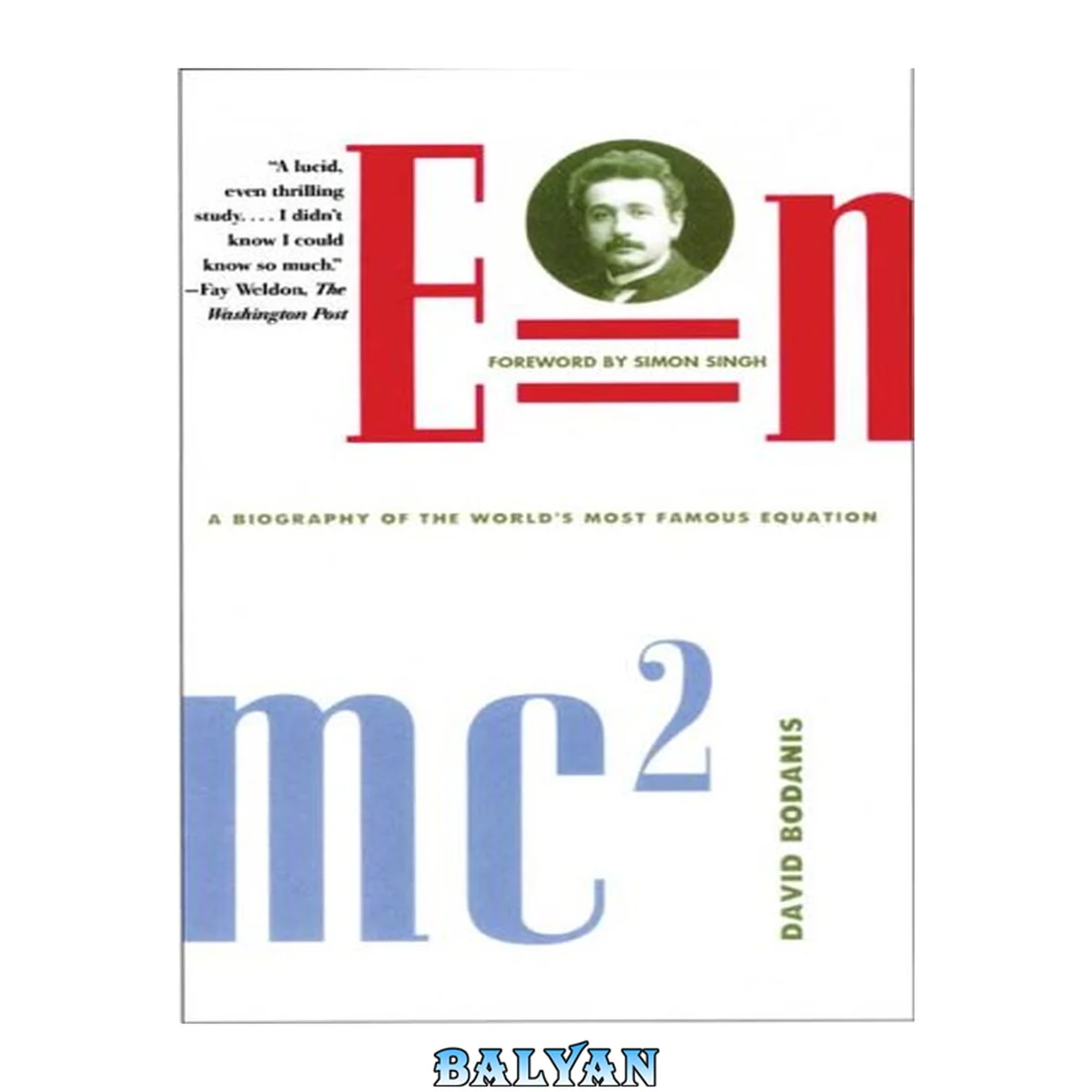
معرفی کتاب «E = mc2: A Biography of the World's Most Famous Equation» نوشتهٔ David Bodanis، منتشرشده توسط نشر Berkley Publishing Group در سال 2000. این کتاب در فرمت pdf، زبان انگلیسی ارائه شده است.
Generations have grown up knowing that the equation E=mc2 changed the shape of our world, but never understanding what it actually means, why it was so significant, and how it informs our daily lives today—governing, as it does, everything from the atomic bomb to a television’s cathode ray tube to the carbon dating of prehistoric paintings. In this book, David Bodanis writes the “biography” of one of the greatest scientific discoveries in history—that the realms of energy and matter are inescapably linked—and, through his skill as a writer and teacher, he turns a seemingly impenetrable theory into a dramatic human achievement and an uncommonly good story. Publishers Weekly Most people know this celebrated equation has something to do with Einstein's theory of relativity, but most nonscientists don't know what it means. This very approachable yet somewhat limited work of popular science explains, and adorns with anecdote and biography, the equation and its place in history. Oxford lecturer Bodanis (The Secret Family) shows what happened to Einstein on the way to the discovery, what other scientists did to bring it about and how the equation created the atom bomb. Part Two tackles separately the components of the equation (E, =, m, c and "squared"), which means that it covers 18th- and 19th-century physics. "`E' Is for Energy" opens with Michael Faraday, whose unusual religious beliefs helped him discover that electricity and magnetism were the same force. "`m' Is for Mass" brings in French chemist Lavoisier, who established the law of conservation of matter. Bodanis then turns to Einstein's life and work. The middle third of the book covers the exploration of the atom and the making of the atom bomb; the cast of characters here includes Marie Curie, Lise Meitner and Enrico Fermi. A concluding section considers how E=mc2 powers the sun, and how our sun and all others will eventually run out of gas. Capsule biographies here include one of the engaging English astronomer Cecilia Payne, who wouldn't let institutional sexism stop her from finding the hydrogen in the sun. Bodanis's writing is accessible to the point of chattiness: he seeks, and deserves, many readers who know no physics. They'll learn a handful--more important, they'll enjoy it, and pick up a load of biographical and cultural curios along the way. 20 photos and drawings not seen by PW. (Oct.) Copyright 2000 Cahners Business Information. E=mc. Just about everyone has at least heard of Albert Einstein's formulation of 1905, which came into the world as something of an afterthought. But far fewer can explain his insightful linkage of energy to mass. David Bodanis offers an easily grasped gloss on the equation. Mass, he writes, "is simply the ultimate type of condensed or concentrated energy," whereas energy "is what billows out as an alternate form of mass under the right circumstances." Just what those circumstances are occupies much of Bodanis's book, which pays homage to Einstein and, just as important, to predecessors such as Maxwell, Faraday, and Lavoisier, who are not as well known as Einstein today. Balancing writerly energy and scholarly weight, Bodanis offers a primer in modern physics and cosmology, explaining that the universe today is an expression of mass that will, in some vastly distant future, one day slide back to the energy side of the equation, replacing the "dominion of matter" with "a great stillness"--a vision that is at once lovely and profoundly frightening. Without sliding into easy psychobiography, Bodanis explores other circumstances as well; namely, Einstein's background and character, which combined with a sterling intelligence to afford him an idiosyncratic view of the way things work--a view that would change the world. --Gregory McNamee Part 1 - Birth -- Bern patent office, 1905 -- Part 2 - Ancestors of E=mc[squared] -- E is for energy -- = -- m is for mass -- c is for celeritas -- 2[hacek(caron)] -- Part 3 - The early years -- Einstein and the equation -- Into the atom -- Quiet in the midday snow -- Part 4 - Adulthood -- Germany's turn -- Norway -- America's turn -- 8:16 a.m. - over Japan -- Part 5 - Till the end of time -- The fires of the sun -- Creating the earth -- A Brahmin lifts his eyes unto the sky -- Epilogue : What else Einstein did -- -- Appendix : Follow-up of other key participants. Bodanis turns a seemingly impenetrable theory into a dramatic and accessible human achievement. He explains its science and brings it to life; making clear the astonishing array of discoveries and consequences it made possible and its impact on our daily lives Examines the science and scientists who provided the backdrop to Einstein's influential 1905 discovery and offers an explanation of the equation from mathematical, historical, and scientific perspectives--Información proporcionada por el editor comercial Examines the science and scientists who provided the backdrop to Einstein's seminal 1905 discovery and offers a definitive explanation of the equation from a mathematical, historical, and scientific perspective Chronicles the "life" of Einstein's theory of relativity, discussing the scientific knowledge that led to it and describing its influence on the world, including the scientific discoveries it made possible
دانلود کتاب E = mc2: A Biography of the World's Most Famous Equation