Disease Prediction using Machine Learning, Deep Learning and Data Analytics
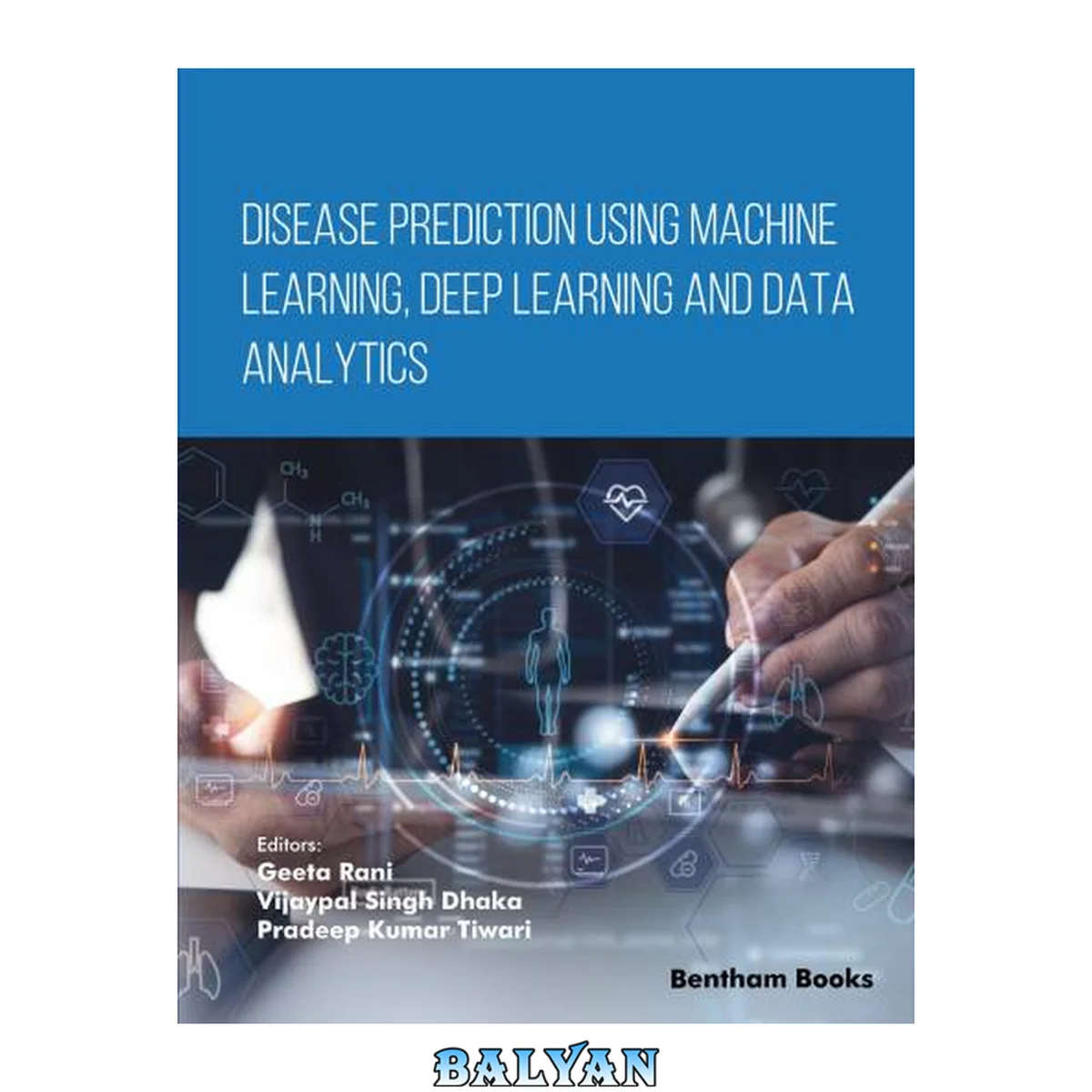
معرفی کتاب «Disease Prediction using Machine Learning, Deep Learning and Data Analytics» نوشتهٔ Review، Harvard Business، Harvard Business Review و Geeta Rani, Vijaypal Singh Dhaka (editor), Pradeep Kumar Tiwari (editor)، منتشرشده توسط نشر Bentham Science Publishers در سال 2024. این کتاب در فرمت pdf، زبان انگلیسی ارائه شده است.
This book is a comprehensive review of technologies and data in healthcare services. It features a compilation of 10 chapters that inform readers about the recent research and developments in this field. Each chapter focuses on a specific aspect of healthcare services, highlighting the potential impact of technology on enhancing practices and outcomes. The main features of the book include 1) referenced contributions from healthcare and data analytics experts, 2) a broad range of topics that cover healthcare services, and 3) demonstration of deep learning techniques for specific diseases. Key topics: - Federated learning in analysis of sensitive healthcare data while preserving privacy and security. - Artificial intelligence for 3-D bone image reconstruction. - Detection of disease severity and creating personalized treatment plans using machine learning and software tools - Case studies for disease detection methods for different disease and conditions, including dementia, asthma, eye diseases - Brain-computer interfaces - Data mining for standardized electronic health records - Data collection, management, and analysis in epidemiological research The book is a resource for learners and professionals in healthcare service training programs and health administration departments. Cover Title Copyright End User License Agreement Contents Foreword Preface Introduction Dedication List of Contributors Role of Federated Learning in Healthcare: A Review Geeta Rani3, Meet Oza1, Heta Patel1, Vijaypal Singh Dhaka3,* and Sushma Hans2 INTRODUCTION LITERATURE REVIEW METHODOLOGY EXPERIMENTS VGG-16 [30] AlexNet [31] ResNet101 [32] DenseNet121 [33] RESULTS AND DISCUSSION CONCLUSION REFERENCES Role of Artificial Intelligence in 3-D Bone Image Reconstruction: A Review Nitesh Pradhan3, Vijaypal Singh Dhaka1, Geeta Rani1,* and Monika Agarwal2 INTRODUCTION ANALYSIS OF RELATED WORK CONCLUSION REFERENCES Role of Machine Learning and Deep Learning Techniques in Detection of Disease Severity: A Survey Geeta Rani1, Vijaypal Singh Dhaka1* and Sushma Hans2 INTRODUCTION LITERATURE REVIEW Severity Detection using Machine Learning Severity Detection using Deep Learning CONCLUSION REFERENCES Computer-aided Bio-medical Tools for Disease Identification E. Francy Irudaya Rani1, T. Lurthu Pushparaj2 and E. Fantin Irudaya Raj3,* INTRODUCTION APPLICATIONS OF CAD IN MEDICAL ANALYSIS Cardiology Study using CAD Ophthalmology Study using CAD Dermatology Study using CAD Pathology Study using CAD IMAGE PROCESSING METHODOLOGY ADOPTED IN CAD Pre-processing Active Contour Method Seeded Region Growing Method Morphological Operations SEGMENTATION Edge Detection for Segmentation Thresholding Method for Segmentation Region-Based Methods for Segmentation Clustering Based Methods for Segmentation Hybrid Image Segmentation using Watershed and Fast Region Merging FEATURE SELECTION Feature Selection in Brain Imaging Feature Selection in Alzheimer’s Disease Feature Selection in Lung Disease Feature Selection in Eye Disease FEATURE SELECTION FOR CLASSIFICATION CLASSIFICATION Statistical Classification Methods Rule-Based Systems Classification Neural Network Classifiers SUPPORT VECTOR MACHINE (SVM) FOR CLASSIFICATION DISCUSSION OF CAD TOOLS FOR MEDICAL APPLICATION CONCLUSION REFERENCES Prognosis of Dementia using Machine Learning Anu Saini1, Sunita Kumari1,*, Ritik 1, Rajni 1 and Sushma Hans2 INTRODUCTION RELATED WORK METHODOLOGY Proposed Model for Predicting Dementia using Patient Record and MRI RESULT ANALYSIS CONCLUSION ACKNOWLEDGMENTS REFERENCES A Clinical Decision Support System for Effective Identification of the Onset of Asthma Disease M.R. Pooja1,* INTRODUCTION RELATED WORK MATERIAL AND METHODS Dataset Description Combatting Class Imbalance Feature Clustering Subject Clustering Performance Evaluation CONCLUSION REFERENCES Applying Deep Learning and Computer Vision for Early Diagnosis of Eye Diseases The Fusion of Human-Computer Interaction and Artificial Intelligence Leads to the Emergence of Brain Computer Interaction M. Kiruthiga Devi1,* INTRODUCTION COMPONENTS OF BRAIN COMPUTER INTERFACE Signal Acquisition Feature Extraction Translation Application/Device Output BCI CHARACTERISTICS BCI Systems are Classified according to how they use the Brain: Active BCI Signal Acquisition Modalities have been used to Classify Structures as Invasive or Noninvasive BCI Invasive Techniques Non-Invasive Techniques CHALLENGES Training Process Information Transfer Rate Technical Challenges Non-Linearity Non-Stationary and Noise Small Training Sets CONCLUSION REFERENCES Mining Standardized EHR Data: Exploration, Issues, and Solution Shivani Batra1,*, Vinay Kumar1, Neha Kohli2 and Vaishali Arya2 INTRODUCTION COMPLEXITY IN EHRS IMPLEMENTING DM ON EHRS CHALLENGES IN MINING STANDARDIZED EHRS SOLUTION FOR MINING STANDARDIZED EHRS DATABASE RELATED WORK CONCLUSION REFERENCES Role of Database in Epidemiological Situation Kanika Soni1, Shelly Sachdeva1 and Shivani Batra2,* INTRODUCTION Role of Data Role of the Database Epidemiology JOURNEY OF DATABASES EPIDEMIOLOGICAL SCENARIO AND DATABASES IMPLEMENTATION DETAILS Dataset Description Query Scenarios DATA ANALYSIS AND VISUALIZATION FUTURE WORK CONCLUSION REFERENCES Subject Index Back Cover
دانلود کتاب Disease Prediction using Machine Learning, Deep Learning and Data Analytics