Differential Equations, Dynamical Systems, and an Introduction to Chaos, Second Edition (Pure and Applied Mathematics (Academic Press), 60.)
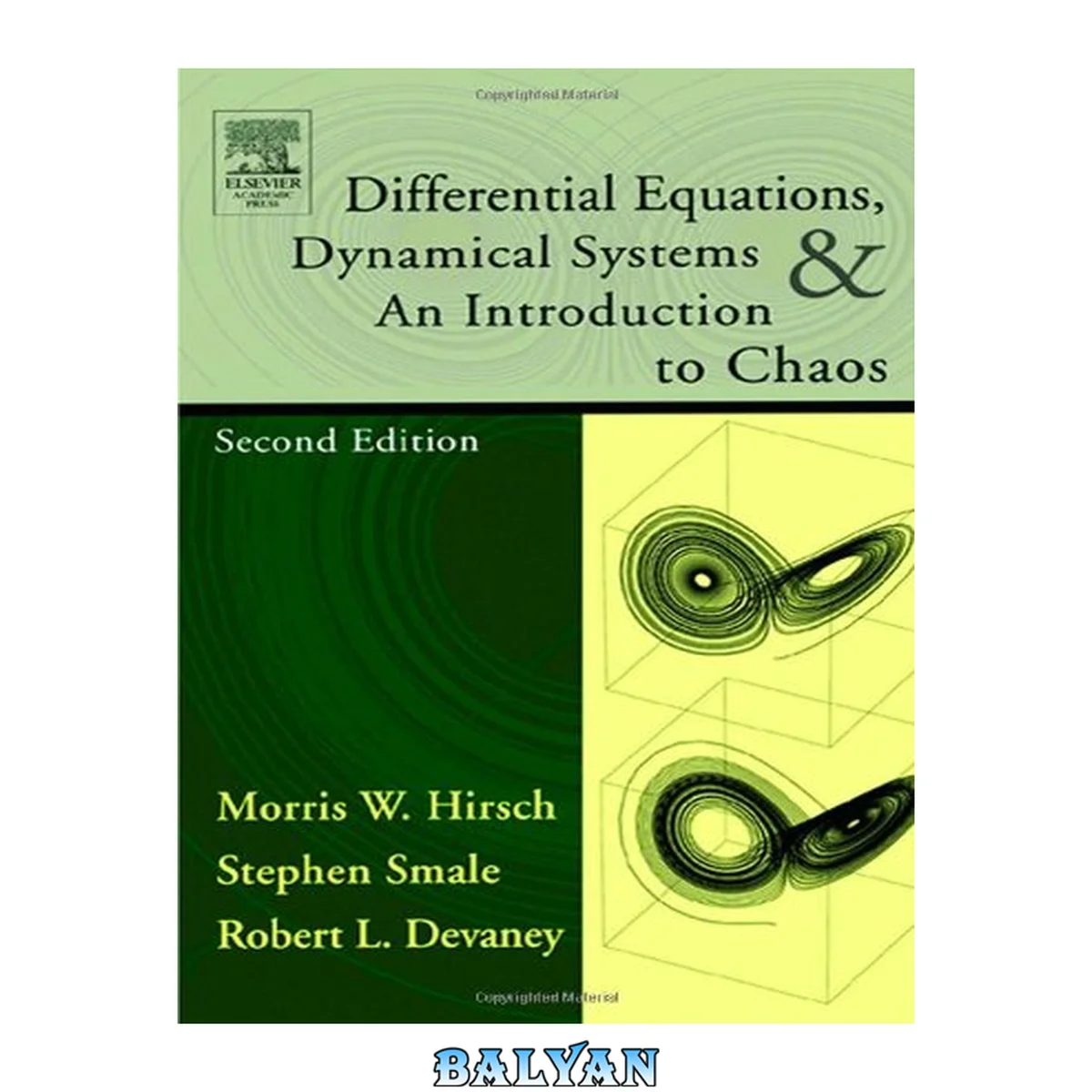
معرفی کتاب «Differential Equations, Dynamical Systems, and an Introduction to Chaos, Second Edition (Pure and Applied Mathematics (Academic Press), 60.)» نوشتهٔ Duchamp Chrystel و Morris W. Hirsch, Stephen Smale, Robert Devaney, Morris W. Hirsch, Hirsch, Morris W., Stephen Smale, Robert L. Devaney، منتشرشده توسط نشر Academic Press در سال 2003. این کتاب در 2 صفحه، فرمت pdf، زبان انگلیسی ارائه شده است.
I bought a copy of this new book and I have its old version with Hirsch and Smale as its only authors. Main differences between these books are some new chapters covering chaos and the exercises. Old version has better chapters dealing with linear algebra. I find this new version hard to read and it leaves many details to be filled by the reader. I would say that the new version is still a good choice for a second course in ODE or supplementary text for a graduate course. I gave it four stars. Thirty years in the making, this revised text by three of the world's leading mathematicians covers the dynamical aspects of ordinary differential equations. it explores the relations between dynamical systems and certain fields outside pure mathematics, and has become the standard textbook for graduate courses in this area. The Second Edition now brings students to the brink of contemporary research, starting from a background that includes only calculus and elementary linear algebra.
The authors are tops in the field of advanced mathematics, including Steve Smale who is a recipient of the Field's Medal for his work in dynamical systems.
* Developed by award-winning researchers and authors
* Provides a rigorous yet accessible introduction to differential equations and dynamical systems
* Includes bifurcation theory throughout
* Contains numerous explorations for students to embark upon
NEW IN THIS EDITION
* New contemporary material and updated applications
* Revisions throughout the text, including simplification of many theorem hypotheses
* Many new figures and illustrations
* Simplified treatment of linear algebra
* Detailed discussion of the chaotic behavior in the Lorenz attractor, the Shil'nikov systems, and the double scroll attractor
* Increased coverage of discrete dynamical systems
Differential Equations, Dynamical Systems, and an Introduction to Chaos, Second Edition, provides a rigorous yet accessible introduction to differential equations and dynamical systems. The original text by three of the world's leading mathematicians has become the standard textbook for graduate courses in this area. Thirty years in the making, this Second Edition brings students to the brink of contemporary research, starting from a background that includes only calculus and elementary linear algebra. The book explores the dynamical aspects of ordinary differential equations and the relations between dynamical systems and certain fields outside pure mathematics. It presents the simplification of many theorem hypotheses and includes bifurcation theory throughout. It contains many new figures and illustrations; a simplified treatment of linear algebra; detailed discussions of the chaotic behavior in the Lorenz attractor, the Shil'nikov systems, and the double scroll attractor; and increased coverage of discrete dynamical systems. This book will be particularly useful to advanced students and practitioners in higher mathematics. NEW IN THIS EDITION This text is about the dynamical aspects of ordinary differential equations and the relations between dynamical systems and certain fields outside pure mathematics. It is an update of one of Academic Press's most successful mathematics texts ever published, which has become the standard textbook for graduate courses in this area. The authors are tops in the field of advanced mathematics. Steve Smale is a Field's Medalist, which equates to being a Nobel prize winner in mathematics. Bob Devaney has authored several leading books in this subject area. Linear algebra prerequisites toned down from first edition Inclusion of analysis of examples of chaotic systems, including Lorenz, Rosssler, and Shilnikov systems Bifurcation theory included throughout This best-selling, classic text by eminent mathematicians Hirsch and Smale has captured the beauty and relative accessibility of chaotic phenomena for three decades. This field has motivated scientists and engineers in many disciplines to understand how differential equations and dynamical systems phenomena appear in virtually every area of science: chemistry, electrical engineering, celestial mechanics, ecological systems, and beyond. The differential equation familiar to all calculus students dx/dt = ax is the simplest differential equation.
دانلود کتاب Differential Equations, Dynamical Systems, and an Introduction to Chaos, Second Edition (Pure and Applied Mathematics (Academic Press), 60.)
The authors are tops in the field of advanced mathematics, including Steve Smale who is a recipient of the Field's Medal for his work in dynamical systems.
* Developed by award-winning researchers and authors
* Provides a rigorous yet accessible introduction to differential equations and dynamical systems
* Includes bifurcation theory throughout
* Contains numerous explorations for students to embark upon
NEW IN THIS EDITION
* New contemporary material and updated applications
* Revisions throughout the text, including simplification of many theorem hypotheses
* Many new figures and illustrations
* Simplified treatment of linear algebra
* Detailed discussion of the chaotic behavior in the Lorenz attractor, the Shil'nikov systems, and the double scroll attractor
* Increased coverage of discrete dynamical systems
Differential Equations, Dynamical Systems, and an Introduction to Chaos, Second Edition, provides a rigorous yet accessible introduction to differential equations and dynamical systems. The original text by three of the world's leading mathematicians has become the standard textbook for graduate courses in this area. Thirty years in the making, this Second Edition brings students to the brink of contemporary research, starting from a background that includes only calculus and elementary linear algebra. The book explores the dynamical aspects of ordinary differential equations and the relations between dynamical systems and certain fields outside pure mathematics. It presents the simplification of many theorem hypotheses and includes bifurcation theory throughout. It contains many new figures and illustrations; a simplified treatment of linear algebra; detailed discussions of the chaotic behavior in the Lorenz attractor, the Shil'nikov systems, and the double scroll attractor; and increased coverage of discrete dynamical systems. This book will be particularly useful to advanced students and practitioners in higher mathematics. NEW IN THIS EDITION This text is about the dynamical aspects of ordinary differential equations and the relations between dynamical systems and certain fields outside pure mathematics. It is an update of one of Academic Press's most successful mathematics texts ever published, which has become the standard textbook for graduate courses in this area. The authors are tops in the field of advanced mathematics. Steve Smale is a Field's Medalist, which equates to being a Nobel prize winner in mathematics. Bob Devaney has authored several leading books in this subject area. Linear algebra prerequisites toned down from first edition Inclusion of analysis of examples of chaotic systems, including Lorenz, Rosssler, and Shilnikov systems Bifurcation theory included throughout This best-selling, classic text by eminent mathematicians Hirsch and Smale has captured the beauty and relative accessibility of chaotic phenomena for three decades. This field has motivated scientists and engineers in many disciplines to understand how differential equations and dynamical systems phenomena appear in virtually every area of science: chemistry, electrical engineering, celestial mechanics, ecological systems, and beyond. The differential equation familiar to all calculus students dx/dt = ax is the simplest differential equation.