کشاورزی دادهمحور: بهرهبرداری از قدرت هوش مصنوعی و یادگیری ماشین در کشاورزی
Data-Driven Farming : Harnessing the Power of AI and Machine Learning in Agriculture
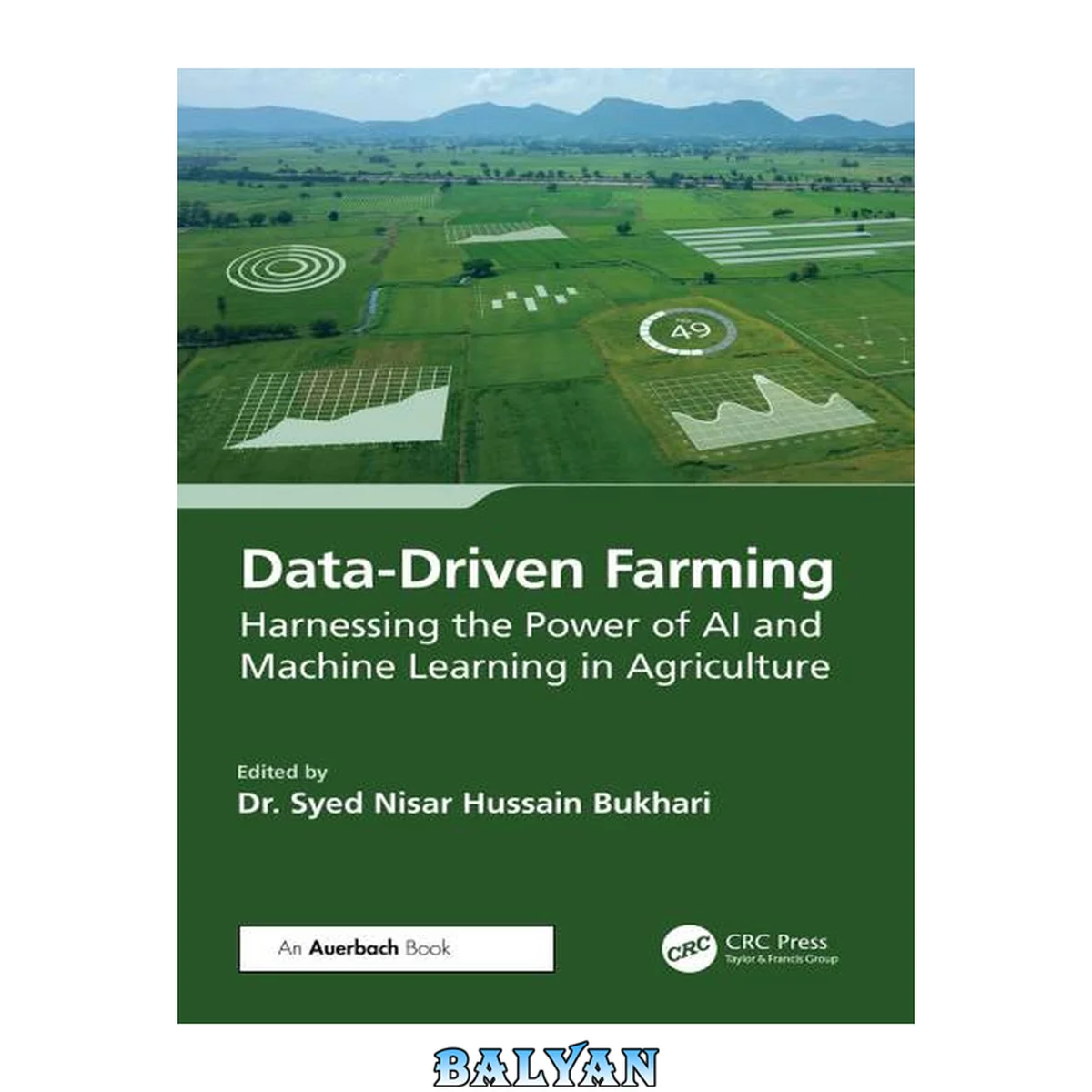
معرفی کتاب «کشاورزی دادهمحور: بهرهبرداری از قدرت هوش مصنوعی و یادگیری ماشین در کشاورزی» (با عنوان لاتین Data-Driven Farming : Harnessing the Power of AI and Machine Learning in Agriculture) نوشتهٔ Stephen King و Edited by Dr. Syed Nisar Hussain Bukhari، منتشرشده توسط نشر Auerbach Publications در سال 2024. این کتاب در فرمت pdf، زبان انگلیسی ارائه شده است.
In the dynamic realm of agriculture, artificial intelligence (AI) and machine learning (ML) emerge as catalysts for unprecedented transformation and growth. The emergence of big data, Internet of Things (IoT) sensors, and advanced analytics has opened up new possibilities for farmers to collect and analyze data in real-time, make informed decisions, and increase efficiency. AI and ML are key enablers of data-driven farming, allowing farmers to use algorithms and predictive models to gain insights into crop health, soil quality, weather patterns, and more. Agriculture is an industry that is deeply rooted in tradition, but the landscape is rapidly changing with the emergence of new technologies. Data-Driven Farming: Harnessing the Power of AI and Machine Learning in Agriculture is a comprehensive guide that explores how the latest advances in technology can help farmers make better decisions and maximize yields. It offers a detailed overview of the intersection of data, AI, and ML in agriculture and offers real-world examples and case studies that demonstrate how these tools can help farmers improve efficiency, reduce waste, and increase profitability. Exploring how AI and ML can be used to achieve sustainable and profitable farming practices, the book provides an introduction to the basics of data-driven farming, including an overview of the key concepts, tools, and technologies. It also discusses the challenges and opportunities facing farmers in today’s data-driven landscape. Covering such topics as crop monitoring, weather forecasting, pest management, and soil health management, the book focuses on analyzing data, predicting outcomes, and optimizing decision-making in a range of agricultural contexts. Cover Half Title Title Page Copyright Page Dedication Table of Contents Editor Biography Contributors Preface Acknowledgments Chapter 1: Leveraging IoT for Precision Health Monitoring in Livestock with Artificial Intelligence 1.1 Introduction 1.2 Concept of Precision Livestock Farming 1.3 Importance of Machine Learning in Precision Livestock Farming 1.4 Literature Review 1.5 Research Gaps 1.6 Comparative Analysis 1.7 Future Research Directions 1.8 Discussions 1.9 Conclusion References Chapter 2: Significance of Machine Learning in Apple Disease Detection and Implications 2.1 Introduction 2.1.1 Brief Description of Traditional Disease Detection Methods 2.1.2 Importance of Machine Learning in Disease Detection 2.1.3 Objectives of the Chapter 2.2 Related Work 2.3 Dataset Preparation 2.3.1 Data Collection 2.3.2 Data Cleaning 2.3.3 Data Augmentation 2.4 Machine Learning Model Selection 2.4.1 Deep-Learning Models 2.4.2 Support Vector Machines 2.4.3 Random Forests 2.4.4 Other Machine Learning Models 2.5 Model Training and Evaluation 2.5.1 Data Splitting 2.5.2 Hyperparameter Tuning 2.5.3 Model Evaluation Metrics 2.6 Ethical, Practical, and Technical Considerations/Implications 2.6.1 Practical Consideration 2.6.2 Technical Considerations 2.7 Challenges and Future Directions 2.7.1 Limited Dataset Availability 2.7.2 Generalization to New Environments 2.7.3 Interpretable Models 2.7.4 Incorporating Domain Knowledge 2.7.5 Integration with Precision Agriculture 2.8 Conclusion References Chapter 3: Intelligent Inputs Revolutionizing Agriculture: An Analytical Study 3.1 Introduction 3.1.1 Crop and Soil Monitoring 3.1.2 Observing Crop Maturity 3.1.3 Hitting the Ground with Computer Vision 3.1.4 Insect and Plant Disease Detection 3.1.5 Keeping Out the Bad Apples (Diagnosing Disease Severity) 3.1.6 Finding Bugs with Code 3.1.7 Livestock Health Monitoring 3.1.8 Intelligent Spraying 3.1.9 Automatic Weeding 3.1.10 Robots in the Weeds 3.1.11 Aerial Survey and Imaging 3.1.12 Produce Grading and Sorting 3.1.13 Picture Perfect Produce 3.2 Analyzing Farm Data Using AI 3.2.1 Yield Management Using AI 3.2.1.1 Tackling the Labor Challenge 3.2.1.1.1 Applications of AI in Agriculture 3.3 AI Start-Ups in Agriculture 3.4 Challenges in the Adoption of AI 3.5 Conclusion Acknowledgment References Chapter 4: Case Studies on the Initiatives and Success Stories of Edge AI Systems for Agriculture 4.1 Introduction 4.2 Related Work 4.2.1 The Edge AI Advantage 4.2.2 The Evolution of Edge AI 4.2.3 Edge AI and IoT in Agriculture 4.2.4 Challenges and Considerations 4.3 Transformative Tales: Case Studies Showcasing Edge AI in Agriculture 4.3.1 Enhancing Plant Disease Classification with Edge AI on IoT Devices 4.3.1.1 Challenges Addressed 4.3.1.2 Key Benefits 4.3.1.3 Results and Implications 4.3.2 Securing Smart Climate Agriculture with Edge AI and Blockchain Integration 4.3.2.1 Challenges Addressed 4.3.2.2 Key Benefits 4.3.2.3 Results and Implications 4.3.3 Enhancing Data Collection Efficiency in Smart Agriculture through Edge Computing 4.3.3.1 Challenges Addressed 4.3.3.2 Key Benefits 4.3.3.3 Results and Implications 4.3.4 Enhancing Precision Agriculture with Low-Power Edge AI 4.3.4.1 Challenges Addressed 4.3.4.2 Key Benefits 4.3.4.3 Results and Implications 4.3.5 Revolutionizing Precision Agriculture with Edge AI Sensor Virtualization 4.3.5.1 Challenges Addressed 4.3.5.2 Key Benefits 4.3.5.3 Results and Implications 4.3.6 Enhancing Crop Yield Prediction in Smart Farms with Edge AI 4.3.6.1 Challenges Addressed 4.3.6.2 Key Benefits 4.3.6.3 Results and Implications 4.3.7 Enhancing Data Sensing in Smart Agriculture through EC 4.3.7.1 Challenges Addressed 4.3.7.2 Key Benefits 4.3.7.3 Results and Implications 4.3.8 Advancing Vineyard Management through Edge AI 4.3.8.1 Challenges Addressed 4.3.8.2 Key Benefits 4.3.8.3 Results and Implications 4.3.9 Transforming Animal Welfare Monitoring in Agriculture with Edge AI Computing 4.3.9.1 Challenges Addressed 4.3.9.2 Key Benefits 4.3.9.3 Results and Implications 4.3.10 Farming with CareBro: An Edge AI–Enabled IoT Farming Assistant 4.3.10.1 Challenges Addressed 4.3.10.2 Key Benefits 4.3.10.3 Results and Implications 4.4 Discussion 4.4.1 Functional Features and Utilization 4.4.2 Benefits 4.4.3 Socio-economic Impact 4.4.4 Adoption and Future Outlook 4.5 Conclusion References Chapter 5: Crop Recommender: Machine Learning–Based Computational Method to Recommend the Best Crop Using Soil and Environmental Features 5.1 Introduction 5.2 Related Work 5.3 Data and Methods 5.3.1 Experimental Scenario 5.3.2 Dataset Collection 5.3.3 Data Visualization 5.3.4 Data Cleaning 5.3.4.1 Outlier Handling 5.3.4.2 Feature Scaling 5.3.5 Model Building 5.3.5.1 Methods 5.3.5.2 Technique 5.3.5.2.1 Decision Tree 5.3.5.2.2 Neural Network 5.3.6 Model Evaluation 5.3.6.1 AUROC Curve 5.3.6.2 K-Fold Cross-Validation 5.4 Results 5.5 Conclusion References Chapter 6: A Perusal of Machine-Learning Algorithms in Crop-Yield Predictions 6.1 Introduction 6.2 Literature Review 6.2.1 Crop-Yield Prediction Methods: Traditional vs. Machine Learning 6.2.2 Key Challenges in Crop-Yield Prediction 6.3 Collection and Preprocessing of Data 6.3.1 Data Sources: Remote Sensing, Internet of Things, Weather Stations, and So On 6.3.2 Cleaning, Transformation, and Integration of Data 6.3.3 Crop-Yield Prediction Using Feature Engineering 6.4 Machine-Learning Algorithms for Crop-Yield Prediction 6.4.1 Linear Regression Models 6.4.2 Decision Tree and Random Forest Models 6.4.3 Support Vector Machine 6.4.4 Neural Network Model 6.4.5 Ensemble Models 6.5 Case Studies 6.5.1 Prediction of Crop Yield for a Specific Crop Type 6.5.2 Dealing with Extreme Weather Events 6.6 Discussion 6.7 Conclusion References Chapter 7: Harvesting Intelligence: AI and ML Revolutionizing Agriculture 7.1 Introduction 7.2 Precision Farming and Crop Management 7.2.1 Crop Yield Prediction 7.2.2 Disease Detection and Pest Management 7.3 Soil Health and Nutrient Management 7.3.1 Soil Fertility Analysis 7.3.2 Irrigation Optimization 7.4 Livestock Management 7.4.1 Automated Monitoring of Livestock 7.5 Feed Optimization 7.6 Conclusion Bibliography Chapter 8: Using Deep Learning to Detect Apple Leaf Disease 8.1 Introduction 8.2 Related Work 8.3 Proposed Methodology 8.3.1 Methods 8.3.1.1 Convolution Layer 8.3.1.2 Pooling Layer 8.3.1.3 Fully Connected Layer 8.3.2 Model Building 8.3.2.1 Custom CNN 8.3.2.2 VGG16 8.3.2.3 ResNet-50 8.3.2.4 InceptionV3 8.3.3 Dataset 8.3.4 Data Augmentation 8.3.5 Experimental Environment 8.4 Model Evaluation 8.5 Results 8.6 Conclusion References Chapter 9: Agricultural Crop-Yield Prediction: Comparative Analysis Using Machine Learning Models 9.1 Introduction 9.2 Literature Review 9.2.1 Neural Networks 9.2.2 Optimization Algorithms 9.2.3 Remote Sensing and Imaging 9.2.4 Feature Selection 9.2.5 Precision Irrigation 9.3 Methodologies 9.3.1 Preprocessing 9.3.2 Linear Regression 9.3.3 Polynomial Regression 9.3.4 XGBoost 9.3.5 KNN 9.4 Results and Discussion 9.4.1 Model Evaluation 9.5 Conclusion References Chapter 10: Fundamentals of AI and Machine Learning with Specific Examples of Application in Agriculture 10.1 Introduction 10.2 Fundamentals of AI and ML 10.2.1 AI 10.2.1.1 AI in Agriculture 10.2.2 ML 10.2.2.1 ML in Agriculture 10.2.2.2 AI and ML Concepts in Agriculture 10.2.3 Data Collection and Preprocessing 10.2.4 Feature Extraction and Engineering 10.2.5 Model Selection and Evaluation 10.3 Applications of AI and ML in Agriculture 10.3.1 Crop Yield Prediction 10.3.2 Disease Detection and Diagnosis 10.3.3 Precision Farming and Decision Support 10.3.4 Soil Health Monitoring and Management 10.3.5 Water Management and Irrigation Optimization 10.4 Case Studies 10.4.1 Crop Disease Detection Using CNN 10.4.2 Precision Agriculture with Decision Trees and IoT 10.4.3 Yield Prediction Using Regression Algorithms 10.5 Challenges and Future Directions 10.5.1 Challenges 10.5.1.1 Data Quality and Availability 10.5.1.2 Privacy and Security 10.5.1.3 Interpretability and Explainability 10.5.1.4 Communication and Education 10.5.2 Future Directions 10.5.2.1 Tailored Algorithms 10.5.2.2 Explainable AI 10.5.2.3 Integration with IoT and Remote Sensing 10.5.2.4 Collaborative Efforts 10.5.2.5 Customization for Local Contexts 10.5.2.6 Ethical Considerations 10.5.2.7 Regulatory Frameworks 10.5.2.8 Scaling and Accessibility 10.6 Conclusion References Chapter 11: Farming Futures: Leveraging Machine Language for Potato Leaf Disease Forecasting and Yield Optimization 11.1 Introduction 11.2 Literature Review 11.3 Objectives and Structure of the Chapter 11.4 Potato as a Staple Food Crop 11.5 Data Acquisition and Augmentation 11.6 ML Models 11.6.1 Convolutional Neural Network 11.7 Model Analysis 11.8 Results and Discussions 11.9 Conclusion References Chapter 12: Classification of Farms for Recommendation of Rice Cultivation Using Naive Bayes and SVM: A Case Study 12.1 Introduction 12.2 Literature Survey 12.3 Methodology 12.3.1 Workflow 12.3.2 Procedure 12.4 Classifiers Explained 12.4.1 Naive Bayes 12.4.1.1 Naive Bayes Confusion Matrix 12.4.2 Support Vector Machines 12.4.2.1 Support Vector Confusion Matrix 12.5 Accuracy 12.6 Area under Curve 12.7 Conclusion References Chapter 13: Neural Networks for Crop Disease Detection 13.1 Introduction 13.2 Introduction of Neural Network 13.3 Contemporary Scenario of Neural Network in Crop Detection 13.4 Significance of Neural Network in Crop Disease Detection 13.5 Role of Neural Network in Crop Disease Detection 13.6 Conclusion References Chapter 14: Short-Term Weather Forecasting for Precision Agriculture in Jammu and Kashmir: A Deep-Learning Approach 14.1 Introduction 14.1.1 Contributions 14.2 Related Work 14.3 Proposed Work 14.3.1 Recurrent Neural Network 14.3.1.1 Backpropagation through Time (BPTT) 14.4 Experiments 14.4.1 Data Collection 14.4.2 Data Preprocessing 14.4.3 Model Configuration and Training 14.4.4 Model Evaluation 14.5 Results and Discussion 14.6 Conclusion and Future Scope References Chapter 15: Deep Reinforcement Learning for Smart Irrigation 15.1 Introduction 15.1.1 Traditional Irrigation Practices and Their Limitations 15.1.2 Understanding Deep Reinforcement Learning 15.1.2.1 Introduction to Deep Learning 15.1.2.2 Combining Deep Learning and Reinforcement Learning 15.1.3 Deep Reinforcement Learning for Smart Irrigation 15.1.3.1 DRL Modification for Agriculture 15.1.3.2 Learning Optimal Irrigation Strategies 15.1.3.3 Factors Considered in Decision-Making for Smart Irrigation 15.1.3.4 Real-Time Data and Sensing Technologies 15.1.4 Applying DRL to Smart Irrigation 15.1.4.1 Understanding the Environment: Soil, Weather, Crop Type 15.1.4.2 Defining the States, Actions, and Rewards 15.1.4.3 Designing the DRL Agent 15.1.5 Successful Applications of DRL in Smart Irrigation 15.1.5.1 Current Methods in Smart Irrigation 15.1.5.2 Limitations of Current Methods 15.1.5.3 Opportunities for Improvement 15.1.6 Future Directions 15.1.6.1 Potential Improvements in DRL for Smart Irrigation 15.1.6.2 Emerging Trends in DRL and Agriculture 15.2 Conclusion References Index
دانلود کتاب کشاورزی دادهمحور: بهرهبرداری از قدرت هوش مصنوعی و یادگیری ماشین در کشاورزی