Creating minds : an anatomy of creativity as seen through the lives of Freud, Einstein, Picasso, Stravinsky, Eliot, Graham, and Gandhi
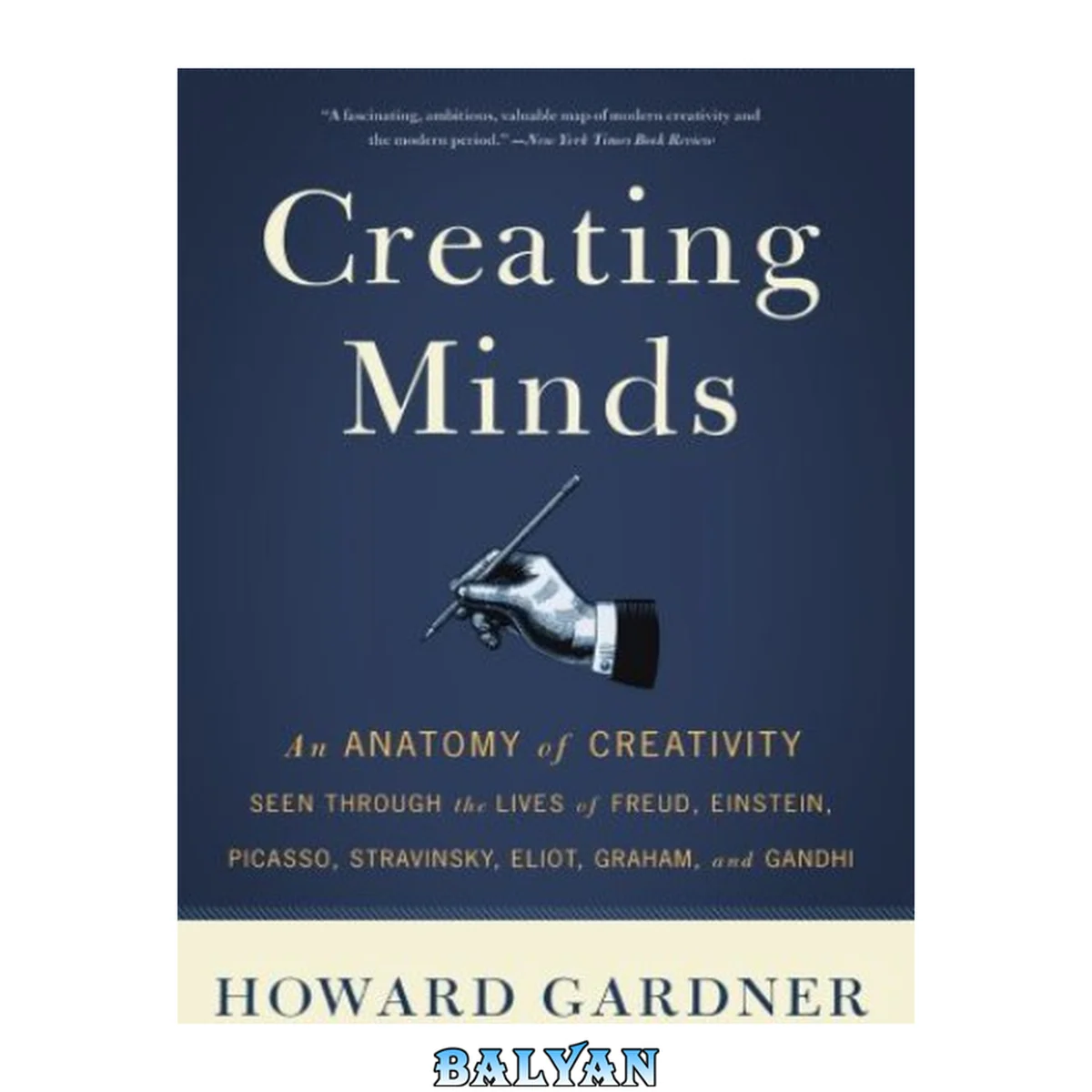
معرفی کتاب «Creating minds : an anatomy of creativity as seen through the lives of Freud, Einstein, Picasso, Stravinsky, Eliot, Graham, and Gandhi» نوشتهٔ Fiona Cole و Gardner, Howard E، منتشرشده توسط نشر Basic Civitas Books در سال 2011. این کتاب در 8 صفحه، فرمت epub، زبان انگلیسی ارائه شده است.
Since it was first published in 1993, __Creating Minds__ has served as a peerless guide to the creative self. Now available as a paperback reissue with a new introduction by the author, the book uses portraits of seven extraordinary individuals to reveal the patterns that drive the creative process�and to demonstrate how circumstance also plays an indispensable role in creative success. From Publishers WeeklyIn this boldly ambitious study, Gardner ( Frames of Mind ) profiles seven creative giants. Creativity, he argues, is not an all-purpose trait but instead involves distinct intelligences, as exemplified by Picasso's visual-spatial skills or by Gandhi's nonviolent approach to human conflict or Martha Graham's search for a distinctly American form of bodily expression. Each of the seven creative geniuses whom Gardner incisively limns transcended interpretive frames or conventions that became entrenched during the 19th century; each forged a new "system of meaning"; and each, in Gardner's view, struck a "Faustian bargain," sacrificing a rounded personal life for the sake of an all-consuming mission. Gardner also finds a childlike component in each of their creative breakthroughs (e.g., Einstein's "thought experiment" of riding a light-beam). This highly stimulating synthesis illuminates the creation of the modern age. Photos. Copyright 1993 Reed Business Information, Inc. From Kirkus ReviewsIt takes chutzpah to come up with a scheme for analyzing creativity--especially in subjects already exhaustively examined. But for psychologist and MacArthur fellow Gardner (Harvard Graduate School of Education), it amounts to a natural progression from his earlier dissections of intelligence: Frames of Mind and Multiple Intelligences argued that, instead of a generalized intelligence, there are at least seven varieties (musical, logical-mathematical, visual, etc.). Here, Gardner chooses prototypes of each variety and provides capsule biographies and analyses along such themes as the child versus the adult creator, and the creator in relation to others and to the work. Gardner finds sufficient commonalities among his seven types of intelligence to provide a synthesis: an `exemplary creator'' (E.C.). This individual (whom Gardner calls`she'') is somewhat `marginal'' in the social milieu, born into a reasonably comfortable family away from the creative center (Picasso and Stravinsky moved to Paris, Freud to Vienna...). There may not be much family love and affection but there may be a devoted nurse or a role model. The child is strong-minded and exhibits ability but isn't necessarily a prodigy. She moves into a decade of mastery of the domain and accomplishes a critical breakthrough that may include the affirmation of a few chosen peers (Picasso and Braque; Stravinsky and Diaghilev). Second and third breakthroughs may develop in successive decades until old age takes its toll. The E.C. retains childlike characteristics, including self- centeredness, even exploitation of others (Stravinsky's litigiousness; Picasso's sadism). E.C.s may make Faustian bargains, often leading to disastrous domestic life and parenthood. One can come up with counterexamples, and argue that there might be Western/20th-century biases at work here. But one has to hand it to Gardner for offering some provocative post-Eriksonian thoughts on creativity that are a lot more stimulating than those that measure creativity according to the`100 uses of a safety pin'' school of thought. -- __Copyright �1993, Kirkus Associates, LP. All rights reserved.__ Since it was first published in 1993, Creating Minds has served as a peerless guide to the creative self. Now available as a paperback reissue with a new introduction by the author, the book uses portraits of seven extraordinary individuals to reveal the patterns that drive the creative process�and to demonstrate how circumstance also plays an indispensable role in creative success. From Publishers Weekly In this boldly ambitious study, Gardner ( Frames of Mind ) profiles seven creative giants. Creativity, he argues, is not an all-purpose trait but instead involves distinct intelligences, as exemplified by Picasso's visual-spatial skills or by Gandhi's nonviolent approach to human conflict or Martha Graham's search for a distinctly American form of bodily expression. Each of the seven creative geniuses whom Gardner incisively limns transcended interpretive frames or conventions that became entrenched during the 19th century; each forged a new "system of meaning"; and each, in Gardner's view, struck a "Faustian bargain," sacrificing a rounded personal life for the sake of an all-consuming mission. Gardner also finds a childlike component in each of their creative breakthroughs (e.g., Einstein's "thought experiment" of riding a light-beam). This highly stimulating synthesis illuminates the creation of the modern age. Photos. Copyright 1993 Reed Business Information, Inc. From Kirkus Reviews It takes chutzpah to come up with a scheme for analyzing creativity--especially in subjects already exhaustively examined. But for psychologist and MacArthur fellow Gardner (Harvard Graduate School of Education), it amounts to a natural progression from his earlier dissections of intelligence: Frames of Mind and Multiple Intelligences argued that, instead of a generalized intelligence, there are at least seven varieties (musical, logical-mathematical, visual, etc.). Here, Gardner chooses prototypes of each variety and provides capsule biographies and analyses along such themes as the child versus the adult creator, and the creator in relation to others and to the work. Gardner finds sufficient commonalities among his seven types of intelligence to provide a synthesis: an exemplary creator'' (E.C.). This individual (whom Gardner calls she'') is somewhat marginal'' in the social milieu, born into a reasonably comfortable family away from the creative center (Picasso and Stravinsky moved to Paris, Freud to Vienna...). There may not be much family love and affection but there may be a devoted nurse or a role model. The child is strong-minded and exhibits ability but isn't necessarily a prodigy. She moves into a decade of mastery of the domain and accomplishes a critical breakthrough that may include the affirmation of a few chosen peers (Picasso and Braque; Stravinsky and Diaghilev). Second and third breakthroughs may develop in successive decades until old age takes its toll. The E.C. retains childlike characteristics, including self- centeredness, even exploitation of others (Stravinsky's litigiousness; Picasso's sadism). E.C.s may make Faustian bargains, often leading to disastrous domestic life and parenthood. One can come up with counterexamples, and argue that there might be Western/20th-century biases at work here. But one has to hand it to Gardner for offering some provocative post-Eriksonian thoughts on creativity that are a lot more stimulating than those that measure creativity according to the 100 uses of a safety pin'' school of thought. -- Copyright �1993, Kirkus Associates, LP. All rights reserved. Howard Gardner changed the way we think about intelligence. In his classic work Frames of Mind, he undermined the common notion that intelligence is a single capacity that every human being possesses to a greater or lesser extent. Now building on the framework he developed for understanding intelligence, Gardner gives us a path breaking view of creativity, along with riveting portraits of seven figures who each reinvented an area of human endeavor. Using as a point of departure his concept of seven "intelligences," ranging from musical intelligence to the intelligence involved in understanding oneself, Gardner examines seven extraordinary individuals---Sigmund Freud, Albert Einstein, Pablo Picasso, Igor Stravinsky, T.S. Eliot, Martha Graham, and Mahatma Gandhi---each an outstanding exemplar of one kind of intelligence. Understanding the nature of their disparate creative breakthroughs not only sheds light on their achievements but also helps to elucidate the "modern era"--The times that formed these creators and which they in turn helped to define. While focusing on the moment of each creator's most significant breakthrough, Gardner discovers patterns crucial to our understanding of the creative process. Not surprisingly, Gardner believes that a single variety of creativity is a myth. But he supplies evidence that certain personality configurations and needs characterize creative individuals in our time, and that numerous commonalities color the ways in which ideas are conceived, articulated, and disseminated to the public. He notes, for example, that it almost invariably takes ten years to make the initial creative breakthrough and another ten years for subsequent breakthroughs. Creative people feature unusual combinations of intelligence and personality, and Gardner delineates the indispensable role of the circumstances in which an individual works and the crucial reactions of the surrounding group of informed peers. He finds that an essential element of the creative process is the support of caring individuals who believe in the revolutionary ideas of the creators. And he documents the fact that extraordinary creativity almost always carries with it extraordinary costs in human terms. --taken from Amazon.com "Howard Gardner changed the way we think about intelligence. In his classic work Frames of Mind, he undermined the common notion that intelligence is a single capacity that every human being possesses to a greater or lesser extent. Now building on the framework he developed for understanding intelligence, Gardner gives us a path breaking view of creativity, along with riveting portraits of seven figures who each reinvented an area of human endeavor." "Using as a point of departure his concept of seven "intelligences," ranging from musical intelligence to the intelligence involved in understanding oneself, Gardner examines seven extraordinary individuals - Sigmund Freud, Albert Einstein, Pablo Picasso, Igor Stravinsky, T.S. Eliot, Martha Graham, and Mahatma Gandhi - each an outstanding exemplar of one kind of intelligence. Understanding the nature of their disparate creative breakthroughs not only sheds light on their achievements but also helps to elucidate the "modern era"--The times that formed these creators and which they in turn helped to define." "While focusing on the moment of each creator's most significant breakthrough, Gardner discovers patterns crucial to our understanding of the creative process. Not surprisingly, Gardner believes that a single variety of creativity is a myth. But he supplies evidence that certain personality configurations and needs characterize creative individuals in our time, and that numerous commonalities color the ways in which ideas are conceived, articulated, and disseminated to the public. He notes, for example, that it almost invariably takes ten years to make the initial creative breakthrough and another ten years for subsequent breakthroughs." This peerless classic guide to the creative self uses portraits of seven extraordinary individuals to reveal the patterns that drive the creative process -- to demonstrate how circumstance also plays an indispensable role in creative success. Howard Gardner changed the way the world thinks about intelligence. In his classic work Frames of Mind, he undermined the common notion that intelligence is a single capacity that every human being possesses to a greater or lesser extent. With Creating Minds, Gardner gives us a path breaking view of creativity, along with riveting portraits of seven figures who each reinvented an area of human endeavor. Using as a point of departure his concept of seven "intelligences," ranging from musical intelligence to the intelligence involved in understanding oneself, Gardner examines seven extraordinary individuals -- Sigmund Freud, Albert Einstein, Pablo Picasso, Igor Stravinsky, T.S. Eliot, Martha Graham, and Mahatma Gandhi -- each an outstanding exemplar of one kind of intelligence. Understanding the nature of their disparate creative breakthroughs not only sheds light on their achievements but also helps to elucidate the "modern era" -- the times that formed these creators and which they in turn helped to define. While focusing on the moment of each creator's most significant breakthrough, Gardner discovers patterns crucial to our understanding of the creative process. Creative people feature unusual combinations of intelligence and personality, and Gardner delineates the indispensable role of the circumstances in which an individual's creativity can thrive -- and how extraordinary creativity almost always carries with it extraordinary human costs. "Creative people feature unusual combinations of intelligence and personality, and Gardner delineates the indispensable role of the circumstances in which an individual works and the crucial reactions of the surrounding group of informed peers. He finds that an essential element of the creative process is the support of caring individuals who believe in the revolutionary ideas of the creators. And he documents the fact that extraordinary creativity almost always carries with it extraordinary costs in human terms."--Jacket
دانلود کتاب Creating minds : an anatomy of creativity as seen through the lives of Freud, Einstein, Picasso, Stravinsky, Eliot, Graham, and Gandhi