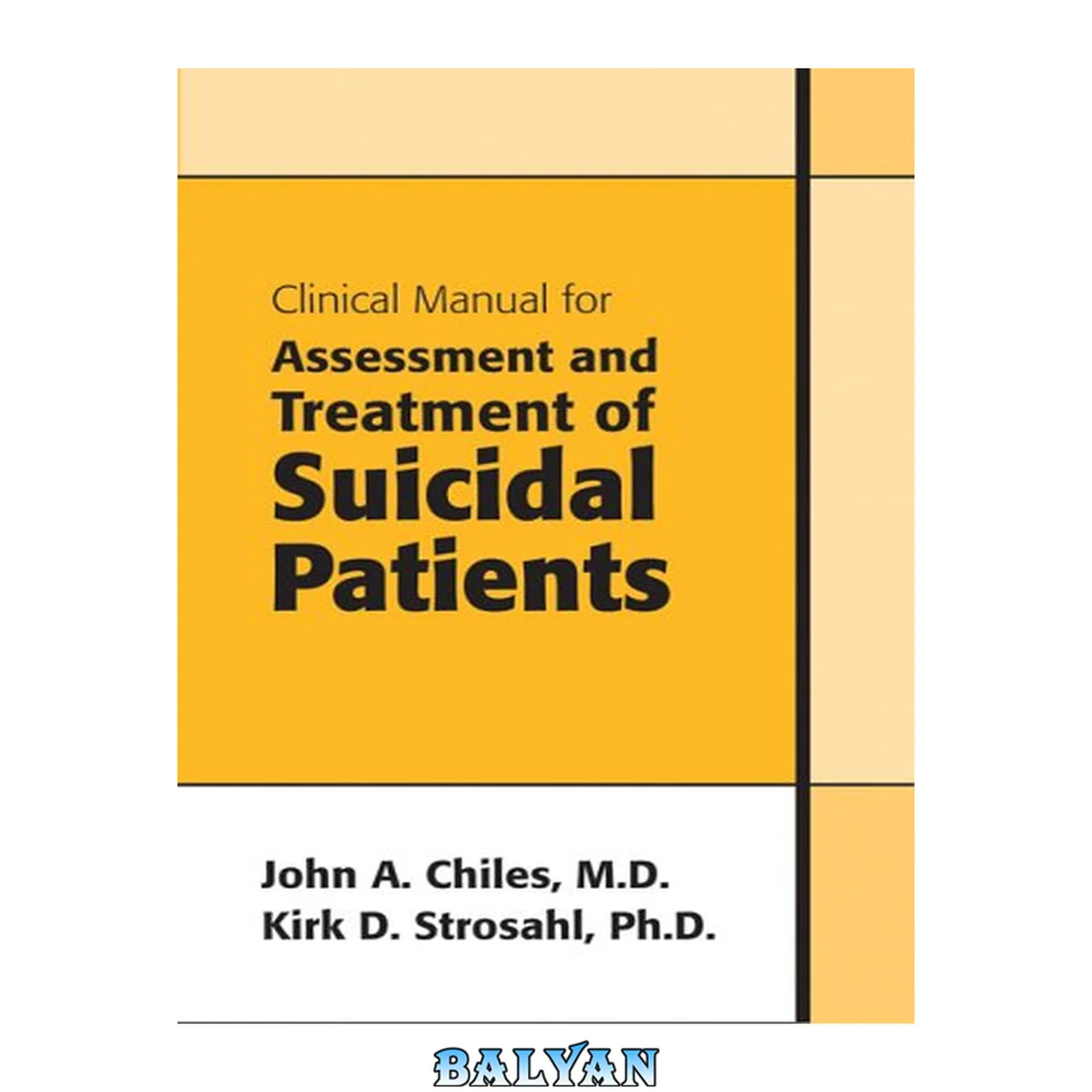
معرفی کتاب «راهنمای بالینی برای ارزیابی و درمان بیماران خودکشی» (با عنوان لاتین Clinical Manual for Assessment and Treatment of Suicidal Patients) نوشتهٔ John A., M.D. Chiles, Kirk D. Strosahl، منتشرشده توسط نشر American Psychiatric Publishing در سال 2004. این کتاب در فرمت pdf، زبان انگلیسی ارائه شده است.
The cornerstone of any intervention approach with suicidal patients is the recognition and treatment of psychiatric disorders. For many patients, however, treating the mental illness is not enoughAthat is, suicidal behavior is not necessarily reduced by treatments that target those illnesses. Something more is needed. In this provocative and insightful work, Drs. Chiles and Strosahl offer a concrete, practical framework to fill this gap. In doing so, they challenge one of the chief underlying assumptions of traditional approaches to suicide assessment and treatmentAthat suicidal behavior can be predicted and controlled. In its place, they propose a new conceptualization of suicidalityAas learned, reinforced problem-solving behaviors that an individual uses when all other options seem to have failed. Rather than focusing on risk prediction and management, interventions in this learning model target the problems that the suicidal behavior is being used to solve. The assumption is that a patient's suicidal behavior represents his or her best attempt at that moment in time to deal with life's difficulties. The clinician's initial task is therefore not to judge or criticize but rather to acknowledge the struggle and pain the patient is experiencing and to help the patient begin to explore other ways of dealing with the overwhelming troubles. Efforts to reduce suicidal risk are accomplished by techniques that maximize individual autonomy and encourage positive behaviorsAthe person's unique resources for addressing and modifying the suicidal behavior. Designed to be used both for personal instruction and as a training manual, this comprehensive guide -Presents an evidence-based model for understanding and treating suicidal behavior in all its forms. -Features self-evaluation exercises to help clinicians develop an enhanced awareness of their own emotional reactions, moral/religious responses, and personal values about suicidality. -Provides interactive checklists and patient assessment tools designed for easy use by the typical clinician in daily practice. -Includes case vignettes and narratives highlighting key assessment and intervention principles. In Clinical Manual for the Assessment and Treatment of Suicidal Patients, the authorsAa psychiatrist and clinical psychologistAhave combined their diverse training and disciplinary backgrounds to create a workable approach to dealing with suicidal patients. Much more than merely an academic text on suicide, this thought-provoking handbook provides detailed guidance and a true sense of what to do to help suicidal patients. Practitioners in all domains of health careAclinicians, residents, therapists, and graduate students in psychiatry, psychology, social work, and nursingAwill benefit from this valuable and accessible work. Front Matter ......Page 0 Cover ......Page 1 Title Page ......Page 4 Copyright Information ......Page 5 Contents......Page 6 Contributor......Page 20 Preface......Page 22 1 Introduction: The Dimensions of Suicidal Behavior......Page 24 Can Suicide Be Predicted?......Page 29 The Role of Psychiatric Diagnosis......Page 30 Demographic Factors......Page 32 Personality and Environmental Characteristics......Page 33 The Role of Biochemistry......Page 35 Helpful Hints......Page 36 Selected Readings......Page 37 2 The Clinician’s Emotions, Values, Legal Exposure, and Ethics: Global Issues in the Treatment of Suicidal Patients......Page 40 Emotions and “Hot Buttons” Exercise......Page 41 Evaluation of Responses......Page 43 Morals- and Values-Based Stances on Suicide......Page 46 Consequences of Suicidal Behavior Questionnaire......Page 49 Reasons for Living Inventory......Page 51 Legal and Risk Management Issues......Page 52 From Adverse Event to the Courtroom......Page 53 Malpractice Claims......Page 55 The Process of Discovery......Page 57 The Civil Trial......Page 58 Characteristic Claims in Wrongful Death Suits......Page 59 The Search for the Elusive Standard of Care......Page 62 What Is the Standard of Care for the Treatment of Suicidal Patients?......Page 63 Conduct a Competent Clinical Assessment and Document the Plan......Page 64 Reassess Suicidal Behavior Over Time......Page 66 Do Not Be Fooled by Suicide Prevention Measures......Page 67 Reduce Policy- and Procedure-Driven Services......Page 68 Never Alter the Clinical Record After the Fact......Page 69 Never Second-Guess a Decision......Page 70 Ethical Issues in the Treatment of Suicidal Patients......Page 71 Ethical Guidelines for the Treatment of Suicidal Patients......Page 72 Helpful Hints......Page 75 Selected Readings......Page 76 3 A Basic Model of Suicidal Behavior......Page 78 The Role of Problems......Page 79 The Role of Emotional Control and Avoidance......Page 81 The Role of Learning and Reinforcement......Page 82 The Role of Short-Term Versus Long-Term Consequences......Page 83 Instrumental Versus Expressive Functions......Page 84 The Basic Formula for Suicidal Crisis: The Three Is......Page 86 The Patient’s Relationship to Suffering......Page 88 Helpful Hints......Page 89 Selected Readings......Page 90 4 Assessment of Suicidal Behavior and Predisposing Factors: Blending Your Assessment With Treatment......Page 92 Prediction of Suicidal Behavior: Clinical Lore Versus Clinical Research......Page 93 Risk Prediction Systems......Page 94 Assessing Suicidal Behavior......Page 96 Prevention-Focused Assessment......Page 101 Treatment-Focused Assessment......Page 102 Using Self-Monitoring to Study Suicidal Behavior......Page 105 Prescribing Self-Monitoring Tasks......Page 106 Collaboration in Data Collection......Page 107 Using Self-Report Inventories......Page 108 Assessing Predisposing Factors......Page 109 Thinking Style......Page 110 Social Behavior......Page 111 Behavior Change Skills......Page 112 Life Stress......Page 113 Predisposing Factors Assessment Tool......Page 114 Helpful Hints......Page 115 References......Page 116 Selected Readings......Page 117 5 Outpatient Interventions With Suicidal Patients......Page 118 An Overview of Treatment Philosophies......Page 119 Reconciling Opposites: A Key to Managing Suicidal Behavior......Page 121 The Main Objectives......Page 123 Validation of Emotional Pain......Page 125 The Problem-Solving Framework......Page 126 Ending the Initial Session......Page 128 The Early Phase of Treatment......Page 129 Assaulting the Stigma......Page 131 Self-Monitoring......Page 132 Trigger Situations......Page 133 The Personal Scientist......Page 135 Three Clinical Pitfalls of the Early Phase of Treatment......Page 136 Session Logistics and Course of Treatment......Page 137 The Intermediate Phase of Treatment: Developing Acceptance of Feelings and a Commitment to Act......Page 138 Recontextualization......Page 139 Comprehensive Distancing......Page 141 Personal Problem-Solving Skills......Page 142 Interpersonal Effectiveness......Page 143 Three Clinical Pitfalls of the Intermediate Phase of Treatment......Page 144 Session Scheduling and Course of Treatment......Page 145 The Termination Phase of Treatment: Building the Future......Page 146 Shaping a Positive Future......Page 147 Putting a New Frame on Terminating Treatment......Page 148 Clinical Pitfalls of the Termination Phase of Treatment......Page 151 Helpful Hints......Page 152 Selected Readings......Page 153 6 The Repetitiously Suicidal Patient: Evaluation, Psychotherapy, and Basic Case Management......Page 154 Suicide, Attempted Suicide, and Parasuicide......Page 156 Pervasiveness of Maladaptive Behavior......Page 158 Persistence of Dysfunctional Behavior......Page 160 Resistance to Change......Page 161 Behavior That Is Self-Defeating......Page 163 See the World Your Repetitiously Suicidal Patient Sees......Page 164 A Basic Treatment Approach......Page 165 Phase One: Create a Humanizing Clinical Foothold......Page 166 Phase Two: Attack the Rationale for, and the Workability of, Suicidal Behavior......Page 168 Phase Three: Substitute Acceptance and Willingness for Emotional Control......Page 170 Phase Four: Develop Expanding Patterns of Committed Action......Page 171 Three Therapy Process Issues With the Repetitiously Suicidal Patient......Page 172 Allow Your Patient “to Be”......Page 174 Steal the Point of Resistance......Page 175 Make Suicidal Impulses an It......Page 176 Suicidal Feelings Are Your Friends......Page 177 Dealing With Downers......Page 178 The Moment of Truth: The First Crisis in Treatment......Page 181 Resistance: An Overused Interpretation......Page 183 Sample Dialogue: Accepting and Working With Suicidal Communication......Page 184 Providing Crisis and Social Support......Page 186 The Therapeutic Management of Chronic Crisis......Page 187 Case Management in the Community......Page 189 Someone Has to Be in Charge......Page 191 To Hospitalize or Not to Hospitalize?......Page 192 Helpful Hints......Page 194 References......Page 195 Selected Readings......Page 196 7 Managing Suicidal Emergencies: More on Crisis and Case Management......Page 198 We Are All Case Managers......Page 199 Working Through Suicidal Crises: Five Principles......Page 200 Working Through Escalating Suicidal Behavior: Strategies......Page 201 The Positive Behavior Action Plan......Page 203 The No-Suicide Pact: Who Is the Beneficiary?......Page 205 The Emotional Tone of the Intervention......Page 206 Suicidal Behavior Protocols......Page 207 Scheduling Additional Sessions......Page 208 Receiving Telephone Calls......Page 209 Making Random Support Calls......Page 210 Identification of Resources......Page 211 Growing Through Suicidal Behavior......Page 212 To Hospitalize or Not to Hospitalize: That Is the Question......Page 214 Emphasizing Responsibility and Self-Control......Page 215 Case Management: Crisis Intervention at the System Level......Page 216 The Concept of Funneling: Someone Has to Be in Charge......Page 217 Qualities of the Effective Case Manager......Page 218 During Crisis......Page 221 Selected Readings......Page 222 8 Hospitals and Suicidal Behavior: A Complex Relationship......Page 224 Does Hospitalization Prevent Suicide?......Page 226 Latrogenesis: The Unintended Side Effects......Page 227 Will I Get Sued if I Do Not Hospitalize?......Page 229 When Hospitalization Goes Sour......Page 230 When Should You Hospitalize a Patient?......Page 232 Short-Term Sanctuary......Page 233 Reshaping Suicidal Behavior: Planned Hospitalization......Page 234 Targets for a Short-Term Hospital Stay......Page 235 The Trouble With Discharge......Page 238 Component 1: An Emergency Center......Page 239 Component 3: A Brief-Stay Inpatient Service......Page 241 Component 5: A Crisis Stabilization Outpatient Program......Page 242 Keep All the Doors Open......Page 243 Selected Readings......Page 244 9 Working With Special Populations: Substance-Abusing, Psychotic, Young, and Elderly Patients......Page 246 Medications and the Suicidal Patient: They Don’t Work if You Don’t Take Them, and They Don’t Work if You Take Them All at Once......Page 247 Antianxiety Agents......Page 248 Antidepressant Medications......Page 250 Antipsychotic Medications......Page 252 Polymedication Regimens......Page 254 Case Management in Microcosm: The Prescribing Physician–Therapist–Patient Triangle......Page 257 Substance Abuse and Suicide: The Patient Who Is Left Out in the Cold......Page 259 The Substance-Abusing Suicidal Patient......Page 260 Alcohol on Breath: AOB in the Clinic......Page 263 The Inpatient Substance Abuse Unit......Page 264 The Special Case of Schizophrenia......Page 266 The Young: Working With Suicidal Children and Adolescents......Page 268 An Adolescent Suicidal Behavior Scenario......Page 269 Family Evaluation Is a Must: Therapy May Be a Bust......Page 270 The Forgotten Many: Suicidal Behavior in the Elderly......Page 272 Helpful Hints......Page 275 Selected Readings......Page 276 10 Suicidal Patients in General Health Care......Page 278 Develop Quick, Effective Screens for Suicidality......Page 281 Four Indicators to Look For......Page 282 The Role of Diagnostic Screening......Page 283 After Detection, Assign an Urgency Level......Page 285 Target 1: Validate Emotional Pain......Page 286 Target 2: Discuss Ambivalence and Provide Encouragement to Come Down on the Side of Life......Page 287 Target 3: Create a Positive Action Plan......Page 288 Target 4: Develop a Crisis Management Plan......Page 289 Target 6: Arrange Telephone Follow-Up......Page 290 Target 7: Initiate Appropriate Medication Treatment......Page 291 Helpful Hints......Page 293 Selected Readings......Page 294 11 Understanding and Providing Care to the Survivors of Suicide......Page 296 Clinical Characteristics of Survivors of Suicide......Page 299 A Three-Stage Model for Intervening With Survivors of Suicide......Page 308 Stage 1: Awareness of a Story and Acceptance of the Impact of the Story......Page 312 Stage 2: Reforming the Story and Creating More Behavioral Flexibility......Page 314 Stage 3: Applying the New Story to the World......Page 316 Group Treatment of Survivors of Suicide......Page 318 Treating Survivors of Suicide in Primary Care Settings......Page 319 References......Page 323 Selected Readings......Page 325 III. Suicide Is Not a Moral or Ethical Issue......Page 328 V. Suicide Has Intrinsic Positive Value......Page 329 Appendix B: Consequences of Suicidal Behavior Questionnaire......Page 330 Survival and Coping Beliefs......Page 334 Fear of Social Disapproval......Page 335 Moral Objections......Page 336 Appendix D: Suicidal Thinking and Behaviors Questionnaire......Page 338 Appendix E: Malpractice Management Assessment......Page 340 A......Page 342 C......Page 343 D......Page 345 E......Page 346 H......Page 347 M......Page 349 P......Page 350 R......Page 352 S......Page 353 W......Page 356
The cornerstone of any intervention approach with suicidal patients is the recognition and treatment of psychiatric disorders. For many patients, however, treating the mental illness is not enough—that is, suicidal behavior is not necessarily reduced by treatments that target those illnesses. Something more is needed.
In this provocative and insightful work, Drs. Chiles and Strosahl offer a concrete, practical framework to fill this gap. In doing so, they challenge one of the chief underlying assumptions of traditional approaches to suicide assessment and treatment—that suicidal behavior can be predicted and controlled. In its place, they propose a new conceptualization of suicidality—as learned, reinforced problem-solving behaviors that an individual uses when all other options seem to have failed. Rather than focusing on risk prediction and management, interventions in this learning model target the problems that the suicidal behavior is being used to solve. The assumption is that a patient's suicidal behavior represents his or her best attempt at that moment in time to deal with life's difficulties. The clinician's initial task is therefore not to judge or criticize but rather to acknowledge the struggle and pain the patient is experiencing and to help the patient begin to explore other ways of dealing with the overwhelming troubles. Efforts to reduce suicidal risk are accomplished by techniques that maximize individual autonomy and encourage positive behaviors—the person's unique resources for addressing and modifying the suicidal behavior.
Designed to be used both for personal instruction and as a training manual, this comprehensive guide
• Presents an evidence-based model for understanding and treating suicidal behavior in all its forms.• Features self-evaluation exercises to help clinicians develop an enhanced awareness of their own emotional reactions, moral/religious responses, and personal values about suicidality.
• Provides interactive checklists and patient assessment tools designed for easy use by the typical clinician in daily practice.
• Includes case vignettes and narratives highlighting key assessment and intervention principles.
In Clinical Manual for the Assessment and Treatment of Suicidal Patients, the authors—a psychiatrist and clinical psychologist—have combined their diverse training and disciplinary backgrounds to create a workable approach to dealing with suicidal patients. Much more than merely an academic text on suicide, this thought-provoking handbook provides detailed guidance and a true sense of what to do to help suicidal patients. Practitioners in all domains of health care—clinicians, residents, therapists, and graduate students in psychiatry, psychology, social work, and nursing—will benefit from this valuable and accessible work.
Doody Review Services
Reviewer:Regina Rosa Lopez, MD(University of Illinois at Chicago College of Medicine)
Description:This is a comprehensive, clinically-applicable guide to dealing with suicidal behavior. This book's unique approach to suicidal behavior as problem-solving behavior makes the clinician feel less helpless facing this difficult issue.
Purpose:According to the authors, the purpose of this book is to serve as a guide to the individual assessment and treatment of suicidal patients and as a training manual. These objectives are worthy for such a complex subject. The book has done a superb job meeting the author's objectives.
Audience:I agree with the authors that this book is for practitioners in all domains of health care, particularly psychiatry, psychology, and social work. The authors, a psychiatrist and clinical psychologist, have joined their diverse training and backgrounds in writing this book. They have had previous publications on suicidal behavior, and therefore seem to be credible authorities.
Features:The book provides a better understanding of suicidal behavior, both the act itself and the individual. Also, the assessment and treatment of the different forms of suicidal behavior in the various clinical settings are covered in depth. The book also helps clinicians to examine and deal with their emotions and attitudes towards suicidal behavior. Finally, legal issues regarding suicide are covered. The best feature of this book is the organization. The Helpful Hints provide the most relevant information from each chapter in a succinct manner. The appendixes are unique tools for teaching various aspects of the management of suicidal behavior.
Assessment:This is a well written, comprehensive, clinically-applicable book on suicidal behavior. I know I will find this book useful in my own practice.
The cornerstone of any intervention approach with suicidal patients is the recognition and treatment of psychiatric disorders. For many patients, however, treating the mental illness is not enough -- that is, suicidal behavior is not necessarily reduced by treatments that target those illnesses. Something more is needed. In this provocative and insightful work, Drs. Chiles and Strosahl offer a concrete, practical framework to fill this gap. In doing so, they challenge one of the chief underlying assumptions of traditional approaches to suicide assessment and treatment -- that suicidal behavior can be predicted and controlled. In its place, they propose a new conceptualization of suicidality -- as learned, reinforced problem-solving behaviors that an individual uses when all other options seem to have failed. Rather than focusing on risk prediction and management, interventions in this learning model target the problems that the suicidal behavior is being used to solve. The assumption is that a patient's suicidal behavior represents his or her best attempt at that moment in time to deal with life's difficulties. The clinician's initial task is therefore not to judge or criticize but rather to acknowledge the struggle and pain the patient is experiencing and to help the patient begin to explore other ways of dealing with the overwhelming troubles. Efforts to reduce suicidal risk are accomplished by techniques that maximize individual autonomy and encourage positive behaviors -- the person's unique resources for addressing and modifying the suicidal behavior. Designed to be used both for personal instruction and as a training manual, this comprehensive guide - Presents an evidence-based model for understanding and treating suicidal behavior in all its forms. - Features self-evaluation exercises to help clinicians develop an enhanced awareness of their own emotional reactions, moral/religious responses, and personal values about suicidality. - Provides interactive checklists and patient assessment tools designed for easy use by the typical clinician in daily practice. - Includes case vignettes and narratives highlighting key assessment and intervention principles. In Clinical Manual for the Assessment and Treatment of Suicidal Patients, the authors -- a psychiatrist and clinical psychologist -- have combined their diverse training and disciplinary backgrounds to create a workable approach to dealing with suicidal patients. Much more than merely an academic text on suicide, this thought-provoking handbook provides detailed guidance and a true sense of what to do to help suicidal patients. Practitioners in all domains of health care -- clinicians, residents, therapists, and graduate students in psychiatry, psychology, social work, and nursing -- will benefit from this valuable and accessible work. "In Clinical Manual for Assessment and Treatment of Suicidal Patients, the authors - a psychiatrist and clinical psychologist - have combined their diverse training and disciplinary backgrounds to create a workable approach to dealing with suicidal patients. This handbook provides detailed guidance and a true sense of what to do to help suicidal patients. Practitioners in all domains of health care - clinicians, residents, therapists, and graduate students in psychiatry, psychology, social work, and nursing - will benefit from this valuable and accessible work."--BOOK JACKET.