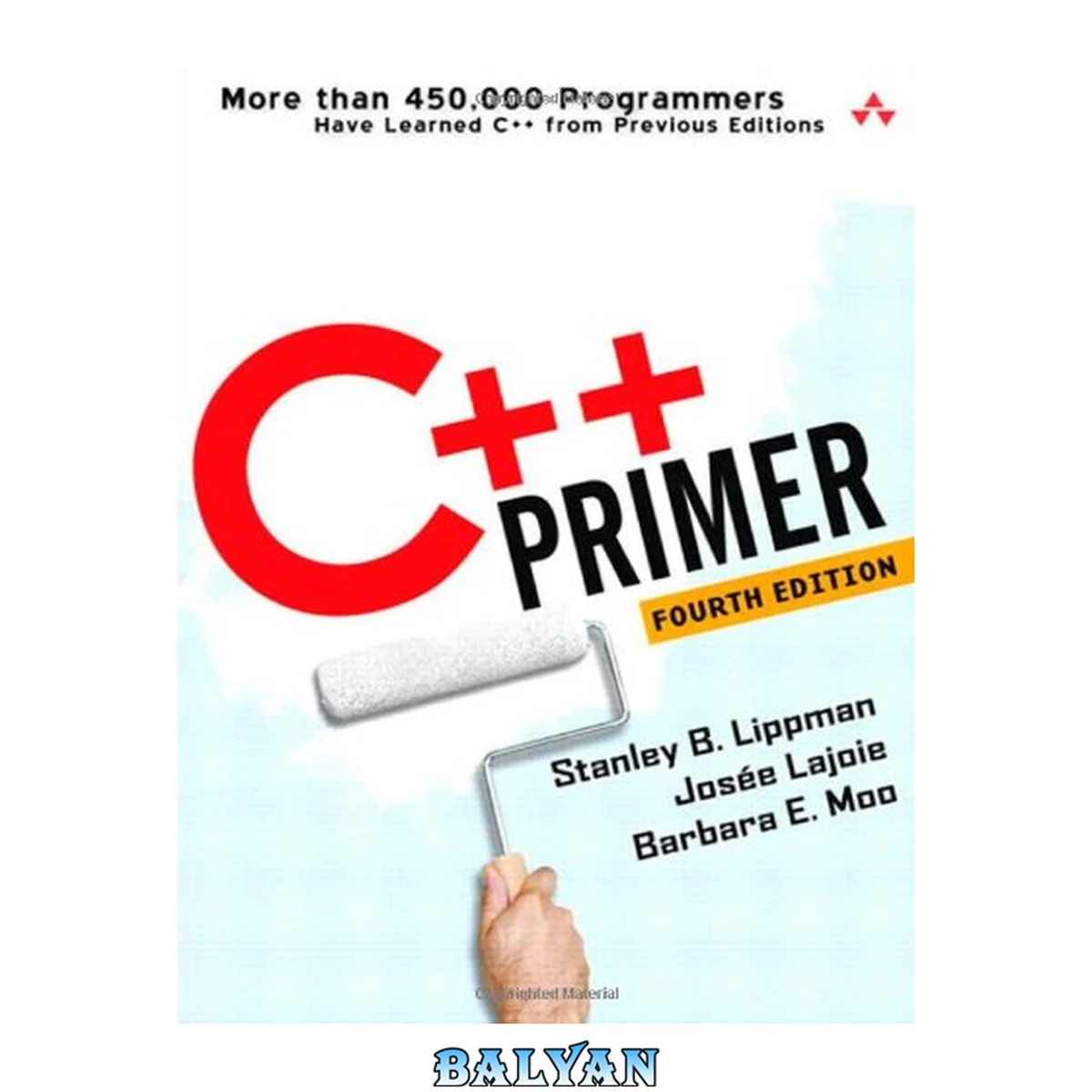
معرفی کتاب «C++ Primer (4th Edition)» نوشتهٔ Stanley B. Lippman, Josée Lajoie, Barbara E. Moo، منتشرشده توسط نشر Addison-Wesley Professional در سال 2005. این کتاب در 800 صفحه، فرمت pdf، زبان انگلیسی ارائه شده است.
As pointed out in other reviews: compared to previous editions, the 4th edition of the "C++ Primer" is considerably different (and shorter). For this edition, Barbara E. Moo (co-author of "Accelerated C++"), a long-time programmer and writer, vastly revamped and enhanced Stan Lippman's (and Josee Lajoie's) classic.The Good: This book is over 800 pages long, and it is quite complete in its coverage, but it is highly readable. The "C++ Primer" can be used as an introductory text: the authors have interspersed a myriad of code snippets throughout the text (which they also integrated into complete working programs; these are provided on the publisher's website, packaged for different platforms). Similarly, there are exercises at the end of most sections; these are well thought out, and greatly facilitate the reader's learning (unauthorized solutions exist on the web in the form of a wiki). Furthermore, throughout the book parts of the text have been highlighted to call attention to common pitfalls, good programming practices, and important concepts. Finally, each chapter concludes with a summary and a glossary of defined terms. In contradistinction to many other popular volumes, this book teaches real C++, not "C with classes", i.e., it contains extensive treatments of the standard library containers and algorithms, of object-oriented programming, and of generic programming. For example, the coverage of the standard library in this book is much more extensive than in "C++ Primer Plus" by Stephen Prata, a book that is often compared with (or confused with) the "C++ Primer". Even so, the "C++ Primer" also covers a number of older topics such as C-style character strings, lower-level bit manipulation of integral values, and old-style casts. The material in this book is thematically organized (pointers, expressions, functions, classes, constructors, object-oriented programming, template programming, etc.). This, along with the many forward and backward cross-references, makes it a great reference both for people who have never read it, and for those who read it a while back.The Bad: Object-oriented programming is covered in approximately 60 pages. The coverage is solid, just like in the rest of the book, but it is condensed. For the sake of comparison: Josuttis's book "Object-Oriented Programming in C++" devotes 170 pages on more or less the same topics. In other words, an object-oriented design background, while not strictly necessary, would make reading this book easier. This aspect of "condensedness" is a more general feature of reading the "C++ Primer": even though the book is quite long, there is no filler material. This slows the reader down, so it might interfere with one's progress when using this as a first C++ book. For example, the first 300 pages (perhaps mention but) do not discuss in detail the standard library algorithms, smart pointers, object-oriented or generic programming, and other aspects of professional C++ development. A related point: I mentioned above that the book works as a reference since it is complete and contains many cross-references. A side-effect of this is that some of the earlier chapters make repeated mention of topics that have not yet been covered; that's great if this is your second C++ book (since it means every chapter is complete), but is potentially too much information for a total newbie. Finally, this book was intentionally limited to Standard C++. As a result, it doesn't talk about TR1 (a specification for functionality being added to C++'s standard library) or boost (a collection of libraries offering TR1 implementations and much more), or threading in C++. A 5th edition of the "C++ Primer" will probably appear after the new standard (still known as C++0x) comes out.Despite the few drawbacks that I have noted above, I believe that this is a wonderful book which deserves 5 stars.----------------Here are my suggestions on related START Start TRANSACTION WITH CONSISTENT SNAPSHOT; /\* 671 = 2d6c9b6cb19df2e59ed1c0852fbc2ea3 "C++ Primer is well known as one of the best books for learning C++ and is useful for C++ programmers of all skill levels. This Fourth Edition not only keeps this tradition alive, it actually improves on it."
--
Steve Vinoski, Chief Engineer, Product Innovation, IONA Technologies "The Primer really brings this large and complex language down to size."
--Justin Shaw, Senior Member of Technical Staff, Electronic Programs Division, The Aerospace Corporation
"It not only gets novices up and running early, but gets them to do so using good programming practices."
--Nevin ":-)" Liber, Senior Principal Engineer (C++ developer since 1988)
This popular tutorial introduction to standard C++ has been completely updated, reorganized, and rewritten to help programmers learn the language faster and use it in a more modern, effective way.
Just as C++ has evolved since the last edition, so has the authors' approach to teaching it. They now introduce the C++ standard library from the beginning, giving readers the means to write useful programs without first having to master every language detail. Highlighting today's best practices, they show how to write programs that are safe, can be built quickly, and yet offer outstanding performance. Examples that take advantage of the library, and explain the features of C++, also show how to make the best use of the language. As in its previous editions, the book's authoritative discussion of fundamental C++ concepts and techniques makes it a valuable resource even for more experienced programmers.
Program Faster and More Effectively with This Rewritten Classic
- Restructured for quicker learning, using the C++ standard library
- Updated to teach the most current programming styles and program design techniques
- Filled with new learning aids that emphasize important points, warn about common pitfalls, suggest good programming practices, and provide general usage tips
- Complete with exercises that reinforce skills learned
- Authoritative and comprehensive in its coverage
The source code for the book's extended examples is available on the Web at www.awprofessional.com/cpp_primer.
This classic and definitive text on the C++ language has been extensively revised and expanded. In its third edition, it is based on the final draft specification of ANSI/ISO Standard. Be forewarned, this is a primer in name only; there is nothing simplistic in its presentation or in its breadth and scope. Knowledge of C is NOT assumed, but knowledge of object-oriented programming and a modern language will make this text more understandable. As the authors point out, "This book is intended as a first book on C++; it is not intended as a first book on programming!"
" C++ Primer is well known as one of the best books for learning C++ and is useful for C++ programmers of all skill levels. This Fourth Edition not only keeps this tradition alive, it actually improves on it." --Steve Vinoski, Chief Engineer, Product Innovation, IONA Technologies " The Primer really brings this large and complex language down to size." --Justin Shaw, Senior Member of Technical Staff, Electronic Programs Division, The Aerospace Corporation "It not only gets novices up and running early, but gets them to do so using good programming practices." --Nevin ":-)" Liber, Senior Principal Engineer (C++ developer since 1988) This popular tutorial introduction to standard C++ has been completely updated, reorganized, and rewritten to help programmers learn the language faster and use it in a more modern, effective way. Just as C++ has evolved since the last edition, so has the authors' approach to teaching it. They now introduce the C++ standard library from the beginning, giving readers the means to write useful programs without first having to master every language detail. Highlighting today's best practices, they show how to write programs that are safe, can be built quickly, and yet offer outstanding performance. Examples that take advantage of the library, and explain the features of C++, also show how to make the best use of the language. As in its previous editions, the book's authoritative discussion of fundamental C++ concepts and techniques makes it a valuable resource even for more experienced programmers. Program Faster and More Effectively with This Rewritten Classic The source code for the book's extended examples is available on the Web at the address below. (http://www.awprofessional.com/cpp_primer) www.awprofessional.com/cpp_primer Want to learn how to program in C++ immediately? Want to start writing better, more powerful C++ programs today? Accelerated C++'s uniquely modern approach will help you learn faster and more fluently than you ever believed possible. Based on the authors' intensive summer C++ courses at Stanford University, Accelerated C++ covers virtually every concept that most professional C++ programmers will ever use -- but it turns the "traditional" C++ curriculum upside down, starting with the high-level C++ data structures and algorithms that let you write robust programs immediately . Once you're getting results, Accelerated C++ takes you "under the hood," introducing complex language features such as memory management in context , and explaining exactly how and when to use them. From start to finish, the book concentrates on solving problems, rather than learning language and library features for their own sake. The result: You'll be writing real-world programs in no time -- and outstanding code faster than you ever imagined. "This popular tutorial introduction to standard C++ has been completely updated, reorganized, and rewritten to help programmers learn the language faster and use it in a more modern, effective way. Just as C++ has evolved since the last edition, so has the authors' approach to teaching it. They now introduce C++ standard library from the beginning, giving readers the means to write useful programs without first having to master every language detail. Highlighting today's best practices, they show how to write programs that are safe, can be built quickly, and yet offer outstanding performance. Examples that take advantage of the library, and explain the features of C++, also show how to make the best use of the language. As in its previous editions, the book's authoritative discussion of fundamental C++ concepts and techniques makes it a valuable resource even for more experienced programmers."--Jacket Whether You Are Eager To Get Started Writing Your First C++ Programs, Or You Are Already Using C++ And Seeking Deeper Understanding, The Authors' Unique Approach And Expertise Make Accelerated C++ An Indispensable Addition To Your Library.--jacket. Getting Started -- Working With Strings -- Looping And Counting -- Working With Batches Of Data -- Organizing Programs And Data -- Using Sequential Containers And Analyzing Strings -- Using Library Algorithms -- Using Associative Containers -- Writing Generic Functions -- Defining New Types -- Managing Memory And Low-level Data Structures -- Defining Abstract Data Types -- Making Class Objects Act Like Values -- Using Inheritance And Dynamic Binding -- Managing Memory (almost) Automatically -- Revisiting Character Pictures -- Where Do We Go From Here? Andrew Koenig, Barbara E. Moo. Includes Index. The third edition of the C++ Primer combines Stanley Lippman's practical experience with Josee Lajoie's inside knowledge of the ANSI/ISO Standard C++. This tutorial is rewritten to describe the features and programming usage of Standard C++. Especially useful for developers new to C++ are the many real-world programming examples that illustrate the design of generic and object-oriented programs, the use of templates, and other aspects of program design using Standard C++. In addition, the C++ Primer provides usage and efficiency guidelines where appropriate.