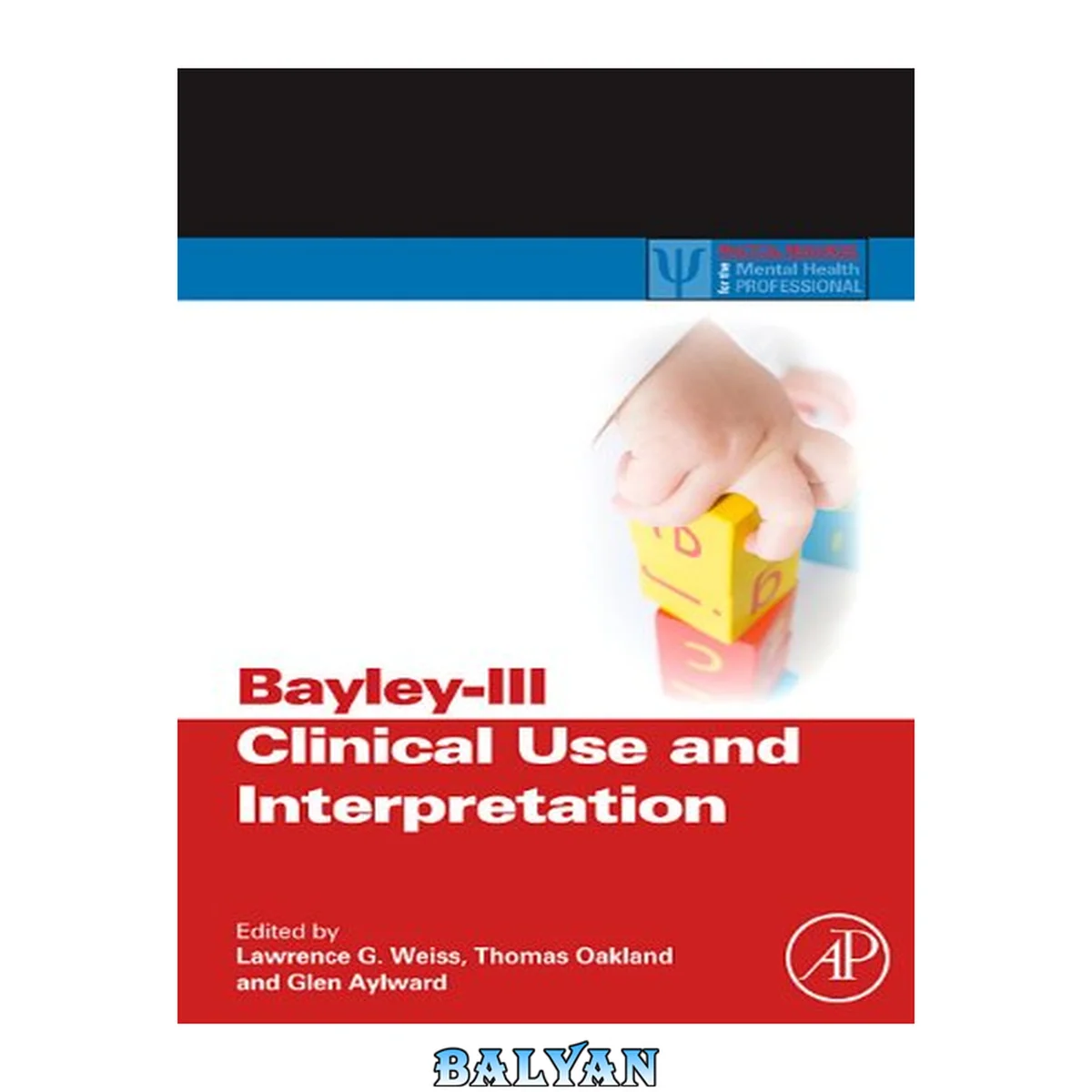
معرفی کتاب «Bayley-III Clinical Use and Interpretation (Practical Resources for the Mental Health Professional)» نوشتهٔ edited by Lawrence G. Weiss, Thomas Oakland, Glen P. Aylward، منتشرشده توسط نشر Academic Press در سال 2010. این کتاب در 20 صفحه، فرمت pdf، زبان انگلیسی ارائه شده است.
One of the most widely used assessments of infants and toddlers, the BAYLEY-III measures the major areas of development including cognitive, language, motor, social-emotional, and adaptive functioning. This book provides an introduction into use of the BAYLEY-III in each of these five areas. For each of these areas, individual chapters cover the relevant test content, administration, scoring, interpretation, strengths / concerns, and uses in clinical populations. Each chapter also includes a real life case study demonstrating typical performance of a child with delays one of the five areas of development. The book concludes with a special chapter on procedures for brief neurodevelopmental screening of infants in pediatric settings. Covering all major areas of development, the book is informative for a wide range of professionals who use the BAYLEY-III to evaluate development of infants and toddlers from multiple perspectives including psychology, speech and language, and occupational/physical therapy. * Provides an overview of the theoretical background and structure of BAYLEY-III written by the lead Research Director * Introduces practitioners to the test content in each of the five major areas of child development covered by the BAYLEY-III: cognitive, language, motor, social-emotional, and adaptive functioning * Readers will learn how to competently administer, score, and interpret each of the five scales in the BAYLEY-III * Explains the strengths and limitations of the test in each of the five areas it measures * Instructs readers on uses of the test in specific clinical populations * Includes five case studies showing typical patterns of children delayed in one of the five areas of development * Concludes with a special chapter on neurodevelopmental screening procedures in pediatric settings Bayley-III Clinical Use and Interpretation......Page 1 BAYLEY-III CLINICAL USE AND INTERPRETATION......Page 2 Copyright ......Page 3 Preface......Page 4 List of Contributors......Page 7 INTRODUCTION ......Page 8 RATIONALE FOR THE BAYLEY-III ......Page 9 The Normative Data......Page 10 Psychometric Quality......Page 11 Special Group Studies......Page 12 PERVASIVE DEVELOPMENTAL DISORDER......Page 13 SPECIFIC LANGUAGE IMPAIRMENT OR SUSPECTED IMPAIRMENT ......Page 14 ASPHYXIATION AT BIRTH ......Page 15 SMALL FOR GESTATIONAL AGE ......Page 16 PREMATURE OR LOW BIRTH WEIGHT ......Page 17 Growth Scores and Charts Provided to Monitor Growth......Page 18 Accommodations and Modifications Guidelines......Page 19 Administrative Features......Page 20 SCHOLARSHIP FOR THE BAYLEY SCALES ......Page 21 OVERVIEW OF TEST STRUCTURE ......Page 23 Assumes Typical Development......Page 24 A More Naturalistic Approach......Page 25 Cognitive Scale......Page 26 Motor Scale......Page 27 Adaptive Behavior Scale......Page 28 Limitations of Bayley-III and How Those are Addressed......Page 29 SUMMARY OF FEATURES ......Page 30 References......Page 31 INTRODUCTION ......Page 36 CONTENT ......Page 37 ADMINISTRATION ......Page 39 SCORING ......Page 41 INTERPRETATION ......Page 44 STRENGTHS AND CONCERNS ......Page 45 CASE STUDY: KATIE ......Page 47 References......Page 50 INTRODUCTION ......Page 53 CONTENT ......Page 55 Social-Emotional Skills......Page 57 Prelinguistic Communication Skills......Page 58 More Complex Language Levels......Page 60 ADMINISTRATION AND SCORING ......Page 61 INTERPRETATION ......Page 64 STRENGTHS AND CONCERNS ......Page 67 USE IN CLINICAL POPULATIONS ......Page 68 CASE STUDY: JACK ......Page 69 Background Information......Page 70 CDI-WG......Page 71 Bayley-III (Language Components)......Page 72 Bayley-III Results......Page 74 Case Conclusions......Page 75 SUMMARY ......Page 77 References......Page 78 Neuromaturation......Page 82 Influence of Body System Interaction of Motor Development......Page 83 Influence of Social and Physical Context of Motor Development......Page 85 Functional Outcomes Motivate Development......Page 86 Fine Motor Subtest......Page 87 Early Hand and Finger Movement......Page 88 Reach/Movement of Hands in Space......Page 89 Grasping Patterns......Page 91 Bimanual Coordination......Page 93 Functional Use of Objects and Tools/Prewriting Skills......Page 95 CONTROL OF FINGER MOVEMENTS, REFINED GRASP AND PLACEMENT, KINESTHETIC PERCEPTION ......Page 98 STACKING BLOCKS AND BLOCK DESIGN: COMBINING GRASP, RELEASE, AND CONTROLLED MOVEMENT OF ARM IN SPACE ......Page 103 Tool Use and Motor Planning......Page 104 Gross Motor Subtest......Page 108 Early Movement......Page 109 Postural Stability and Control......Page 110 Balance and Locomotion......Page 111 BI-PEDAL AND UNI-PEDAL BALANCE AND MOTOR SKILLS ......Page 114 Preparing the Testing Environment......Page 120 Item Sequence and Flow of Test Administration......Page 127 Influence of the Environment on the Child’s Performance ......Page 129 Interpreting Variability in Performance......Page 131 Interrelationship of Scales......Page 133 STRENGTHS AND CONCERNS ......Page 134 Children with Autism Spectrum Disorder......Page 135 Children with Cerebral Palsy......Page 137 Children with Visual Impairment......Page 139 Children with Intellectual Disability......Page 140 CASE STUDY: MATTHEW ......Page 141 Behavioral Observations......Page 142 Results of the Bayley Scales of Infant and ToddlerDevelopment......Page 143 Motor Observations......Page 144 Impressions......Page 145 Recommendations......Page 146 References......Page 147 INTRODUCTION ......Page 152 CONTENT ......Page 153 Administration......Page 157 Scoring......Page 159 Percentile Ranks, Composite Scores, and Confidence Intervals......Page 161 Intra-Individual Discrepancy Comparisons Using Scaled Scores......Page 162 Using the Social-Emotional Growth Chart......Page 165 Reliability......Page 167 Validity......Page 168 STRENGTHS AND CONCERNS ......Page 169 USE IN CLINICAL POPULATIONS ......Page 171 CASE STUDY: STEVEN ......Page 176 References......Page 179 INTRODUCTION ......Page 181 ADAPTIVE BEHAVIOR IN YOUNG CHILDREN ......Page 182 Attachment Theory......Page 183 Synactive Theory of Development......Page 184 Autonomic System......Page 185 State-organizational System......Page 186 Self-regulatory System......Page 187 THE ADAPTIVE BEHAVIOR SCALE ......Page 188 Purposes......Page 189 Content......Page 190 Scoring and Interpretation......Page 192 Test-retest Reliability......Page 193 Background Information......Page 194 DEVELOPMENTAL HISTORY ......Page 195 Clinical Observation of Behavior......Page 196 DEVELOPMENTAL ASSESSMENT ......Page 197 Summary and Case Discussion......Page 201 Reflections on Rochelle’s Assessment ......Page 202 References......Page 203 BACKGROUND......Page 205 Setting the Stage I: Infant and Early Childhood Neuropsychology......Page 206 Setting the Stage II: Screening......Page 208 BAYLEY INFANT NEURODEVELOPMENTAL SCREENER......Page 209 Final item sets......Page 213 Cut Scores......Page 214 Validity......Page 215 3- to 4-month Item Set......Page 216 5- to 6-month Item Set......Page 217 7- to 10-month Item Set......Page 218 11- to 15-month Item Set......Page 219 21- to 24-month Item Set......Page 220 STUDIES USING THE BINS......Page 221 Prediction......Page 222 CLINICAL CASES......Page 225 Case Study 1......Page 226 Case Study 2......Page 227 Appendix A: The Early Neuropsychologic Optimality Rating Scales (ENORS)......Page 228 Appendix B: Studies Using the Bayley Infant Neurodevelopmental Screener......Page 230 References......Page 235 Index......Page 238
One of the most widely used assessments of infants and toddlers, the BAYLEY-III measures the major areas of development including cognitive, language, motor, social-emotional, and adaptive functioning. This book provides an introduction into use of the BAYLEY-III in each of these five areas. For each of these areas, individual chapters cover the relevant test content, administration, scoring, interpretation, strengths / concerns, and uses in clinical populations. Each chapter also includes a real life case study demonstrating typical performance of a child with delays one of the five areas of development. The book concludes with a special chapter on procedures for brief neurodevelopmental screening of infants in pediatric settings. Covering all major areas of development, the book is informative for a wide range of professionals who use the BAYLEY-III to evaluate development of infants and toddlers from multiple perspectives including psychology, speech and language, and occupational/physical therapy.
- Provides an overview of the theoretical background and structure of BAYLEY-III written by the lead Research Director
- Introduces practitioners to the test content in each of the five major areas of child development covered by the BAYLEY-III: cognitive, language, motor, social-emotional, and adaptive functioning
- Readers will learn how to competently administer, score, and interpret each of the five scales in the BAYLEY-III
- Explains the strengths and limitations of the test in each of the five areas it measures
- Instructs readers on uses of the test in specific clinical populations
- Includes five case studies showing typical patterns of children delayed in one of the five areas of development
- Concludes with a special chapter on neurodevelopmental screening procedures in pediatric settings
Overview and Introduction to the Bayley-III; Becoming Proficient with Bayley-III Administration; Development of the Bayley-III; Cognitive Development; Language Deelopment; Motor Development; Social-Emotional Development; Adaptive Behavior Development; Use and Interpretation of the Bayley-III with Exceptional Children; Placing Scores in Context: Integrating Information from the Bayley-III; From Interpretation to Intervention; Next Steps.