ماده ۴۷ منشور اتحادیه اروپا و حمایت مؤثر قضایی، جلد اول: دیدگاه دیوان عدالت اروپا
Article 47 of the EU Charter and Effective Judicial Protection, Volume 1 : The Court of Justice's Perspective
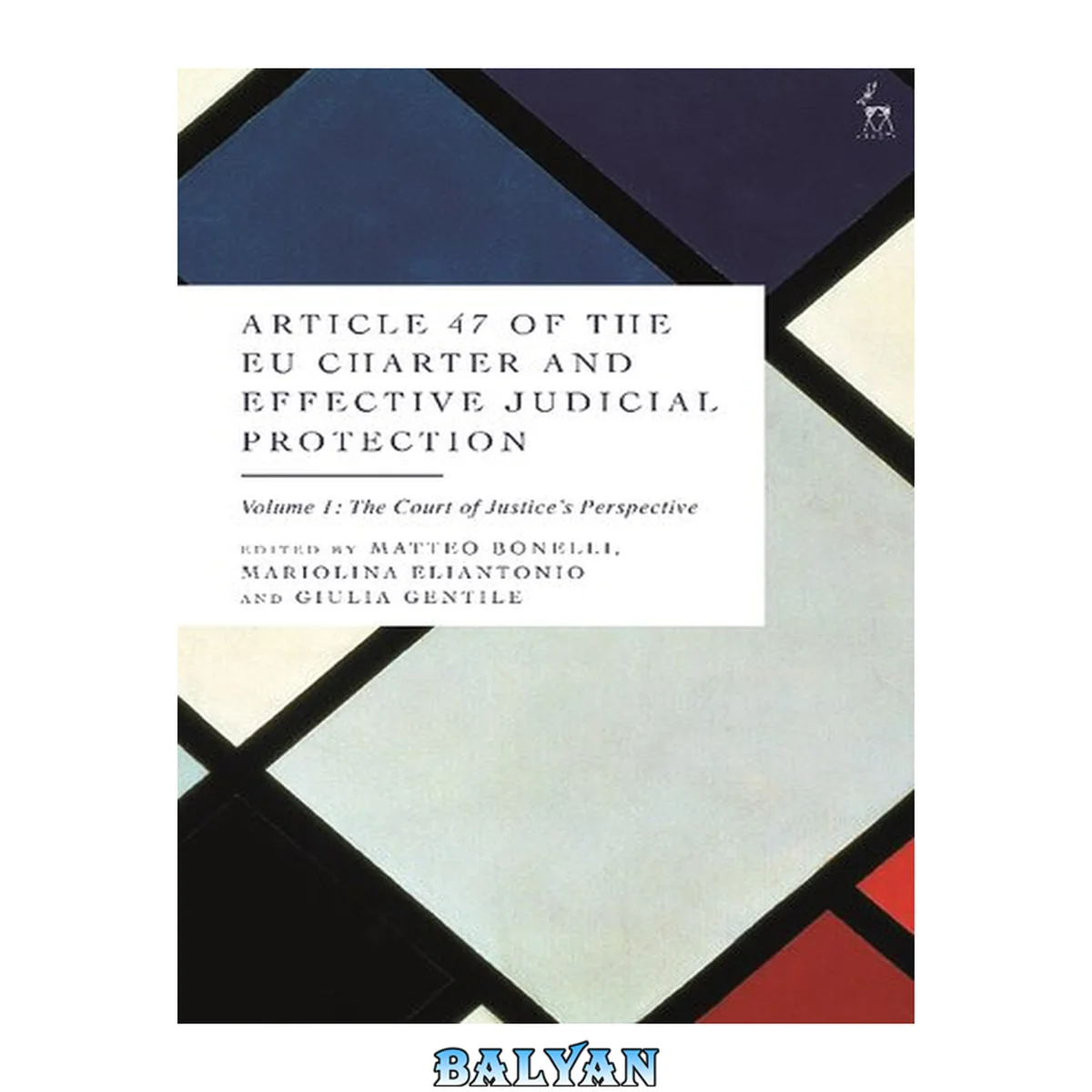
معرفی کتاب «ماده ۴۷ منشور اتحادیه اروپا و حمایت مؤثر قضایی، جلد اول: دیدگاه دیوان عدالت اروپا» (با عنوان لاتین Article 47 of the EU Charter and Effective Judicial Protection, Volume 1 : The Court of Justice's Perspective) نوشتهٔ Matteo Bonelli; Mariolina Eliantonio; Giulia Gentile (editors)، منتشرشده توسط نشر Beck/Hart Publishing در سال 2022. این کتاب در فرمت pdf، زبان انگلیسی ارائه شده است.
This ambitious, innovative project examines the principle of effective judicial protection in EU law over two volumes. The principle of effective judicial protection is a cornerstone of the EU’s judicial system and is re-affirmed in Article 47 of the Charter of Fundamental Rights of the European Union. Since the 1980s the Court of Justice has used the principle to shape EU and national procedural rules; more recently, the principle has acquired an even more central role in the EU constitutional structure. In this first volume, an expert team explores how the Court of Justice has interpreted the principle, as expressed in particular by Article 47 of the Charter, in selected policy areas, and reflects on the impact of the principle on the EU’s constitutional structure. Addressing key questions such as legal certainty, judicial independence and procedural autonomy, this volume significantly adds to our understanding of judicial protection within the multi-level EU judicial architecture. Contents List of Authors List of Tables and Figures List of Cases Introduction The Project The First Volume and its Structure PART 1: THE CONSTITUTIONAL DIMENSION OF ARTICLE 47 OF THE CHARTER 1. Article 19 TEU and National Courts: A New Role for the Principle of Effective Judicial Protection? I. Introduction II. From Van Gend & Loos to Article 19(1) TEU III. Article 19(1) TEU Brought to Life IV. The Content and Scope of Application of Effective Judicial Protection V. Another Perspective VI. Conclusion 2. Searching for the Pieces of the EU Justice Puzzle: Articles 47, 48, 49 and 50 of the EU Charter of Fundamental Rights I. Introduction II. The Justice Title of the Charter: A Systematic Reading III. Interdependent but Autonomous: Articles 47 and 48 of the EU Charter IV. Reciprocal Influences and Missed Opportunities: Article 47 and Article 49 Charter V. Shining in Their Own Lights: Articles 47 and 50 Charter VI. Finding (Some) Pieces of the EU Justice Jigsaw Puzzle VII. Conclusion 3. Effective Judicial Protection before National Courts: Article 47 of the Charter, National Constitutional Remedies and the Preliminary Reference Procedure I. Introduction II. The Preliminary Reference as an Individual Right III. Towards a More Rights-Based Approach? IV. Enhancing Judicial Protection Through Empowered National Courts V. Conclusions 4. The EU Right to an Independent Judge: How Much Consensus Across the EU? I. Introduction II. The Mandate of the Court of Justice III. Different Aspects of Judicial Independence IV. Conclusion 5. Article 47 of the Charter, Effective Judicial Protection and the (Procedural) Autonomy of the Member States I. Introduction II. Effective Judicial Protection, Article 47 and Procedural Autonomy III. Procedural Autonomy: The Interplay between Article 47 and EU Secondary Legislation IV. 'Remedial' Autonomy: The Empowering Function of Article 47 V. Institutional and Structural Autonomy: Judicial Independence VI. What Has Article 47 Changed? Concluding Thoughts 6. 'A Spectre is Haunting Kirchberg' - The Spectre of Article 47: The CJEU Case Law on the Finality of Judicial Decisions and on the Ex Officio Application of EU Law I. Introduction II. Re-Opening Final Judicial Decisions: Procedural Autonomy Limited by Equivalence and Effectiveness III. Raising Points of EU Law Ex Officio IV. Conclusions PART 2: ARTICLE 47 OF THE CHARTER IN SELECTED POLICY AREAS 7. The Role of Article 47 of the EU Charter of Fundamental Rights in the Field of Non-Discrimination: Onwards and Upwards I. Introduction II. Origins of the Relationship between Article 47 of the Charter and Non-Discrimination III. Article 47 of the Charter and the Main Directives in the Field of Non-Discrimination IV. Opportunities for Further Development of Article 47 of the Charter in the Field of Non-Discrimination V. Conclusion 8. No Turning Back? The Empowerment of National Asylum and Migration Courts under Article 47 of the Charter I. Introduction II. Ensuring the Jurisdiction of National Courts III. The Scope and Intensity of Judicial Review: Defining the Role of the National Courts IV. Conclusion 9. Article 47 of the Charter and the European Arrest Warrant: Chronicle of a Death Foretold? I. Introduction II. The Role of 'Judicial Authorities' and the Right to an Effective Remedy: Hesitancy and Deference in the Early Case Law of the Court III. The Development of an Autonomous Concept of 'Judicial Authority' and the Growing Limits to Procedural Autonomy: A Negative Obligation? IV. What Role for Public Prosecutors? Judicial Independence, Procedural Autonomy and the Disappearance of Article 47 V. The Approach of the Court to 'Judicial Independence' and the EAW: Inconsistencies and Double Standards VI. The Right to an Effective Judicial Remedy and the EAW: Article 47 and Habeas Corpus Proceedings VII. Conclusion 10. Article 47 of the Charter of Fundamental Rights in the Common Foreign and Security Policy: Does it Afford an Adequate Protection of the Right to Effective Judicial Protection to Private Parties? I. Introduction II. Article 47 of the Charter as an Instrument to Broadly Interpret the Competence of the Court of Justice with Respect to Acts Adopted in the Framework of the CFSP III. The Legal Standing to Challenge Restrictive Measures in the Light of Article 47 of the EUCFR: Are There Any Limits to Its Scope Ratione Personae? IV. An Overview of the Substance of Annulment Actions against Individual Restrictive Measures: An Enhanced Protection of Due Process Rights V. The Obligation of the Council to Verify that the Right to Effective Judicial Protection and the Right of Defence are Respected by Third Countries VI. Conclusions 11. Article 47 of the Charter and Effective Judicial Protection in Environmental Matters: The Need to Grant Civil Society the Right to Defend the Environment I. Introduction II. The CJEU and Access to Environmental Justice III. The Aarhus Convention and its Criticism of the EU Public Authorities IV. Possible Ways Ahead V. Conclusion 12. Article 47 of the EU Charter of Fundamental Rights in the Field of Public Procurement: Time to Take the Charter Seriously? I. Introduction II. The Codification of Procurement Remedies III. Gaps and Shortcomings in the Procurement Remedies Directives IV. Article 47 and Procurement Remedies V. Conclusions: Guidance is Badly Needed 13. Article 47 of the EU Charter of Fundamental Rights in EU Competition Enforcement: A Quantitative and Qualitative Assessment I. Introduction II. Article 47 EUCFR in Competition Judgments in Numbers III. The Manifestations of Article 47 EUCFR in Competition Judgments IV. A Multifaceted Principle in the Process of Crystallisation V. The Role of Article 47 EUCFR in Competition Enforcement VI. Conclusion 14. The Evolution of the Right to an Effective Remedy and to a Fair Trial in Direct and Indirect Taxation: Are We There Yet? I. Introduction II. The Right to Effective Judicial Protection and to an Effective Remedy in Tax Matters: Setting Up the Framework III. The Right to an Effective Remedy in the Context of Exchange of Information (Berlioz I and Berlioz II) IV. Luxembourg State v L V. The Right to an Effective Remedy and to a Fair Trial in Indirect Taxation (VAT) VI. Use of Evidence from Criminal Proceedings without the Knowledge of the Taxpayer VII. Conclusion 15. Conclusions I. Introduction II. The Constitutional Impact of Article 47 of the Charter in the EU Legal Landscape: Between Continuity and Rupture III. Article 47 of the Charter in the Policy Areas: A Kaleidoscope of Colours with Increasingly More Visible Shapes IV. The Pivotal Role of Article 47 to Further the Acquis Communautaire V. The Broad Range of Procedural Areas Affected by Article 47 VI. Conclusions Index "The principle of effective judicial protection ('PEJP') is specifically provided for in the EU Charter of Fundamental Rights Article 47. But how effective is the provision and the protection it affords? This ambitious, innovative project examines that question over two volumes. In the first volume an expert team explores how the Court of Justice of the European Union (CJEU) has interpreted the PEJP, as expressed in particular by Article 47, in selected policy areas, and reflects on the impact of the principle on the EU's constitutional structure. Taking both a horizontal interpretation, analysing the constitutional themes in play, and a vertical one, which looks at the Court's interpretation in specific policy areas, it shows the interplay of the protection within the wider architecture of the EU. Addressing key questions such as legal certainty, judicial autonomy and division of competences, it significantly adds to our understanding of judicial protection within the EU."-- Provided by publisher
دانلود کتاب ماده ۴۷ منشور اتحادیه اروپا و حمایت مؤثر قضایی، جلد اول: دیدگاه دیوان عدالت اروپا