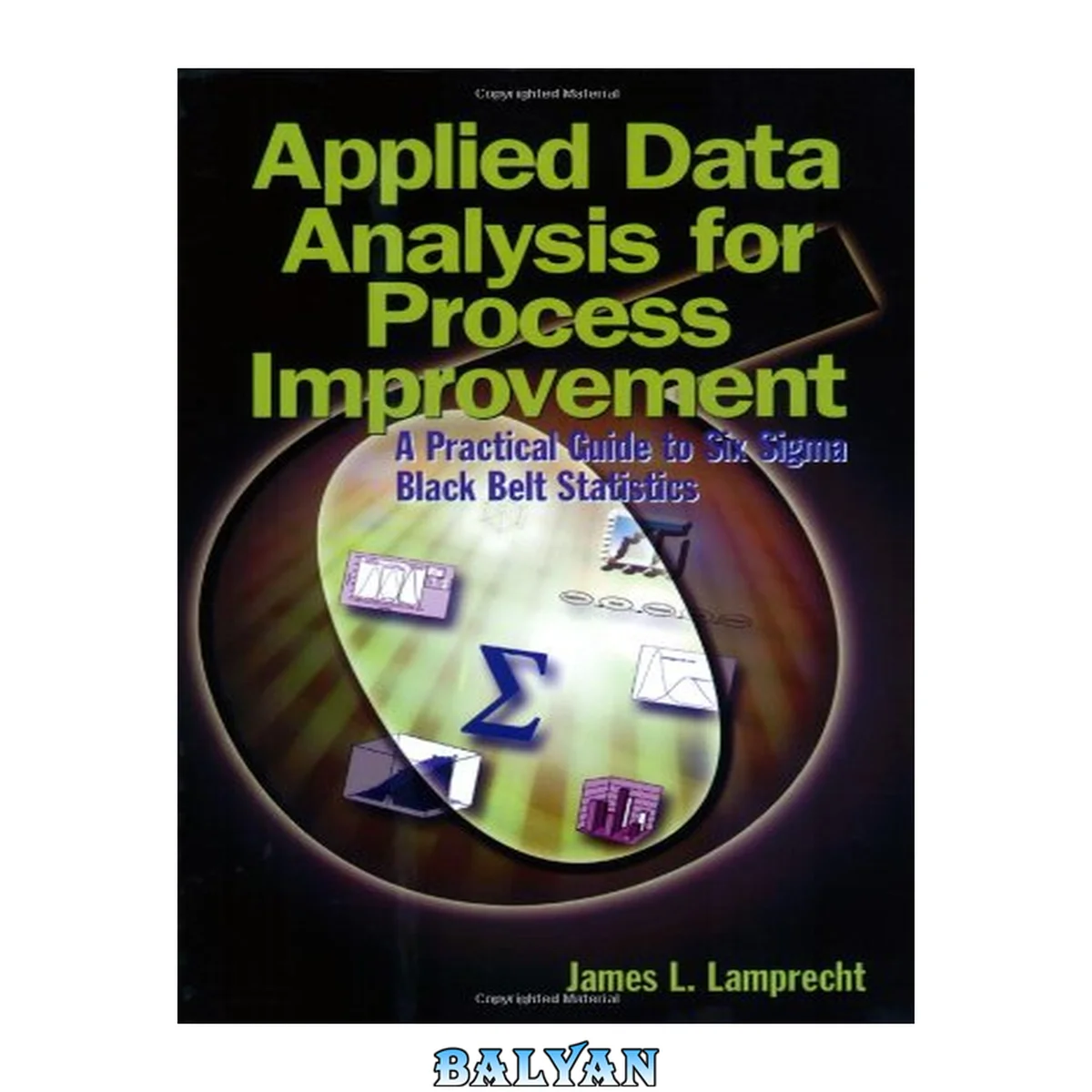
معرفی کتاب «Applied data analysis for process improvement : a practical guide to six sigma black belt statistics» نوشتهٔ Ria Wilde و Hytinen, Annemieke; Lamprecht, James L.; O'Mara, Paul، منتشرشده توسط نشر ASQ Quality Press در سال 2005. این کتاب در فرمت pdf، زبان انگلیسی ارائه شده است.
With the rise of Six Sigma, the use of statistics to analyze and improve processes has once again regained a prominent place in businesses around the world. An increasing number of employees and managers, bestowed with the titles Green Belt, Black Belt, or even Master Black Belts, are asked to apply statistical techniques to analyze and resolve industrial and non-industrial (also known as transactional) problems. These individuals are continuously faced with the daunting task of sorting out the vast array of sophisticated techniques placed at their disposal by an equally impressive array of statistical computer software packages. This book is intended for the ever-growing number of certified Black Belts as well as uncertified others that would like to understand how data can be analyzed. Many courses, including Six Sigma Black Belt courses, do a good job introducing participants to a vast array of sophisticated statistical techniques in as little as ten days, leaning heavily on statistical software packages. Although it is true that one can simplify statistical principles, learning how to interpret results produced by any statistical software requires the understanding of statistics that this book concisely provides. Benefits: Numerous examples illustrate how various techniques are applied. Each example is reviewed from the perspective of what was not said in the example; in other words, the very information you will be faced with when you conduct your own analysis. Titles of some sections in the book include the word optional or advanced. These sections cover more advanced but nonetheless useful topics, but skipping these sections will not affect the overall flow of the various subjects presented At last, a book that offers the reader a practical approach to process improvement using examples of common problems faced by data analysts! Author James L. Lamprecht, an experienced, widely published statistician, Master Black Belt, teacher, and consultant, has succeeded in combining examples that guide the reader through data analysis, Six Sigma project definition, conducting experiments, graphical analysis, and errors to avoid, all in one concise text. Unlike other books on data analysis, Lamprecht steers clear of classic, or “perfect” examples, preferring instead to address the everyday issues that data analysts confront, and explain the value certain data does and does not offer. The book includes numerous graphs that illustrate ways to intuitively analyze data. Data analysis techniques are presented first, then the author introduces Six Sigma concepts and integrates the two disciplines in a concluding chapter.!--nl--This book is ideal for Certified Six Sigma Black Belts as well as those who are uncertified, but would like to understand how data can be analyzed. Even those who rely on sophisticated statistical software to conduct their Six Sigma analysis will benefit from this insightful yet easy-to-use book by developing a true understanding of statistics and a better understanding of the results they are receiving. Numerous examples illustrate how various techniques are applied. Each example is reviewed from the perspective of what was not said in the example; in other words, the very information you will be faced with when you conduct your own analysis. Titles of some sections in the book include the words'optional'or'advanced.'These sections cover more advanced but nonetheless useful topics, but skipping these sections will not affect the overall flow of the various subjects presented. Annotation With the rise of Six Sigma, the use of statistics to analyze and improve processes has once again regained a prominent place in businesses around the world. an increasing number of employees and managers, bestowed with the titles Green Belt, Black Belt, or even Master Black Belts, are asked to apply statistical techniques to analyze and resolve industrial and non-industrial (also known as transactional) problems. These individuals are continuously faced with the daunting task of sorting out the vast array of sophisticated techniques placed at their disposal by an equally impressive array of statistical computer software packages. This book is intended for the ever-growing number of certified Black Belts as well as uncertified others that would like to understand how data can be analyzed. Many courses, including Six Sigma Black Belt courses, do a good job introducing participants to a vast array of sophisticated statistical techniques in as little as ten days, leaning heavily on statistical software packages. Although it is true that one can simplify statistical principles, learning how to interpret results produced by any statistical software requires the understanding of statistics that this book concisely provides
since 1998 Six Sigma Has Been Training Managers To Conduct Process Improvement Through Close Data Analysis. Expert Practitioner Lamprecht Gives Those At The Highest Level In Six Sigma Methods, And Those Who Would Like To Learn Some Of Their Secrets, Practical Information Based On The Company's Precepts. He Starts With Intuitive Statistics, Or The Creation And Reading Of Graphs, And Then Covers Frequency Distributions, Statistical Inference, Experiment Design, Factorial Designs And Fractional Factorial Designs, Regression Analysis, And Response Surfaces. Follow This Foundation Is A Description Of The Dmaic Methodology, Including Problem Definition And A Case Study. Annotation ©2005 Book News, Inc., Portland, Or