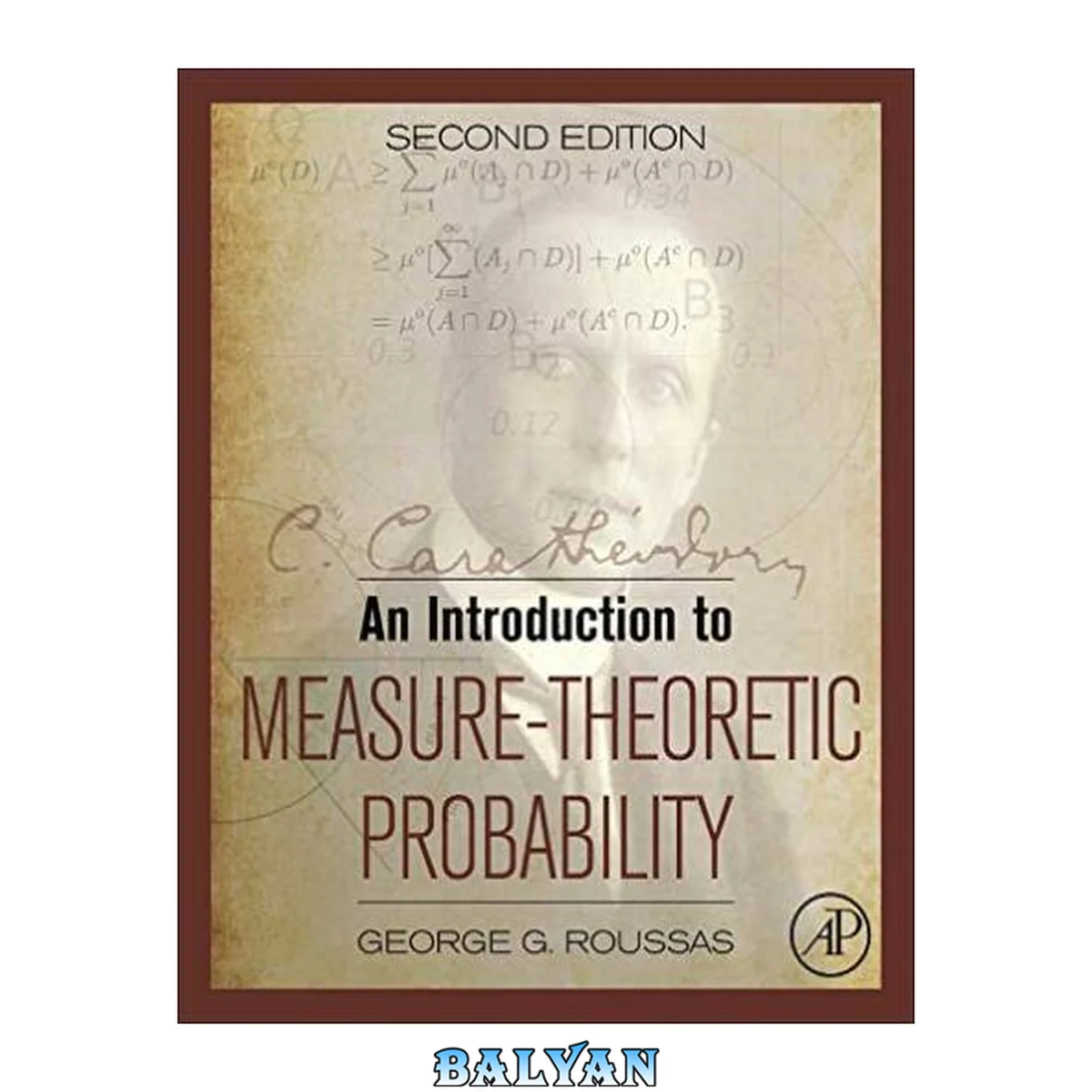
An Introduction to Measure-Theoretic Probability , Second Edition [2nd Ed] (Solutions) (Instructor's Solution Manual)
معرفی کتاب «مقدمهای بر احتمال اندازهای، ویرایش دوم» (با عنوان لاتین An Introduction to Measure-Theoretic Probability , Second Edition [2nd Ed] (Solutions) (Instructor's Solution Manual)) نوشتهٔ George G. Roussas، منتشرشده توسط نشر Academic Press در سال 2014. این کتاب در فرمت pdf، زبان انگلیسی ارائه شده است.
Certain classes of sets, measurability, and pointwise approximation -- Definition and construction of a measure and its basic properties -- Some modes of convergence of sequences of random variables and their relationships -- The integral of a random variable and its basic properties -- Standard convergence theorems, the Fubini theorem -- Standard moment and probability inequalities, convergence in the rth mean and its implications -- The Hahn-Jordan decomposition theorem, the Lebesgue decomposition theorem, and the Radon-Nikodym theorem -- Distribution functions and their basic properties, Helly-Bray type results -- Conditional expectation and conditional probability, and related properties and results -- Independence -- Topics from the theory of characteristic functions -- The central limit problem: the centered case -- The central limit problem: the noncentered case -- Topics from sequences of independent random variables -- Topics from Ergodic theory -- Two cases of statistical inference: estimation of a real-valued parameter, nonparametric estimation of a probability density function -- Appendixes: A. Brief review of chapters 1-16 -- B. Brief review of Riemann-Stieltjes integral -- C. Notation and abbreviations.;"In this introductory chapter, the concepts of a field and of a [sigma]-field are introduced, they are illustrated bymeans of examples, and some relevant basic results are derived. Also, the concept of a monotone class is defined and its relationship to certain fields and [sigma]-fields is investigated. Given a collection of measurable spaces, their product space is defined, and some basic properties are established. The concept of a measurable mapping is introduced, and its relation to certain [sigma]-fields is studied. Finally, it is shown that any random variable is the pointwise limit of a sequence of simple random variables"-- An Introduction to Measure-Theoretic Probability, Second Edition , employs a classical approach to teaching the basics of measure theoretic probability. This book provides in a concise, yet detailed way, the bulk of the probabilistic tools that a student working toward an advanced degree in statistics, probability and other related areas should be equipped with. This edition requires no prior knowledge of measure theory, covers all its topics in great detail, and includes one chapter on the basics of ergodic theory and one chapter on two cases of statistical estimation. Topics range from the basic properties of a measure to modes of convergence of a sequence of random variables and their relationships; the integral of a random variable and its basic properties; standard convergence theorems; standard moment and probability inequalities; the Hahn-Jordan Decomposition Theorem; the Lebesgue Decomposition T; conditional expectation and conditional probability; theory of characteristic functions; sequences of independent random variables; and ergodic theory. There is a considerable bend toward the way probability is actually used in statistical research, finance, and other academic and nonacademic applied pursuits. Extensive exercises and practical examples are included, and all proofs are presented in full detail. Complete and detailed solutions to all exercises are available to the instructors on the book companion site. This text will be a valuable resource for graduate students primarily in statistics, mathematics, electrical and computer engineering or other information sciences, as well as for those in mathematical economics/finance in the departments of economics. Provides in a concise, yet detailed way, the bulk of probabilistic tools essential to a student working toward an advanced degree in statistics, probability, and other related fields Includes extensive exercises and practical examples to make complex ideas of advanced probability accessible to graduate students in statistics, probability, and related fields All proofs presented in full detail and complete and detailed solutions to all exercises are available to the instructors on book companion site Considerable bend toward the way probability is used in statistics in non-mathematical settings in academic, research and corporate/finance pursuits
An Introduction to Measure-Theoretic Probability, Second Edition, employs a classical approach to teaching students of statistics, mathematics, engineering, econometrics, finance, and other disciplines that measure theoretic probability. This book requires no prior knowledge of measure theory, discusses all its topics in great detail, and includes one chapter on the basics of ergodic theory and one chapter on two cases of statistical estimation. There is a considerable bend toward the way probability is actually used in statistical research, finance, and other academic and nonacademic applied pursuits. This book provides in a concise, yet detailed way, the bulk of the probabilistic tools that a student working toward an advanced degree in statistics, probability and other related areas should be equipped with.
"In this introductory chapter, the concepts of a field and of a [sigma]-field are introduced, they are illustrated bymeans of examples, and some relevant basic results are derived. Also, the concept of a monotone class is defined and its relationship to certain fields and [sigma]-fields is investigated. Given a collection of measurable spaces, their product space is defined, and some basic properties are established. The concept of a measurable mapping is introduced, and its relation to certain [sigma]-fields is studied. Finally, it is shown that any random variable is the pointwise limit of a sequence of simple random variables"-- Provided by publisher