An Incomplete Education: 3,684 Things You Should Have Learned but Probably Didn't, Third Edition (1987,1995,2006; Ballantine Books)
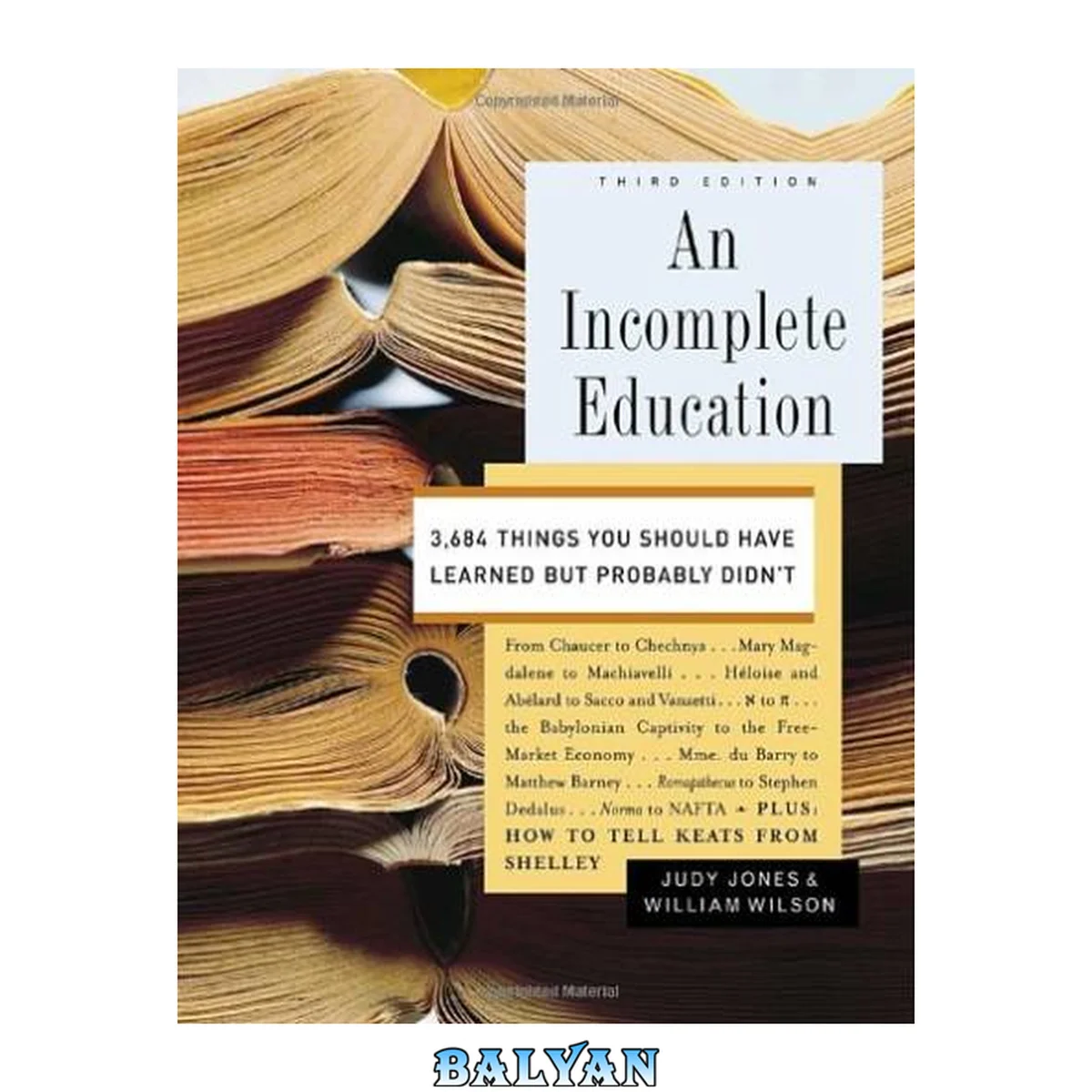
معرفی کتاب «An Incomplete Education: 3,684 Things You Should Have Learned but Probably Didn't, Third Edition (1987,1995,2006; Ballantine Books)» نوشتهٔ Reece Barden و Judy Jones; William Wilson; 3M Cloud Library، منتشرشده توسط نشر Ballantine Books در سال 2006. این کتاب در فرمت pdf، زبان انگلیسی ارائه شده است.
When it was originally published in 1987, An Incomplete Education became a surprise bestseller. Now this instant classic has been completely updated, outfitted with a whole new arsenal of indispensable knowledge on global affairs, popular culture, economic trends, scientific principles, and modern arts. Here’s your chance to brush up on all those subjects you slept through in school, reacquaint yourself with all the facts you once knew (then promptly forgot), catch up on major developments in the world today, and become the Renaissance man or woman you always knew you could be!How do you tell the Balkans from the Caucasus? What’s the difference between fission and fusion? Whigs and Tories? Shiites and Sunnis? Deduction and induction? Why aren’t all Shakespearean comedies necessarily thigh-slappers? What are transcendental numbers and what are they good for? What really happened in Plato’s cave? Is postmodernism dead or just having a bad hair day? And for extra credit, when should you use the adjective continual and when should you use continuous?An Incomplete Education answers these and thousands of other questions with incomparable wit, style, and clarity. American Studies, Art History, Economics, Film, Literature, Music, Philosophy, Political Science, Psychology, Religion, Science, and World History: Here’s the bottom line on each of these major disciplines, distilled to its essence and served up with consummate flair.In this revised edition you’ll find a vitally expanded treatment of international issues, reflecting the seismic geopolitical upheavals of the past decade, from economic free-fall in South America to Central Africa’s world war, and from violent radicalization in the Muslim world to the crucial trade agreements that are defining globalization for the twenty-first century. And don’t forget to read the section A Nervous American’s Guide to Living and Loving on Five Continents before you answer a personal ad in the International Herald Tribune__.__ As delightful as it is illuminating, An Incomplete Education packs ten thousand years of culture into a single superbly readable volume. This is a book to celebrate, to share, to give and receive, to pore over and browse through, and to return to again and again. Reference Cover 1 Copyright page 8 Acknowledgments 9 Contents 11 Introduction to the First Revised Edition, July 1994 13 Introduction to the Original Edition, March 1986 17 1 American Studies 22 American Literature 101: A First-Semester Syllabus 24 Jonathan Edwards (1703–1758) 24 Benjamin Franklin (1706–1790) 26 Washington Irving (1783–1859) 27 James Fenimore Cooper (1789–1851) 28 Ralph Waldo Emerson (1803–1882) 29 Nathaniel Hawthorne (1804–1864) 30 Edgar Allan Poe (1809–1849) 31 Harriet Beecher Stowe (1811–1896) 32 Henry David Thoreau (1817–1862) 33 Herman Melville (1819–1891) 35 Mark Twain (1835–1910) 36 The Beat Goes On: A Hundred Years' Worth of Modern American Poetry 37 The Five Big Deals 38 Ezra Pound (1885–1972) 38 T. S. (Thomas Sterns) Eliot (1888–1965) 40 William Carlos Williams (1883–1963) 41 Robert Frost (1874–1963) 43 Wallace Stevens (1879–1955) 44 The Five Runners-Up 45 Marianne Moore (1887–1972) 45 John Crowe Ransom (1888–1974) 46 E. E. (Edward Estlin) Cummings (1894–1962) 46 Hart Crane (1899–1932) 47 Robert Lowell (1917–1977) 47 Roots: Four Primary Influences 48 The Romantics 48 The Symbolists 48 Walt Whitman 48 Emily Dickinson 48 Hoots: Four Twentieth-Century Poets Not to Touch with a Ten-Foot Strophe 48 Offshoots: Five Cult Figures 50 Allen Ginsberg 50 Frank O'Hara 50 Robert Creeley 50 Sylvia Plath 51 Imamu Amiri Baraka 51 American Intellectual History, and Stop That Snickering 51 Eight American Intellectuals 51 Gertrude Stein (1874–1946) 52 Edmund Wilson (1895–1972) 53 Lionel Trilling (1905–1975) 54 Hannah Arendt (1906–1974) 55 Paul Goodman (1911–1972) 56 Norman Mailer (1923–) 57 Noam Chomsky (1928–) 58 Susan Sontag (1933–2004) 60 And Eight People Who, American or Not, Had Ideas Whose Time, It Seemed at the Time, Had Come 61 Marshall McLuhan (1911–1980) 61 R. Buckminster Fuller (1895–1983) 62 Kate Millett (1934–) 62 Malcolm X (1925–1965) 63 Ernesto "Che" Guevara (1928–1967) 64 Hunter S. Thompson (1939–2005) 64 Wilhelm Reich (1897–1957) 65 George Ivanovitch Gurdjieff (1874–1949) 66 Family Feud: A Brief History of American Political Parties 66 American Mischief: Five Tales of Ambition, Greed, Paranoia, and Mind-Boggling Incompetence that Took Place Long Before the Invasion of Iraq 68 The Tweed Ring 68 Crédit Mobilier 69 Teapot Dome 70 The Sacco-Vanzetti Case 71 The Pumpkin Papers 71 Famous Last Words: Twelve Supreme Court Decisions Worth Knowing by Name 72 Marbury v. Madison (1803) 73 McCulloch v. Maryland (1819) 74 Dred Scott v. Sanford (1857) 75 Hammer v. Dagenhart (1918) 75 Schenck v. United States (1919) 76 Brown v. Board of Education of Topeka (1954) 77 Baker v. Carr (1962) 78 Miranda v. Arizona (1966) 78 A Book Named John Cleland's "Memoirs of a Woman of Pleasure" v. Massachusetts (1966) 79 Furman v. Georgia (1972) 80 Roe v. Wade (1973) 81 University of California Regents v. Allan Bakke (1978) 82 2 Art History 84 Ten Old Masters 86 Giotto (Giotto Di Bondone) (c. 1266–c. 1337) 86 Masaccio (Tommaso Di Ser Giovanni Di Mone) (1401–1428?) 87 Raphael (Raffaello Sanzio) (1483–1520) 88 Titian (Tiziano Vecellio) (1477–1576) 89 El Greco (Domenicos Theotocopoulos) (1541–1614) 90 Peter Paul Rubens (1577–1640) 92 Rembrandt Van Rijn (1606–1669) 94 Claude Monet (1840–1926) 95 Paul Cézanne (1839–1906) 96 Pablo Picasso (1881–1973) 97 The Leonardo/Michelangelo Crib Sheet 99 Practical Italian for the Gallery-Goer 101 Six –isms, One –ijl, and Dada: Your Personal Guide to European Art Movements Between 1900 and Hitler 105 Fauvism 105 Expressionism 106 Cubism 107 Futurism 108 Constructivism 109 De Stijl ("The Style") 110 Dada 111 Surrealism 112 Thirteen Young Turks 113 Jackson Pollock (1912–1956) 113 Mark Rothko (1903–1970) 114 Willem De Kooning (1904–1997) 114 David Smith (1906–1965) 115 Andrew Wyeth (1917–) 115 Robert Rauschenberg (1925–); Jasper Johns (1930–) 115 Andy Warhol (1928–1987) 117 Frank Stella (1936–) 117 Christo and Jeanne-Claude (1935–, 1935–) 118 Laurie Anderson (1947–) 119 Julian Schnabel (1951–) 120 Matthew Barney (1967–) 120 Raiders of the Lost Architecture: A Sprinter's Guide to the Greek Temple and the Gothic Cathedral 122 Real-Estate Investment for the Aesthete 124 Five Modern Styles 124 The International Style 124 Brutalism 125 Expressionism 126 Postmodernism 126 The Chicago School 127 Five Modern Architects 127 Ludwig Mies van der Rohe (1886–1969) 128 Le Corbusier (1887–1965) 128 Walter Gropius (1883–1969) 129 Frank Lloyd Wright (1869–1959) 129 Alvar Aalto (1896–1976) 130 Five Modern Buildings 131 The Barcelona Pavilion 131 L'Unité d'Habitation 134 The Robie House 134 Carson, Pirie, Scott 135 The Chrysler Building 135 Five Modern Maxims 136 Snap Judgments 136 Landscape 137 Fashion 137 Fine Art 138 Fine Art, Abstract Division 139 Fine Art, Still-Life Division 139 Photojournalism 139 Portraiture 140 Documentary 141 Surrealism 141 Women 142 Celebrity 143 3 Economics 144 Now, What Exactly Is Economics, and What Do Economists Do, Again? 146 EcoSpeak 146 EcoThink 150 EcoPeople 152 Adam Smith (1723–1790) 152 David Ricardo (1772–1823) 152 Thomas Malthus (1766–1834) 153 John Stuart Mill (1806–1873) 153 Joseph Schumpeter (1883–1950) 154 John Maynard Keynes (1883–1946) 154 John Kenneth Galbraith (1908–) 155 Five Easy Theses 155 The Laffer Curve 155 Kondratieff Long Wave Cycle 155 Econometrics 156 Monetarism 156 Neo-Keynesianism 156 Action Economics: Or, Putting Your Money Where Their Mouths Are 157 The Federal Reserve Board 157 Money Supply 158 Interest Rates 159 Disinflation 161 Global Competition 161 Floating Currencies and the Gold Standard 162 Adventure Economics: Or, Putting Your Money Where Your Mouth Is 163 The Stock Market 163 Economics Punch Lines: Or, Putting Your Mouth Where Your Mouth Is 167 4 Film 168 Remedial Watching for Chucky Fans 170 The Birth of a Nation (American, 1915) 170 The Cabinet of Dr. Caligari (German, 1919) 172 Nanook of the North (American, 1922) 174 The Last Laugh (German, 1924) 176 Greed (American, 1924) 177 The Gold Rush (American, 1925) 180 Potemkin (Russian, 1925) 182 The Passion of Joan of Arc (French, 1928) 184 L'Age D'Or (French, 1930; English Title, The Golden Age) 186 Stagecoach (American, 1939) 187 La Règle Du Jeu (French, 1939; English Title, The Rules of the Game) 190 Citizen Kane (American, 1940) 192 For Extra Credit: The Thirteen Next-Biggest-Deal Movies They Made Before You—or Steven Spielberg—Were Born 195 1. The General (Buster Keaton, 1926) 195 2. Mother (Vsevolod Pudovkin, 1926) 195 3. Metropolis (Fritz Lang, 1926) 196 4. Napoléon (Abel Gance, 1927; Full Title, Napoléon vu par Abel Gance) 197 5. Pandoras Box (G. W. Pabst, 1929) 197 6. The Blue Angel (Josef Von Sternberg, 1930) 197 7. Earth (Aleksandr Dovzhenko, 1930) 198 8. Le Million (René Clair, 1931) 199 9. Trouble in Paradise (Ernst Lubitsch, 1932) 199 10. Zéro de Conduite and L'Atalante (Jean Vigo, 1933 and 1934) 200 11. Triumph of the Will (Leni Riefenstahl, 1936) 200 12. Henry V (Laurence Olivier, 1944) 201 13. Les Enfants du Paradis (Marcel Carné, 1945; English Title, Children of Paradise) 201 French, Likewise Hollywoodese, for the Movie-Goer 202 5 Literature 206 A Whirlwind Tour of British Poetry: If It's Tuesday, This Must Be Browning 208 Geoffrey Chaucer 208 Edmund Spenser 209 John Donne 210 John Milton 210 Alexander Pope 211 William Wordsworth 212 Robert Browning 213 William Butler Yeats 214 How to Tell Keats from Shelley 215 Triple Play 216 Wit 217 Irony 218 Ambiguity 219 Bellying Up to the Bard 221 The Histories 222 Close-Up: Henry IV, Part I 222 The Other Histories 223 The Comedies 225 Close-Up: Twelfth Night 225 The Other Comedies 227 The Tragedies 230 Close-Up: King Lear 230 The Other Tragedies 231 The Romances 233 Close-Up: The Tempest 233 The Other Romances 235 Five Definitions (Out of Five Thousand or So) That Might Make the Going a Little Easier 236 The Second Most Famous English Playwright 237 Let's Pause for a Moment and Consider Boswell's Life of Johnson 238 A Bedside Companion to the Nineteenth-Century English Novel 240 The Topography: Picking Your Way through the Countryside 240 At the Seashore 240 In the Woods 241 On the Moor 241 In the Meadow 241 In the Valley 242 In the Hills 242 By the Lake 243 On the Farm 243 At the Manor 243 In the Garden 244 The Class Structure: The Duke at the Top of the Stairs 244 The Royals 244 Kings and Queens 244 Princes and Princesses 245 The Nobles 245 Dukes and Duchesses 246 Marquesses and Marchionesses 246 Earls and Countesses 246 Viscounts and Viscountesses 247 Barons and Baronesses 247 As for the Kids 247 The Lesser Nobles 247 Baronets 248 Knights 248 The Gentry 248 Esquires 248 Gentlemen 249 And So On 249 Yeomen 249 The Clergy: Keeping Them—You Should Pardon The Expression—Straight 250 Rector 250 Vicar 250 Parson 251 Curate 251 Beadle 251 The Drinks: What to Serve with the Oysters, the Soup, the Fish, the Savoury, the Game, the Trifle, and the Cigar 251 Upstairs 251 Claret 252 Port 252 Hock 253 Sack 253 Sherry 253 Madeira 253 Sauterne 254 Tokay 254 Negus 254 Mead 254 Downstairs 254 Beer 255 Bitter 255 Porter 255 Stout 255 Grog 256 Gin 256 The Carriages: Wheels of Fortune 257 Phaeton 257 Curricle 257 Cabriolet 257 Brougham 257 Victoria 258 Landau 258 Barouche 258 Gig 259 Dogcart 259 Wagonette 259 Post Chaise 259 Hansom Cab 259 The Money: A Guide for Pickpockets, Wastrels, and Fortune Hunters 260 Pound 260 Shilling 261 Penny 261 Guinea 261 Florin 261 Crown 261 Farthing 261 Mite 261 The Names: English As a Second Language 263 Guess Who's Coming to Dinner? Twelve Fictional Characters with Whom You Should Have at Least a Nodding Acquaintance 265 Baron de Charlus (from Proust's Rememberance of Things Past) 265 Cousin Bette (from Balzac's Cousin Bette) 265 Father Zossima (from Dostoevsky's The Brothers Karamazov) 265 Isabel Archer (from James' The Portrait of a Lady) 265 Julien Sorel (from Stendhal's The Red and the Black) 265 Dorothea Brooke (from Eliot's Middlemarch) 266 Alexey Vronsky (from Tolstoy's Anna Karenina) 266 Emma Woodhouse (from Jane Austen's Emma) 266 Stephen Dedalus (from Joyce's A Portrait of the Artist as a Young Man and Ulysses) 266 Eustacia Vye (from Hardy's The Return of the Native) 266 Marlow (from Conrad's Lord Jim, Heart of Darkness, and other tales) 266 Mrs. Ramsay (from Woolf 's To the Lighthouse) 267 Three Important-Sounding Fallacies (and Two Important-Sounding Other Things) You May or May Not Want to Watch Out For 267 Pathetic Fallacy 267 Intentional Fallacy 267 Affective Fallacy 268 Objective Correlative 268 Negative Capability 268 Three Twentieth-Century Novels to Reckon With 270 Ulysses (1922) James Joyce 270 Remembrance of Things Past (1913–1927) Marcel Proust 271 The Magic Mountain (1924) Thomas Mann 273 Gifts from the Greeks: A Few Enriching Ideas from the Classic Classical Civilization 274 Homerwork 274 Hero Worship 277 Two Guys from Delphi (Apollo and Dionysus) 278 You Say Your Father Sacrificed Your Sister... 280 Aeschylus (525–456 B.C.) 281 Sophocles (c. 496–c. 406 B.C.) 282 Euripides (480 or 485–406 B.C.) 282 Speak Ancient Greek Like a Native: Take This Simple Quiz 283 How Is Greek Tragedy Different from the Six O'Clock News? 283 Hamartia 283 Hubris 283 Nemesis 283 Catharsis 283 How Is an Ancient Greek Like a Modern Californian? 284 What's Love Got to Do, Got to Do with It? 284 6 Music 286 Classical Music for the Disconcerted: Play It Again, Sam—And This Time We'll Try to Listen 288 Josquin Desprez: La Déploration Sur La Mort D'Ockeghem 288 Johann Sebastian Bach: Mass in B Minor, BWV 232 289 Wolfgang Amadeus Mozart: Symphony No. 41 In C Major ("Jupiter"), K. 551 289 Ludwig Van Beethoven: Piano Sonata No. 29 In B Flat Major, Opus 106 ("Hammerklavier" Sonata) 290 Frédéric Chopin: Twenty-Four Preludes, Opus 28 291 Peter Ilyich Tchaikovsky: Concerto in D for Violin and Orchestra, Opus 35 292 Arnold Schoenberg: Pierrot Lunaire, Opus 21 292 Igor Stravinsky: Le Sacre Du Printemps (The Rite of Spring) 293 Béla Bartók: The Six String Quartets 294 Terry Riley: In C 294 The Parts of an Orchestra, Dear, Once and for All 295 Practical Italian for the Concertgoer 296 Five Composers Whose Names Begin With the Letter P: We'd Have Thrown in Paganini, but We Know How Busy You Are 299 Giovanni Pierluigi Da Palestrina (1525–1594) 299 Francis Poulenc (1899–1963) 299 Sergei Prokofiev (1891–1953) 299 Giacomo Puccini (1858–1924) 299 Henry Purcell (1659–1695) 300 The Day the Music Died: Atonality, Twelve-Tone Theory, and Such 301 Tunebusters 302 Beyond BAY-toe-v'n and MOAT-sart 304 Opera for Philistines: 350 Years of Opera at a Glance 305 The Italians 305 The Germans 306 The French 308 The English 309 The Russians 310 The Czechs 310 The Americans 311 Eleven Arias to Sing in the Shower: Bring Your Own Soap 312 Tosca (Puccini), act 2, "Vissi d'arte" 312 Rigoletto (Verdi), act 3, "La donna è mobile" 312 Lucia di Lammermoor (Donizetti), act 3, "Spargi d'amaro pianto" 312 La Traviata (Verdi), act 1, "Sempre libera" 312 Die Walküre (Wagner), act 1, "Winterstürme" ("The Spring Song") 313 Don Giovanni (Mozart), act 1, "Madamina" 313 Norma (Bellini), act 1, "Casta Diva" 313 Fidelio (Beethoven), act 1, "Abscheulicher" 313 La Bohème (Puccini), act 1, "Che gelida manina" 314 Le Nozze di Figaro (Mozart), act 1, "Non so più cosa son" 314 Carmen (Bizet), act 2, "La fleur que tu m'avais jetée" 314 Practical Italian for the Operagoer 315 Opera Houses: The Heavy Half-Dozen 316 Teatro Alla Scala (Milan) 316 Royal Opera House, Covent Garden (London) 317 Staatsoper (Vienna) 318 Festspielhaus (Bayreuth, Germany) 319 L'Opéra National (Paris) 320 Metropolitan Opera House (New York) 321 A Night at the Opera: Manners and Morals for the MTV Generations 322 1. Memorize the plot before you go 322 2. Bring a libretto 322 3. Don't clap until the people around you do 323 4. Go ahead and voice your enthusiasm 323 5. Don't spend a lot of time worrying about what to wear 323 6. Dont choose Wagner your first time out 323 7 Philosophy 324 Philosophy Made Simplistic 326 Got Another Minute or Two? 327 Still with Us? 328 Rating the Thinkers: A Consumer's Guide to Twenty Philosophers 328 Plato (c. 427–c. 347 B.C.) 328 Aristotle (384–322 B.C.) 330 Saint Augustine (A.D. 354–430) 331 Saint Thomas Aquinas (1225–1274) 332 Niccolò Machiavelli (1469–1527) 333 René Descartes (1596–1650) 334 John Locke (1632–1704) 335 Baruch Spinoza (1632–1677) 336 Gottfried Wilhelm Von Leibniz (1646–1716) 337 David Hume (1711–1776) 338 Immanuel Kant (1724–1804) 339 Georg Friedrich Wilhelm Hegel (1770–1831) 341 Arthur Schopenhauer (1788–1860) 342 Søren Kierkegaard (1813–1855) 343 William James (1842–1910) 344 Friedrich Nietzsche (1844–1900) 345 Henri Bergson (1859–1941) 347 Alfred North Whitehead (1861–1947) 348 Ludwig Wittgenstein (1889–1951) 349 John Dewey (1859–1952) 350 Toys in the Attic: Five Famous Philosophical Mind Games 351 Zeno's Arrow 351 Plato's Cave 351 Buridan's Ass 352 Occam's Razor 352 Pascal's Wager 352 Dueling Dualities: Two Pairs of Concepts Dear to the Hearts of Philosophers, Logicians, Literary Poseurs, and Intellectual Bullies Everywhere 353 Deduction vs. Induction 353 A Priori vs. A Posteriori 354 What Was Structuralism? And Why Are We Telling You About It Now That It's Over? 354 Three Well-Worn Arguments for the Existence of God 359 The Cosmological Argument 359 The Ontological Argument 360 The Teleological Argument, or the Argument from Design 360 8 Political Science 362 What You Need to Know Before Answering a Personals Ad in the International Herald Tribune: A Nervous American's Guide to Living and Loving on Five Continents 364 Argentina 364 Cambodia 368 Canada 371 Congo, Democratic Republic of The 375 Ethiopia 378 France 382 Germany 385 Indonesia 388 Italy 392 Mexico 395 Nicaragua 399 Nigeria 403 Pakistan 407 Saudi Arabia 411 Switzerland 414 Taiwan 416 Turkey 419 Separated at Creation? How to Tell the Balkans from the Caucasus 424 The Balkans 424 The Caucasus 425 Dead-Letter Department: Acronyms—and Acrimony—From Maastricht to Mogadishu 427 NATO (North Atlantic Treaty Organization) 428 EU (European Union) 429 OECD (Organization for Economic Cooperation and Development) 431 G7 / G8 (Group of Seven / Group of Eight) 432 OAS (Organization of American States) 432 OPEC (Organization of Petrole Um Exporting Countries) 433 OAU (Organization of African Unity) 433 ASEAN (Association of Southeast Asian Nations) 435 CIS (Commonwealth of Independent States) 436 APEC (Asia-Pacific Economic Cooperation) 436 WTO (World Trade Organization) 437 NAFTA (North American Free Trade Association) 438 Trio of Geographical Clarifications for a Nation That, Frankly, Would Rather Skateboard 440 Islands in the Stream 441 Why England, While Admittedly a Royal Throne of Kings and a Little World, Is Not Exactly a Sceptered Isle or a Precious Stone Set in the Silver Sea 442 Why the Orient Express Never Got to Tokyo 443 9 Psychology 446 Herr Doktor, What's Wrong with Me? A Guide to Neurosis, Psychosis, and PMS 448 Eleven Ways to Leave a Mother 450 Return with Us Now to a Quiet Side Street in a Working-Class Neighborhood in Turn-of-the-Century Vienna... 454 Freud and His Followers 454 Sigmund Freud (Himself) 455 Five Followers 457 Melanie Klein (1882–1960): Hypothesis on Hypothesis 458 Harry Stack Sullivan (1892–1949): Things Are Often What They Seem 460 Donald W. Winnicott (1896–1971): The "Good-Enough Mother" of the Year 462 Heinz Kohut (1913–1981): Mirror, Mirror on the Wall 463 Jacques Lacan (1901–1981): Enfant Terrible 466 Crumbs from the Master's Table: Quotations from the Writings of Sigmund Freud 468 Fruits of the Master's Labors: Five Famous Flipped-Out Cases 470 Anna O. 470 Little Hans 470 Dora 470 The Rat Man 471 The Wolf Man 471 Hello, Jung Lovers 472 Getting Straight: A Cornucopia of Cures, Crazes, and Quick Fixes 473 10 Religion 480 Those Old-Time Religions: Divine to Some, Merely Fabulous to Others 482 Judaism 483 Christianity 485 Islam 487 Zoroastrianism 489 Hinduism 491 Buddhism 493 Taoism and Confucianism 495 Shintoism 497 The Good Book as Good Read 498 The Good Book as Good Business 500 Bible Baedeker: A Mercifully Brief Who-What-and-Where Guide to the Holy Land 504 Six Important Places That Begin with the Letter G 504 Gilead 504 Gaza 505 Gehenna 506 Goshen 506 Gethsemane 506 Golgotha 506 Five Familiar Characters Who Won't Stay Put 507 Absalom 507 Ishmael 507 Job 508 Susanna 509 Mary Magdalen 509 Four Pairs of Groups Who Keep Stepping on Each Other's Toes 510 Apostles and Disciples 510 Seraphim and Cherubim 511 Pharisees and Sadducees 512 Assyrians and Babylonians 512 Seven People Not to Bother Sharing Your Old God-Spelled-Backward Insight With 514 Karl Barth (Swiss, Calvinist, 1886–1968) 514 Paul Tillich (German Emigrant to the United States, Lutheran, 1886–1965) 515 Rudolf Bultmann (German, Lutheran, 1884–1976) 516 Reinhold Niebuhr (American, Evangelical, 1892–1971) 516 Dietrich Bonhoeffer (German, Lutheran, 1906–1945) 517 Martin Buber (Austrian, Jewish, 1878–1965) 518 Pierre Teilhard de Chardin (French, Catholic, 1881–1955) 519 11 Science 520 Out of the Cyclotron, into the Streets 522 Catalyst 522 Centrifugal Force 522 Fission and Fusion 523 Half-life 524 Mass 524 Matrix 524 Osmosis 525 Parameter 525 Quantum 526 Quark 526 Symbiosis 527 Synapse 527 Synergy 528 Valence 528 Keeping Up with Cosmology 529 The Early Universe 531 What Matter Is Made Of 532 The Fundamental Forces 533 Gravity: Odd Man Out 534 Checking In With Quantum Mechanics 536 Hot Science: Two Trendy Theories That May Revolutionize Our Worldview—or May Not Make Much Difference at All 537 Riding Herd on the Life Sciences 542 All in the Family 542 The Splice of Life 550 Many Are Cold but Few Are Frozen 552 Some Like It Hot 553 One Sings, The Other Doesn't 554 State of Siege 556 Genes "R" Us 558 Cloning and the Stem Cell Debate 560 Making a Name for Yourself in Science: Eight Bright Ideas That Lit Up Their Owners' Lives 563 Archimedes' Principle 563 Fibonacci Series 564 The Linnaean System of Taxonomic Classification 564 Brownian Movement 565 The Doppler Effect 566 Boolean Algebra 566 Möbius Strip 567 Gödel's Incompleteness Theorem 568 Fun—or at Least a Few Minutes—with Numbers 569 Natural 570 Prime 570 Integer 571 Rational 571 Real 571 Transcendental 572 Complex 573 Algebraic 573 Transfinite 574 Quaternion 574 Double Whammy 575 Entropy, the Laws of Thermodynamics, and Why You May Have Been Feeling Tired and Listless Lately 575 Evolution, the Law of Natural Selection, and Why You May Have Been Feeling Stressed Out and Paranoid Lately 577 Ten Burning Questions in the History of Science 579 Were The Ancients Really Scientists or Did They Just Make Some Lucky Guesses? 579 Is It True That the Arabs Kept Science Alive During the Middle Ages, While Europe Slumbered? 580 Did Galileo Really Drop a Couple of Lead Weights from the Leaning Tower of Pisa, Thereby Proving Something or Other? 581 Did Newton Really Watch an Apple Fall—And If So, So What? (And If Not, So What?) 582 How Come Chemistry Took So Long to Come Up from the Dark Ages? 583 Who Got to the Evolution Theory First, Darwin or This Alfred Russel Wallace? 584 Honest, Now, Was Lobachevsky The Greatest Mathematician Ever to Get Chalk on His Coat? 585 What Does Planck's Constant Have to Do with Heisenberg's Uncertainty? 586 Wait, You're Forgetting the Danes. Didn't They Contribute Anything? 587 Is Science Worth Dying For? 588 12 World History 590 The World According to Whom? 592 Spokespersons 592 The Greeks: Herodotus and Thucydides 592 The Romans: Livy and Tacitus 593 The Germans: Ranke and Mommsen 594 The Victorians: Macaulay and Carlyle 595 Meanwhile, Back at the Ranch: Turner and Beard 596 Think Tankers 597 St. Augustine (354–430) 597 Vico (1668–1744) 598 Voltaire (1694–1778) 598 Herder (1744–1803) 598 Hegel (1770–1831) 598 Spengler (1880–1936) 599 Legends 599 Edward Gibbon (1737–1794) 599 Arnold Toynbee (1889–1975) 601 The Paris Bureau 602 Role Models 604 Jacob Burckhardt (1818–1897) 604 Benedetto Croce (1866–1952) 605 Pieter Geyl (1887–1966) 605 Fernand Braudel (1902–1985) 605 A. J. P. Taylor (1906–1990) 605 Isaiah Berlin (1909–) 606 Barbara Tuchman (1912–1989) 606 Richard Hofstadter (1916–1970) 607 Michel Foucault (1926–1984) 607 Fun Couples 608 Justinian and Theodora (married A.D. 525) 608 Heloise and Abelard (married c. 1118) 609 Henry II And Eleanor of Aquitaine (married 1152) 609 Ferdinand and Isabella (married 1469) 610 William and Mary (married 1677) 610 Napoleon and Josephine (married 1796) 611 Franklin and Eleanor Roosevelt (married 1905) 611 Mao Zedong and Jiang Qing (married c. 1938, if ever) 612 Vintage Years: For Those Who've Already Savored 1066, 1588, and 1789 613 1453 613 1598 613 1648 614 1762 614 1815 615 1848 616 1854 617 1945 617 Louis, Louis 618 Louis XIII (1601–1643) 618 Louis XIV (1638–1715) 620 Louis XV (1710–1774) 622 Louis XVI (1754–1793) 624 Special Souvenir-Program Section: You Can't Tell the Players—or, in Some Cases, the Innings—Without One 626 Persian Wars, Peloponnesian War, Punic Wars 626 Middle Ages, Dark Ages, Medieval Times, Feudalism 627 Thomas Aquinas, Thomas à Becket, Thomas à Kempis, Thomas More 628 John Wyclif, John Huss, John Calvin, John Knox 629 Jacobean, Jacobite, Jacobin, Jacquerie 630 Puritans, Pilgrims, Dissenters, Roundheads 631 Diggers, Levellers, Luddites, Chartists 631 Whigs, Tories 632 Colony, Protectorate, Dominion, Territory, Mandate, Trusteeship, Dependency, Possession 633 The Boer War, the Boxer Rebellion 633 Redshirts, Brownshirts, Blackshirts, Black and Tans 635 Epoch, Era, Period, Age, Eon 635 Reds 636 Karl Marx (German, 1818–1883) 636 Friedrich Engels (German, 1820–1895) 639 Vladimir Ilyich Lenin (Russian, 1870–1924) 639 Rosa Luxemburg (Polish, 1871–1919) 640 Josef Stalin (Russian, 1879–1953) 641 Leon Trotsky (Russian, 1879–1940) 641 Mao Zedong (Chinese, 1893–1976) 642 Georg Lukács (Hungarian, 1885–1971) 643 Antonio Gramsci (Italian, 1891–1937) 643 Herbert Marcuse (German-born American, 1898–1979) 644 Louis Althusser (French, 1918–1990) 645 Four Cautionary Tales: Each of Them Considerably More Sobering Than the Ones Maury Povich and Jerry Springer Try to Scare You With 646 The Dreyfus Affair 646 The Sarajevo Assassination 648 The Spanish Civil War 650 Dien Bien Phu 653 Lexicon 656 In the Beginning Was the Prefix 658 Who's on Top? 658 Who's for Real? 658 Which Came First? 659 How Big? 660 Which Half? 660 To What Degree? 660 Where Do We Go from Here? 661 Distinctions Worth Making (Or at Least Being in a Position to Make) 662 affect and effect 662 anxious and eager 662 assume and presume 662 authentic and genuine 663 canonical, catholic, ecclesiastical, ecumenical, evangelical, and liturgical 663 compleat and complete 664 compose and comprise 664 continual and continuous 664 converse and inverse 665 deprecate and depreciate 665 discreet and discrete 666 dock and pier 666 egotist, egoist, solipsist, and narcissist 666 enormity and enormousness 667 epidemic and endemic 667 epigram and epigraph 667 ethics and morals 668 farther and further 668 flaunt and flout 669 heathen and pagan 669 infer and imply 670 insidious and invidious 670 jealousy and envy 670 mean, median, mode, and average 670 mutual and common 671 objective and subjective 671 oral and verbal 672 pathos and bathos 672 redundancy, tautology, and pleonasm 672 sensuous and sensual 673 sententious and tendentious 673 specious and spurious 673 sybarite, hedonist, and epicurean 674 sympathy and empathy 674 synecdoche and metonymy 674 turgid, turbid, and tumid 675 uninterested and disinterested 675 venal and venial 675 Twenty-Five Words Not to Say Wrong 676 Twenty-Six Words Not to Write Wrong 677 Plus, As an Extra Added Bonus, Six Phrases You May Not Even Know You Write Wrong 679 Mistaken Identities: Adjectives Whose Looks Are Deceptive 679 Unknown Quantities: Adjectives Whose Looks Are Totally Inscrutable 681 Six Mnemonic Devices: Memories Are Made of These 684 "How Do You Say in Your Country 'Yearning for the Mud'?": A Stay-at-Home's Guide to Words and Phrases in Three Languages 685 Latin Quarter: A Couple Dozen Double-Barreled Phrases and an Equal Number of Sawed-Off Words and Abbreviations 685 Sawed-Off Latin Words and Abbreviations 685 Double-Barreled Latin Phrases 688 Four Latin Phrases for Your Day in Court 690 And Four for Your Day of Judgment 691 From Prussia with Love 691 A Lifetime Supply of Je Ne Sais Quoi 693 For the Freshman 693 For the Sophomore 694 For the Literature Major 695 For the History Major 695 At the Buffet Dinner 696 At the Black-Tie Dinner 697 And So to Bed 698 Index 699 A 699 B 700 C 701 D 703 E 703 F 704 G 705 H 706 I 707 J 708 K 709 L 709 M 710 N 711 O 712 P 712 Q 714 R 715 S 716 T 717 U 718 V 718 W 719 X 719 Y 719 Z 719 Illustration Credits 720 Permissions (continued) 722 About the Authors 723 From the First Edition (1987) 725 Cover 725 Copyright page 729 8 Political Science 730 What You Need to Know Before Answering a Personals Ad in the International Herald Tribune: A Nervous American's Guide to Living and Loving on Five Continents 730 Argentina 730 Cambodia 733 Canada 735 Ethiopia 738 France 740 Indonesia 743 Italy 745 Japan 748 Mexico 751 Nicaragua 753 Nigeria 756 Pakistan 758 Saudi Arabia 761 Switzerland 763 Taiwan 766 Turkey 768 West Germany 771 Yugoslavia 774 Dead-Letter Department: Acronyms—And Acrimony—From Here to Honshu 776 NATA (North Atlantic Treaty Organization) 777 EC (European Community) 778 EFTA (European Free Trade Association) 779 COMECON (Council for Mutual Economic Assistance) 779 OECD (Organization for Economic Cooperation and Development) 780 ANZUS (Australia / New Zealand / United States Council) 780 OAS (Organization of American States) 780 OPEC (Organization of Petroleum Exporting Countries) 781 OAU (Organization of African Unity) 781 ASEAN (Association of Southeast Asian Nations) 783 reference;,american,history;,art;,economics;,film;,literature;,music;,philosophy;,political,science;,psychology;,religion;,science;,world,history reference,american history,art,economics,film,literature,music,philosophy,political science,psychology,religion,science,world history When it was originally published in 1987, An Incomplete Education became a surprise bestseller. Now this instant classic has been completely updated, outfitted with a whole new arsenal of indispensable knowledge on global affairs, popular culture, economic trends, scientific principles, and modern arts. Here's your chance to brush up on all those subjects you slept through in school, reacquaint yourself with all the facts you once knew (then promptly forgot), catch up on major developments in the world today, and become the Renaissance man or woman you always knew you could be!How do you tell the Balkans from the Caucasus? What's the difference between fission and fusion? Whigs and Tories? Shiites and Sunnis? Deduction and induction? Why aren't all Shakespearean comedies necessarily thigh-slappers? What are transcendental numbers and what are they good for? What really happened in Plato's cave? Is postmodernism dead or just having a bad hair day? And for extra credit, when should you use the adjective continual and when should you use continuous?An Incomplete Education answers these and thousands of other questions with incomparable wit, style, and clarity. American Studies, Art History, Economics, Film, Literature, Music, Philosophy, Political Science, Psychology, Religion, Science, and World History: Here's the bottom line on each of these major disciplines, distilled to its essence and served up with consummate flair.In this revised edition you'll find a vitally expanded treatment of international issues, reflecting the seismic geopolitical upheavals of the past decade, from economic free-fall in South America to Central Africa's world war, and from violent radicalization in the Muslim world to the crucial trade agreements that are defining globalization for the twenty-first century. And don't forget to read the section A Nervous American's Guide to Living and Loving on Five Continents before you answer a personal ad in the International Herald Tribune. As delightful as it is illuminating, An Incomplete Education packs ten thousand years of culture into a single superbly readable volume. This is a book to celebrate, to share, to give and receive, to pore over and browse through, and to return to again and again.From the Hardcover edition. A completely updated, revised edition of the classic, outfitted with a whole new arsenal of indispensable knowledge on global affairs, popular culture, economic trends, scientific principles, and modern arts. Here’s your chance to brush up on all those subjects you slept through in school, reacquaint yourself with all the facts you once knew (then promptly forgot), catch up on major developments in the world today, and become the Renaissance man or woman you always knew you could be! How do you tell the Balkans from the Caucasus? What’s the difference between fission and fusion? Whigs and Tories? Shiites and Sunnis? Deduction and induction? Why aren’t all Shakespearean comedies necessarily thigh-slappers? What are transcendental numbers and what are they good for? What really happened in Plato’s cave? Is postmodernism dead or just having a bad hair day? And for extra credit, when should you use the adjective continual and when should you use continuous? An Incomplete Education answers these and thousands of other questions with incomparable wit, style, and clarity. American Studies, Art History, Economics, Film, Literature, Music, Philosophy, Political Science, Psychology, Religion, Science, and World History: Here’s the bottom line on each of these major disciplines, distilled to its essence and served up with consummate flair. In this revised edition you’ll find a vitally expanded treatment of international issues, reflecting the seismic geopolitical upheavals of the past decade, from economic free-fall in South America to Central Africa’s world war, and from violent radicalization in the Muslim world to the crucial trade agreements that are defining globalization for the twenty-first century. And don’t forget to read the section "A Nervous American’s Guide to Living and Loving on Five Continents" before you answer a personal ad in the International Herald Tribune. As delightful as it is illuminating, An Incomplete Education packs ten thousand years of culture into a single superbly readable volume. This is a book to celebrate, to share, to give and receive, to pore over and browse through, and to return to again and again. When it was originally published in 1987, An Incomplete Education became a surprise bestseller. Now this instant classic has been completely updated, outfitted with a whole new arsenal of indispensable knowledge on global affairs, popular culture, economic trends, scientific principles, and modern arts. Here's your chance to brush up on all those subjects you slept through in school, reacquaint yourself with all the facts you once knew (then promptly forgot), catch up on major developments in the world today, and become the Renaissance man or woman you always knew you could be! How do you tell the Balkans from the Caucasus? What's the difference between fission and fusion? Whigs and Tories? Shiites and Sunnis? Deduction and induction? Why aren't all Shakespearean comedies necessarily thigh-slappers? What are transcendental numbers and what are they good for? What really happened in Plato's cave? Is postmodernism dead or just having a bad hair day? And for extra credit, when should you use the adjective continual and when should you use continuous? An Incomplete Education answers these and thousands of other questions with incomparable wit, style, and clarity. American Studies, Art History, Economics, Film, Literature, Music, Philosophy, Political Science, Psychology, Religion, Science, and World History: Here's the bottom line on each of these major disciplines, distilled to its essence and served up with consummate flair.
دانلود کتاب An Incomplete Education: 3,684 Things You Should Have Learned but Probably Didn't, Third Edition (1987,1995,2006; Ballantine Books)