Advanced Arduino Techniques in Science : Refine Your Skills and Projects with PCs or Python-Tkinter
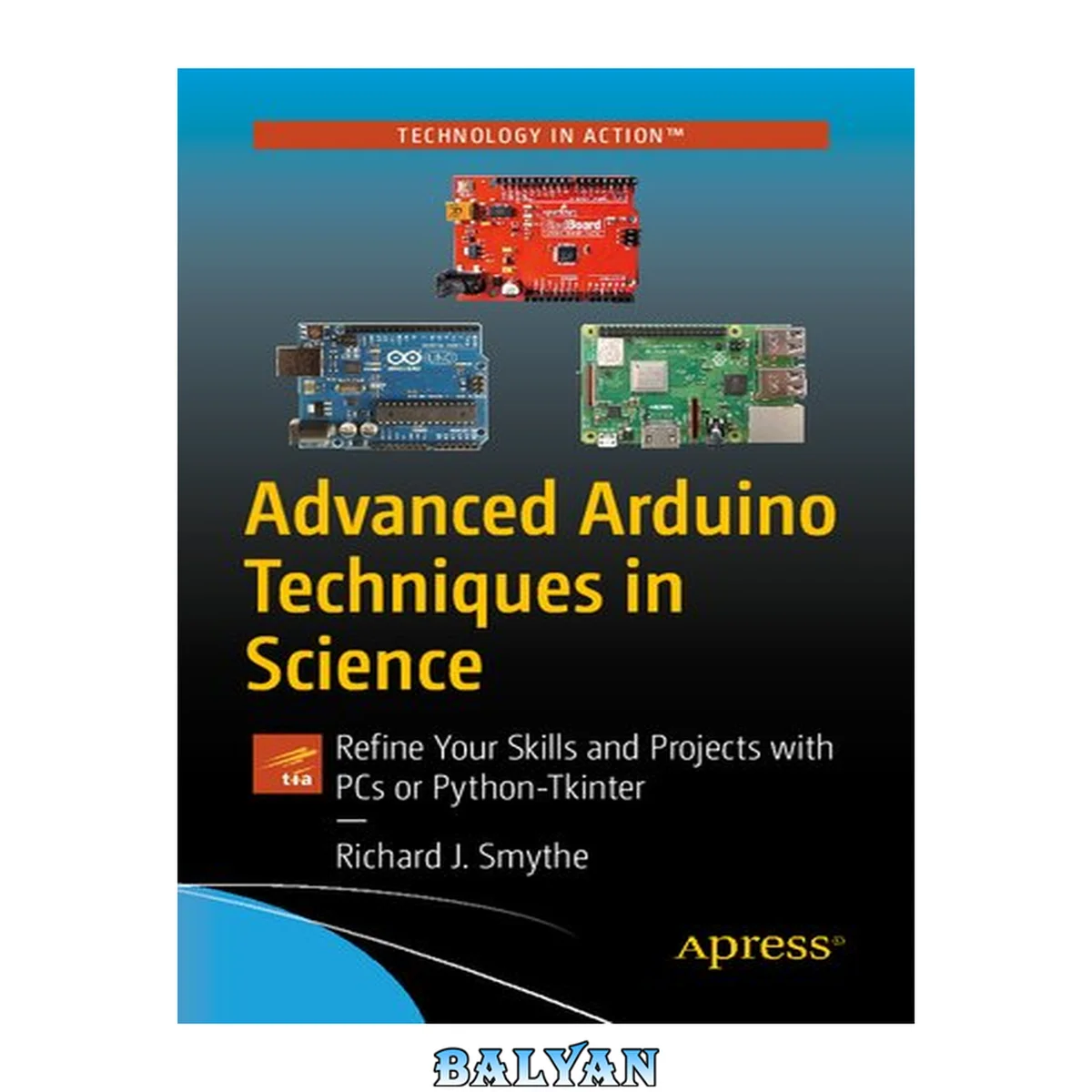
معرفی کتاب «Advanced Arduino Techniques in Science : Refine Your Skills and Projects with PCs or Python-Tkinter» نوشتهٔ David Griffiths، Dawn Griffiths و Richard J. Smythe (auth.)، منتشرشده توسط نشر Apress Springer Science + Business Media در سال 2021. این کتاب در فرمت pdf، زبان انگلیسی ارائه شده است.
If you’re already a comfortable programmer, familiar with your single board computer and microcontroller, and are ready to refine your projects, then let’s get started! This book covers advanced methods and techniques for creating, implementing, monitoring and controlling your experiments and projects with your Raspberry Pi and Arduino. Projects will use Python and the Tkinter GUI and will also cover software development for adding real time data display to the Raspberry Pi.You'll review concepts of frequency occurring in nature and the techniques used to measure the frequency of electrically varying signal voltages. You'll also study procedures for safe design, implementation and operation of experimental measurement systems operating at high heats and high temperatures. Throughout the book you'll look at sources and types of errors, and best practices for minimizing and reducing them. Often times there are simple environmental issues hindering what would seem to be simple projects: high temperatures, controlling the power for elevated temperature with the proportional integral and derivative (PID) algorithm, and the limitations imposed by eight bit code, the influence of noise and errors in measured data, and many more. __Advanced Arduino Techniques in Science__ provides the best tools to move past those restrictions. **What You’ll Learn*** Implement an experimental control system and graphical data display for the Raspberry Pi and Arduino * Manage experimental control with PID algorithm implementation, tuning and limitations imposed by eight bit digital signals * Build an analytical front end * Examine data smoothing capability of the Kalman filter * Explore available methods for measuring both high and low frequency values in electronic signals **Who This Book Is For** Educators, researchers, students, makers, citizen scientists, or hobbyists can all extend their measuring capability or improve upon the quality of their collected data. The book is directed to those with intermediate skills in programming and those who are comfortable with Python programming and Arduino C. Table of Contents 4 About the Author 8 About the Technical Reviewer 9 Acknowledgments 10 The Author’s Preface to Arduino Advanced Techniques in Science 12 Roadmap to the Exercises in Advanced Arduino Techniques in Science 20 Chapter 1: Arduino and Raspberry Pi 36 Arduino 36 Raspberry Pi 40 Raspberry Pi Arduino Combinations 49 Interfacing Arduino – C with Python and the Matplotlib Plotting Programs 51 Arduino Interrupts and Timing Applications 55 Code Listings 61 Summary 66 Chapter 2: Development of a Simplified Python Supervisory Control and Data Acquisition System 67 Program 1: Display Frame 70 Program 2: Display of Changing Data in Realtime 72 Program 3: Activation of Experimental Devices from Button Displays 79 Program 4: A Sliding-Scale Implementation 83 Program 5: Radio Button Controls 87 Program 6: Graphical Data Display—A Realtime Strip-Chart Recording 93 Summary 103 Chapter 3: Experimental Work at High Temperatures and High Heats 105 Safety Considerations 106 Experimental 115 Simple Measurement of Elevated Temperatures 115 Dry Wells 116 Resistance-Wire Heating 119 Powering Heating Elements 123 Solid-State Relays (SSR) 127 Refractory Insulation 132 Observations 137 Failures Involving High Heat and Temperatures 140 Discussion 144 High Temperature and High Heat with Fuel Gases 147 Brazing 149 Discussion 149 Code Listings 151 Summary 165 Chapter 4: The PID Process Control Algorithm 167 Theory 167 Tuning and Practical Applications of the PID Controller 173 PID for Thermal Control 179 PID Control of Optical Brightness 182 Code Listings 186 Summary 192 Chapter 5: Realtime Data Plotting and Visualization 194 Summary 204 Chapter 6: Frequency Measurement 205 Experimental 208 Observations 211 Discussion 214 Summary 216 Chapter 7: Quality Assurance, Quality Control, and Error Analysis 217 Quality Assurance and Control 217 Error Analysis 221 Calibration and Curve Fitting 229 Summary 230 Chapter 8: Power and Noise from the USB 231 Typical Baseline Noise and Large Signal Distortions 234 Commercially Available Noise-Reduction Devices 237 Discussion 238 Summary 239 Chapter 9: Analytical Front Ends 240 IC-based Sensors 242 Microcontrollers 243 Operational Amplifiers 244 Calorimeter Testing, Validation, and Applications 265 Code Listings 271 Summary 278 Chapter 10: The Kalman Filter 279 The Single-Dimension Kalman Filter Process 280 Code Listings 284 Summary 287 Appendix 1 List of Abbreviations 288 Appendix 2 List of Suppliers 297 Index 298 If you’re already a comfortable programmer, familiar with your single board computer and microcontroller, and are ready to refine your projects, then let’s get started! This book covers advanced methods and techniques for creating, implementing, monitoring and controlling your experiments and projects with your Raspberry Pi and Arduino. Projects will use Python and the Tkinter GUI and will also cover software development for adding real time data display to the Raspberry Pi. You'll review concepts of frequency occurring in nature and the techniques used to measure the frequency of electrically varying signal voltages. You'll also study procedures for safe design, implementation and operation of experimental measurement systems operating at high heats and high temperatures. Throughout the book you'll look at sources and types of errors, and best practices for minimizing and reducing them. Often times there are simple environmental issues hindering what would seem to be simple projects: high temperatures, controlling the power for elevated temperature with the proportional integral and derivative (PID) algorithm, and the limitations imposed by eight bit code, the influence of noise and errors in measured data, and many more. Advanced Arduino Techniques in Science provides the best tools to move past those restrictions. What You’ll Learn Implement an experimental control system and graphical data display for the Raspberry Pi and Arduino Manage experimental control with PID algorithm implementation, tuning and limitations imposed by eight bit digital signals Build an analytical front end Examine data smoothing capability of the Kalman filter Explore available methods for measuring both high and low frequency values in electronic signals Who This Book Is For Educators, researchers, students, makers, citizen scientists, or hobbyists can all extend their measuring capability or improve upon the quality of their collected data. The book is directed to those with intermediate skills in programming and those who are comfortable with Python programming and Arduino C. "If you're already a comfortable programmer, familiar with your single board computer and microcontroller, and are ready to refine your projects, then let's get started! This book covers advanced methods and techniques for creating, implementing, monitoring and controlling your experiments and projects with your Raspberry Pi and Arduino. Projects will use Python and the Tkinter GUI and will also cover software development for adding real time data display to the Raspberry Pi. You'll review concepts of frequency occurring in nature and the techniques used to measure the frequency of electrically varying signal voltages. You'll also study procedures for safe design, implementation and operation of experimental measurement systems operating at high heats and high temperatures. Throughout the book you'll look at sources and types of errors, and best practices for minimizing and reducing them. Often times there are simple environmental issues hindering what would seem to be simple projects: high temperatures, controlling the power for elevated temperature with the proportional integral and derivative (PID) algorithm, and the limitations imposed by eight bit code, the influence of noise and errors in measured data, and many more. Advanced Arduino Techniques in Science provides the best tools to move past those restrictions. You will: Implement an experimental control system and graphical data display for the Raspberry Pi and Arduino ; Manage experimental control with PID algorithm implementation, tuning and limitations imposed by eight bit digital signals ; Build an analytical front end ; Examine data smoothing capability of the Kalman filter ; Explore available methods for measuring both high and low frequency values in electronic signals."--Back cover.
دانلود کتاب Advanced Arduino Techniques in Science : Refine Your Skills and Projects with PCs or Python-Tkinter