آدام اسمیت: نوشتههای فلسفی منتخب (کتابخانه فلسفه اسکاتلندی)
Adam Smith: Selected Philosophical Writings (Library of Scottish Philosophy)
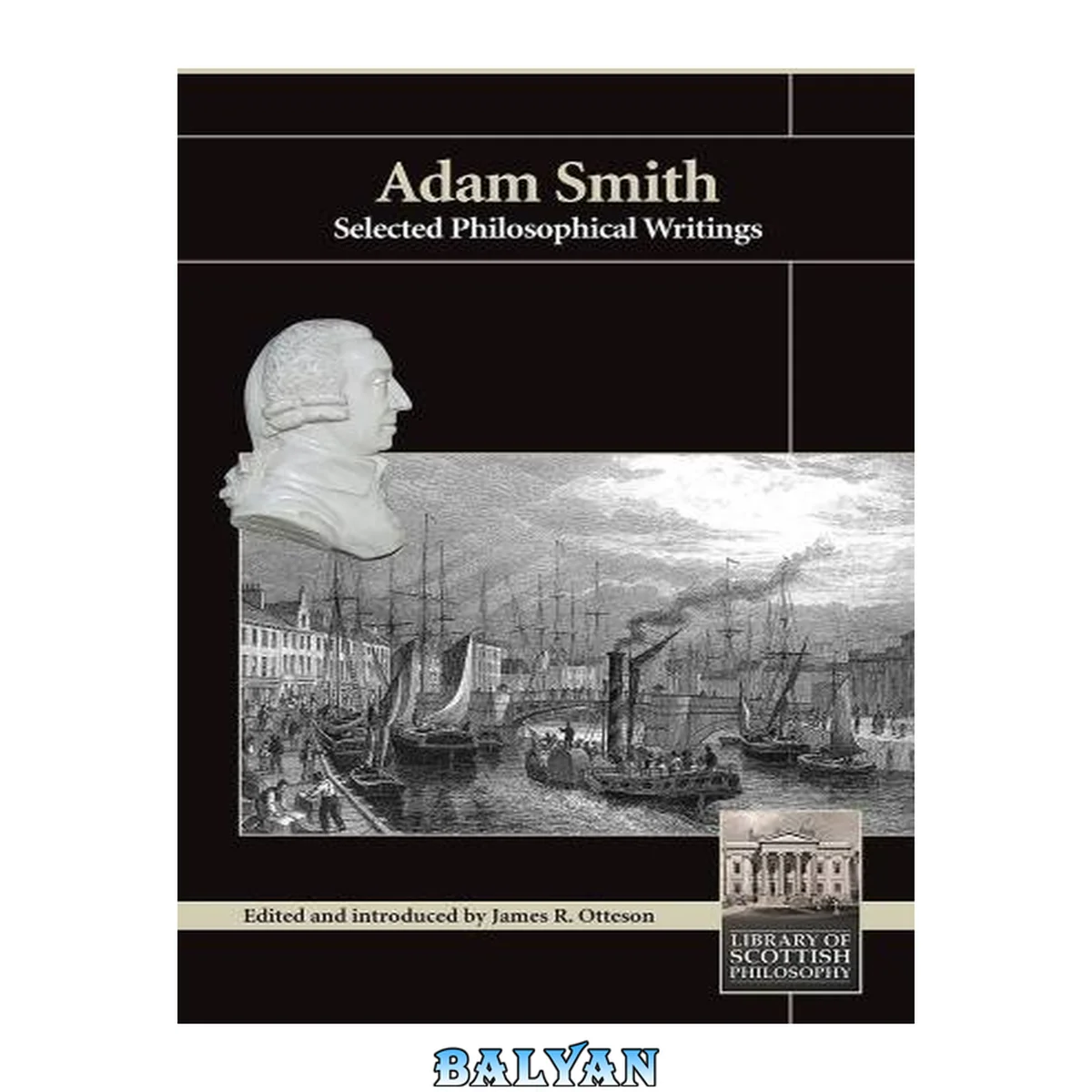
معرفی کتاب «آدام اسمیت: نوشتههای فلسفی منتخب (کتابخانه فلسفه اسکاتلندی)» (با عنوان لاتین Adam Smith: Selected Philosophical Writings (Library of Scottish Philosophy)) نوشتهٔ Smith, Adam;Otteson, James R، منتشرشده توسط نشر Andrews UK;Imprint Academic در سال 2004. این کتاب در فرمت epub، زبان انگلیسی ارائه شده است.
Adam Smith (1723–90) studied under Francis Hutcheson at the University of Glasgow, befriended David Hume while lecturing on rhetoric and jurisprudence in Edinburgh, was elected Professor of Logic, Professor of Moral Philosophy, Vice-rector, and eventually Lord Rector of the University of Glasgow, and, along with Hutcheson, Hume, and a few others, went on to become one of the chief figures of the astonishing period of learning known as the Scottish Enlightenment. He is the author of two books: The Theory of Moral Sentiments (1759) and An Inquiry into the Nature and Causes of the Wealth of Nations (1776). TMS brought Smith considerable acclaim during his lifetime and was quickly considered one of the great works of moral theory. It deeply impressed Immanuel Kant, for example, who called Smith his 'Liebling' or 'favourite', and Charles Darwin, who in his Descent of Man (1871) endorsed and accepted several of Smith's 'striking' conclusions. TMS went through fully six revised editions during Smith's lifetime. Since the nineteenth century, Smith's fame has largely rested on his Wealth of Nations, which must be considered one of the most important works of the millennium: its argument for free trade, its explanation of the price mechanism and the division of labor, its qualified defense of market economies, and its powerful criticisms of mercantilist economic theories are now standard fare in economics courses, not to mention the basis of a large portion of today's worldwide economic policy. And its account of human nature is now classic. Both The Theory of Moral Sentiments and the Wealth of Nations reveal Smith's impressively broad learning, but he wrote and lectured on a number of other subjects as well. This anthology collects, for the first time in one volume, not only generous selections from each of Smith's books but also substantial selections from his other work, including his lectures on jurisprudence, his history and philosophy of science, his criticism and belles lettres, and his philosophy of language. It also includes two important letters from Hume, as well as Smith's account of Hume's death. 1. Moral Theory -- From The Theory Of Moral Sentiments -- Pt. 1. Of The Propriety Of Action -- Pt. 2. Of Merit And Demerit; Or, Of The Objects Of Reward And Punishment -- Pt. 3. Of The Foundation Of Our Judgments Concerning Our Own Sentiments And Conduct, And Of The Sense Of Duty -- Pt. 4. Of The Effect Of Utility Upon The Sentiment Of Approbation -- Pt. 5. Of The Influence Of Custom And Fashion Upon The Sentiments Of Moral Approbation And Disapprobation -- Pt. 6. Of The Character Of Virtue -- Pt. 7. Of Systems Of Moral Philosophy -- 2. Political Economy -- Reading I, From The Wealth Of Nations -- Bk. 1. Of The Causes Of Improvement In The Productive Powers Of Labour, And Of The Order According To Which Its Produce Is Naturally Distributed Among The Different Ranks Of The People -- Bk. 2. Of The Nature, Accumulation, And Employment Of Stock -- Bk. 3. Of The Different Progress Of Opulence In Different Nations -- Bk. 4. Of Systems Of Political Economy -- Bk. 5. Of The Revenue Of The Sovereign Or Commonwealth -- Reading Ii, From The Lectures On Jurisprudence -- 3. Languages And Criticism -- Reading I, Essay From The Philological Miscellany -- Reading Ii, A Letter To The Authors Of The Edinburgh Review -- 4. History And Philosophy Of Science -- From The History Of Astronomy -- Of The Effect Of Unexpectedness, Or Of Surprise -- Of Wonder, Or Of The Effects Of Novelty -- Of The Origin Of Philosophy -- History Of Astronomy -- 5. Correspondence -- Letter From David Hume To Smith, 12 April 1759 -- Letter From David Hume To Smith, 28 July 1759 -- Letter From Smith To William Strahan, 9 November 1776. Edited And Introduced By James R. Otteson. Includes Bibliographical References. Adam Smith (1723–90) studied under Francis Hutcheson at the University of Glasgow, befriended David Hume while lecturing on rhetoric and jurisprudence in Edinburgh, was elected Professor of Logic, Professor of Moral Philosophy, Vice-rector, and eventually Lord Rector of the University of Glasgow, and, along with Hutcheson, Hume, and a few others, went on to become one of the chief figures of the astonishing period of learning known as the Scottish Enlightenment.He is the author of two books: The Theory of Moral Sentiments (1759) and An Inquiry into the Nature and Causes of the Wealth of Nations (1776). TMS brought Smith considerable acclaim during his lifetime and was quickly considered one of the great works of moral theory. It deeply impressed Immanuel Kant, for example, who called Smith his 'Liebling' or 'favourite', and Charles Darwin, who in his Descent of Man (1871) endorsed and accepted several of Smith's 'striking' conclusions. TMS went through fully six revised... Adam Smith,Hutcheson,Hume,rhetoric,jurisprudence,logic,morality,philosophy,Scottish Enlightenment,theory of moral sentiments,wealth of nations,moral theory,Kant,Darwin,free trade,price mechanism,division of labour,division of labor,market economy,economy,mercantile,economics,economic policy,history of science,philosophy of science,philosophy of language,reward,punishment,judgment,judgement,duty,political economy,sovereignty,commonwealth,astronomy "The Scottish philosopher Adam Smith (1723-1790) was as a pioneer of political economy. In fact, his economic thought became the foundation of classical economics and his key work, An Inquiry into the Nature and Causes of the Wealth of Nations, is considered to be the first modern work in economics. For Smith, a free competition environment was the best way to foster economic development that would work in accordance with natural laws. The framework he set up to explain the free market remains true to this day."--Bloomsbury Publishing.
دانلود کتاب آدام اسمیت: نوشتههای فلسفی منتخب (کتابخانه فلسفه اسکاتلندی)