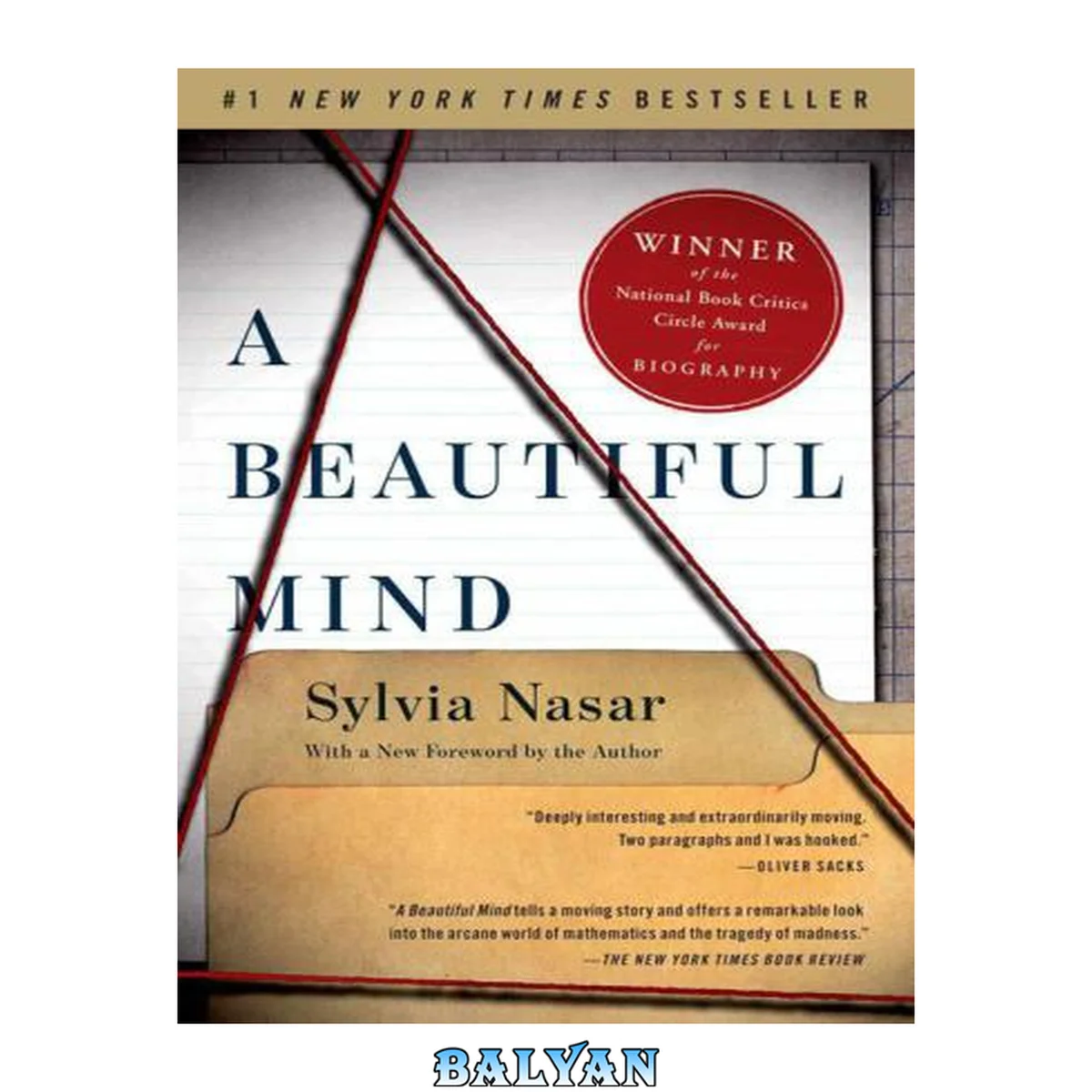
معرفی کتاب «A Beautiful Mind : a Biography of John Forbes Nash, Jr., Winner of the Nobel Prize in Economics, 1994» نوشتهٔ Nasar, Sylvia، منتشرشده توسط نشر Faber and Faber در سال 1994. این کتاب در فرمت mobi، زبان انگلیسی ارائه شده است.
“HOW COULD YOU, A MATHEMATICIAN, BELIEVE THAT EXTRATERRESTRIALS WERE SENDING YOU MESSAGES?” the visitor from Harvard asked the West Virginian with the movie-star looks and Olympian manner. “Because the ideas I had about supernatural beings came to me the same way my mathematical ideas did,” came the answer. “So I took them seriously.” Thus begins the true story of John Nash, the mathematical genius who was a legend by age thirty when he slipped into madness, and who—thanks to the selflessness of a beautiful woman and the loyalty of the mathematics community—emerged after decades of ghostlike existence to win a Nobel Prize for triggering the game theory revolution. The inspiration for an Academy Award–winning movie, Sylvia NasarвЂTMs now-classic biography is a drama about the mystery of the human mind, triumph over adversity, and the healing power of love. Amazon.com Review Stories of famously eccentric Princetonians abound--such as that of chemist Hubert Alyea, the model for The Absent-Minded Professor , or Ralph Nader, said to have had his own key to the library as an undergraduate. Or the "Phantom of Fine Hall," a figure many students had seen shuffling around the corridors of the math and physics building wearing purple sneakers and writing numerology treatises on the blackboards. The Phantom was John Nash, one of the most brilliant mathematicians of his generation, who had spiraled into schizophrenia in the 1950s. His most important work had been in game theory, which by the 1980s was underpinning a large part of economics. When the Nobel Prize committee began debating a prize for game theory, Nash's name inevitably came up--only to be dismissed, since the prize clearly could not go to a madman. But in 1994 Nash, in remission from schizophrenia, shared the Nobel Prize in economics for work done some 45 years previously. Economist and journalist Sylvia Nasar has written a biography of Nash that looks at all sides of his life. She gives an intelligent, understandable exposition of his mathematical ideas and a picture of schizophrenia that is evocative but decidedly unromantic. Her story of the machinations behind Nash's Nobel is fascinating and one of very few such accounts available in print (the CIA could learn a thing or two from the Nobel committees). This highly recommended book is indeed "a story about the mystery of the human mind, in three acts: genius, madness, reawakening." --Mary Ellen Curtin From Publishers Weekly Nasar has written a notable biography of mathematical genius John Forbes Nash (b. 1928), a founder of game theory, a RAND Cold War strategist and winner of a 1994 Nobel Prize in economics. She charts his plunge into paranoid schizophrenia beginning at age 30 and his spontaneous recovery in the early 1990s after decades of torment. He attributes his remission to will power; he stopped taking antipsychotic drugs in 1970 but underwent a half-dozen involuntary hospitalizations. Born in West Virginia, the flamboyant mathematical wizard rubbed elbows at Princeton and MIT with Einstein, John von Neumann and Norbert Wiener. He compartmentalized his secret personal life, shows Nasar, hiding his homosexual affairs with colleagues from his mistress, a nurse who bore him a son out of wedlock, while he also courted Alicia Larde, an MIT physics student whom he married in 1957. Their son, John, born in 1959, became a mathematician and suffers from episodic schizophrenia. Alicia divorced Nash in 1963, but they began living together again as a couple around 1970. Today Nash, whose mathematical contributions span cosmology, geometry, computer architecture and international trade, devotes himself to caring for his son. Nasar, an economics correspondent for the New York Times, is equally adept at probing the puzzle of schizophrenia and giving a nontechnical context for Nash's mathematical and scientific ideas. Copyright 1998 Reed Business Information, Inc. “HOW COULD YOU, A MATHEMATICIAN, BELIEVE THAT EXTRATERRESTRIALS WERE SENDING YOU MESSAGES?” the visitor from Harvard asked the West Virginian with the movie-star looks and Olympian manner. “Because the ideas I had about supernatural beings came to me the same way my mathematical ideas did,” came the answer. “So I took them seriously.” Thus begins the true story of John Nash, the mathematical genius who was a legend by age thirty when he slipped into madness, and who—thanks to the selflessness of a beautiful woman and the loyalty of the mathematics community—emerged after decades of ghostlike existence to win a Nobel Prize for triggering the game theory revolution. The inspiration for an Academy Award–winning movie, Sylvia Nasar’s now-classic biography is a drama about the mystery of the human mind, triumph over adversity, and the healing power of love. Amazon.com Review Stories of famously eccentric Princetonians abound--such as that of chemist Hubert Alyea, the model for The Absent-Minded Professor , or Ralph Nader, said to have had his own key to the library as an undergraduate. Or the "Phantom of Fine Hall," a figure many students had seen shuffling around the corridors of the math and physics building wearing purple sneakers and writing numerology treatises on the blackboards. The Phantom was John Nash, one of the most brilliant mathematicians of his generation, who had spiraled into schizophrenia in the 1950s. His most important work had been in game theory, which by the 1980s was underpinning a large part of economics. When the Nobel Prize committee began debating a prize for game theory, Nash's name inevitably came up--only to be dismissed, since the prize clearly could not go to a madman. But in 1994 Nash, in remission from schizophrenia, shared the Nobel Prize in economics for work done some 45 years previously. Economist and journalist Sylvia Nasar has written a biography of Nash that looks at all sides of his life. She gives an intelligent, understandable exposition of his mathematical ideas and a picture of schizophrenia that is evocative but decidedly unromantic. Her story of the machinations behind Nash's Nobel is fascinating and one of very few such accounts available in print (the CIA could learn a thing or two from the Nobel committees). This highly recommended book is indeed "a story about the mystery of the human mind, in three acts: genius, madness, reawakening." --Mary Ellen Curtin From Publishers Weekly Nasar has written a notable biography of mathematical genius John Forbes Nash (b. 1928), a founder of game theory, a RAND Cold War strategist and winner of a 1994 Nobel Prize in economics. She charts his plunge into paranoid schizophrenia beginning at age 30 and his spontaneous recovery in the early 1990s after decades of torment. He attributes his remission to will power; he stopped taking antipsychotic drugs in 1970 but underwent a half-dozen involuntary hospitalizations. Born in West Virginia, the flamboyant mathematical wizard rubbed elbows at Princeton and MIT with Einstein, John von Neumann and Norbert Wiener. He compartmentalized his secret personal life, shows Nasar, hiding his homosexual affairs with colleagues from his mistress, a nurse who bore him a son out of wedlock, while he also courted Alicia Larde, an MIT physics student whom he married in 1957. Their son, John, born in 1959, became a mathematician and suffers from episodic schizophrenia. Alicia divorced Nash in 1963, but they began living together again as a couple around 1970. Today Nash, whose mathematical contributions span cosmology, geometry, computer architecture and international trade, devotes himself to caring for his son. Nasar, an economics correspondent for the New York Times, is equally adept at probing the puzzle of schizophrenia and giving a nontechnical context for Nash's mathematical and scientific ideas. Copyright 1998 Reed Business Information, Inc. Biography & Autobiography,Mathematics,Science,Azizex666,General "In this biography, Sylvia Nasar re-creates the life of a mathematical genius whose brilliant career was cut short by schizophrenia and who, after three decades of devastating mental illness, miraculously recovered and was honored with a Nobel Prize." "A Beautiful Mind traces the meteoric rise of John Forbes Nash, Jr., from his lonely childhood in West Virginia to his student years at Princeton, where he encountered Albert Einstein, John von Neumann, and a host of other mathematical luminaries. At twenty-one, the handsome, ambitious, eccentric graduate student invented what would become the most influential theory of rational human behavior in modern social science. Nash's contribution to game theory would ultimately revolutionize the field of economics." "At thirty, Nash was poised to take his dreamed-of place in the pantheon of history's greatest mathematicians. Then Nash suffered a catastrophic mental breakdown." "Nasar details Nash's harrowing descent into insanity - his bizarre delusions that he was the Prince of Peace; his resignation from MIT, flight to Europe, and attempt to renounce his American citizenship; his repeated hospitalizations, from the storied McLean, where he came to know the poet Robert Lowell, to the crowded wards of a state hospital; his "enforced interludes of rationality" during which he was able to return briefly to mathematical research." "At age sixty-six, twin miracles - a spontaneous remission of his illness and the sudden decision of the Nobel Prize committee to honor his contributions to game theory - restored the world to him. Nasar recounts the bitter behind-the-scenes battle in Stockholm over whether to grant the ultimate honor in science to a man thought to be "mad." She describes Nash's current ambition to pursue new mathematical breakthroughs and his efforts to be a loving father to his adult sons."--Jacket
"how Could You, A Mathematician, Believe That Extraterrestrials Were Sending You Messages?" The Visitor From Harvard Asked The West Virginian With The Movie-star Looks And Olympian Manner.
"because The Ideas I Had About Supernatural Beings Came To Me The Same Way My Mathematical Ideas Did," Came The Answer. "so I Took Them Seriously."
Thus Begins The True Story Of John Nash, The Mathematical Genius Who Was A Legend By Age Thirty When He Slipped Into Madness, And Who -- Thanks To The Selflessness Of A Beautiful Woman And The Loyalty Of The Mathematics Community -- Emerged After Decades Of Ghostlike Existence To Win A Nobel Prize And World Acclaim. The Inspiration For A Major Motion Picture, Sylvia Nasar's Award-winning Biography Is A Drama About The Mystery Of The Human Mind, Triumph Over Incredible Adversity, And The Healing Power Of Love.
new York Newsday
a Triumph Of Intellectual Biography.
The true story of John Nash, the math genius who was a legend by age thirty when he slipped into madness; through the selflessness of a beautiful woman and the loyalty of the mathematics community he emerged after decades of ghostlike existence to win a Nobel Prize; now a major motion picture--Cover AMONG JOHN NASH'S EARLIEST MEMORIES is one in which, as a child of about two or three, he is listening to his maternal grandmother play the piano in the front parlor of the old Tazewell Street house, high on a breezy hill overlooking the city of Bluefield, West Virginia. Relates how mathematical genius John Forbes Nash, Jr., suffered a breakdown at age thirty-one and was diagnosed with schizophrenia, but experienced a remission of his illness thirty years later.